On Lake Attersee

by Gustav Klimt

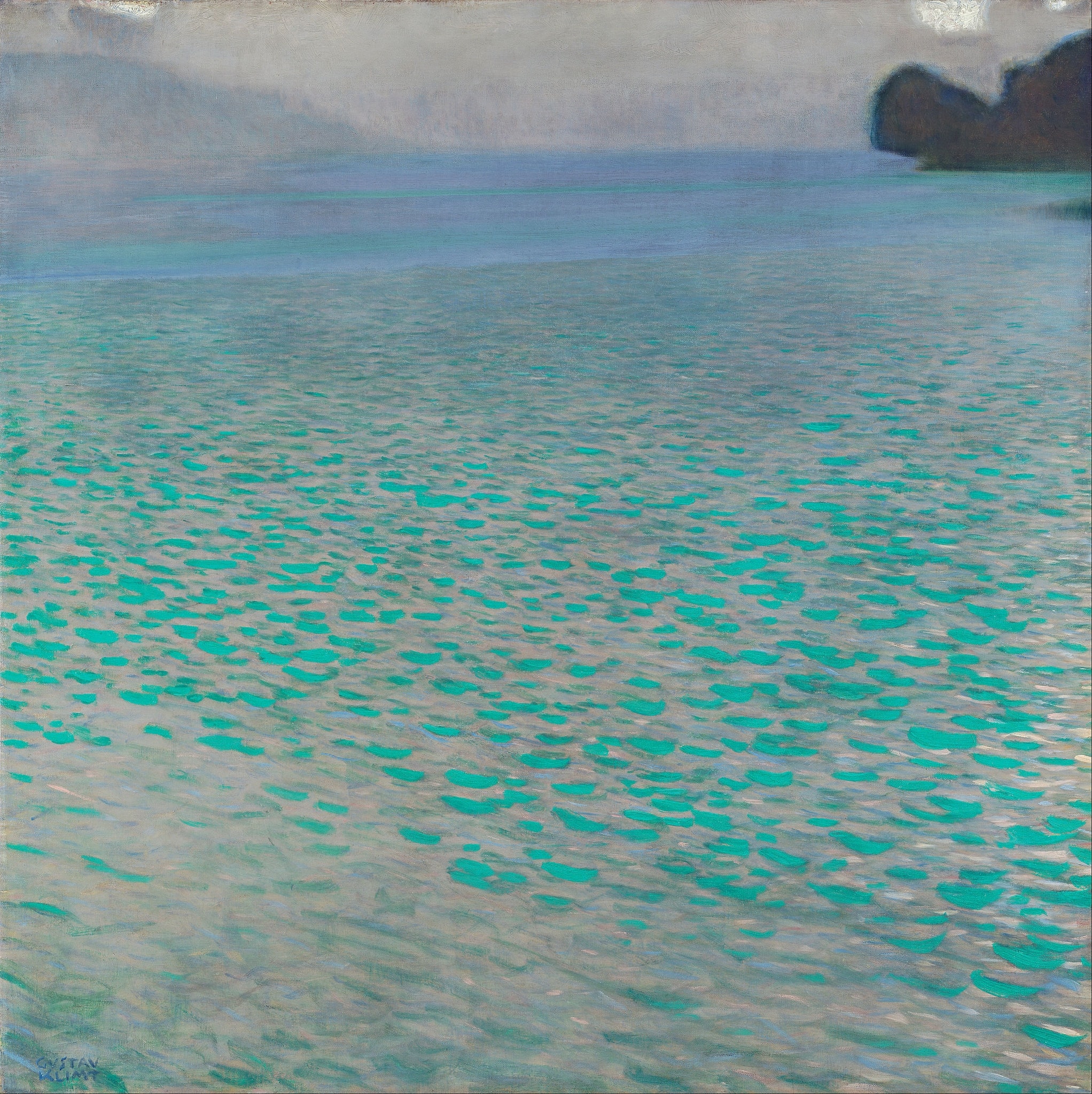
Gustav Klimt’s On Lake Attersee (1900) turns a summer lake into a woven field of light. A square canvas nearly filled with water, it stages a quiet duel between surface pattern and atmospheric depth, letting a tiny dark headland at the upper right anchor an otherwise hypnotic expanse [1][2].
💰

Market Value

$100-140 million

How much is On Lake Attersee worth?

Study Print Studio

Create a personal study print

Build a companion study sheet around the part of this painting that speaks to you most. Choose a detail, shape an interpretation, and walk away with something personal and display-worthy.

Fast Facts

Year
1900
Medium
Oil on canvas
Dimensions
80.2 × 80.2 × 2.1 cm
Location
Leopold Museum, Vienna
See all Gustav Klimt paintings in Vienna
On Lake Attersee by Gustav Klimt (1900) featuring Turquoise oval ripples (mosaic strokes), Gray‑violet undercurrent, Horizon bands, Veil of mist

Click on any numbered symbol to learn more about its meaning

Meaning & Symbolism

Klimt chooses a confrontational crop: the lower three-quarters of the square are nothing but water, its skin tessellated into countless, rounded turquoise and emerald units that sit atop a gray-violet ground. These units are not casual brushmarks; they are a disciplined, mosaic-like syntax that flattens recession and converts light into pattern. The strokes shrink as they approach the horizon, then dissolve into horizontal turquoise and blue-violet bands before meeting a veil of mist. At the extreme upper right, a dark, simplified headland—Litzlberg—cuts in like a punctuation mark, the sole landform permitted in the frame. This compositional gamble establishes a tense equilibrium: planar design versus distant space, ornament versus atmosphere, certainty versus haze. As Ludwig Hevesi observed in 1901, the canvas is “a frame full of lake water,” and Klimt doubles down on that audacity by removing boats, figures, clouds—anything that might domesticate the experiment 1. The meaning of On Lake Attersee emerges from this equilibrium. The water’s repeated ovals behave as both descriptive ripples and ornamental tesserae, a visual mantra that suggests continuity, duration, and the mind’s tendency to order sensation. Klimt’s method—countless small strokes modulated over a cool ground—turns perception into pattern and time into texture, so that looking becomes akin to breathing: steady, cyclical, and quietly absorbing 2. Yet the upper register refuses total flatness. The soft violet haze and faintly banded horizon insist on distance, memory, and transience—qualities that press back against the decorative grid. The painting therefore oscillates between stillness and motion, surface and depth, presence and recollection. It is not a topographic report but a meditation on seeing, calibrated so that reflection (the flashing turquoise scales) keeps trading places with depth (the receding haze). The small headland at right clinches the argument: a single, dark mass proves the scene’s reality even as the rest of the field abstracts it into pure painting 12. Why On Lake Attersee is important is tied to Klimt’s position within the Vienna Secession and Jugendstil. By 1900 he was reconceiving nature through the same decorative intelligence that shapes his figure pictures, aligning landscape with the movement’s credo “to art its freedom.” The square format—already explored in 1899 but here asserted with new confidence—suppresses narrative sweep and encourages a frontal, tapestry-like order that would define his later landscapes 34. In this canvas, ornament is not a veneer; it is the structure by which the world is known. That stance pushes the work to the edge of abstraction while remaining anchored in direct looking, an achievement Tobias Natter calls “an astonishing piece of pure painting” 2. The signed lower-left corner declares authorship, but the real signature is the optical rhythm itself: a calibrated hum of turquoise notes that holds the eye in present tense. On Lake Attersee thus stands as a modern icon of serenity and flux, a picture that makes perception feel designed and time feel continuous—without ever ceasing to be a lake. In reconciling design with nature, it quietly expands what landscape can do, and what looking can mean 124.

Explore Deeper with AI

Ask questions about On Lake Attersee

Popular questions:

Powered by AI • Get instant insights about this artwork

💬 Ask questions about this artwork!

Interpretations

Formal Analysis: Tessellation, Square, and Aerial Bands

Klimt builds the lake from countless, calibrated daubs that behave like tesserae, laid over a cool gray‑violet ground; their scale diminishes toward the horizon before giving way to soft, lateral bands of turquoise and blue‑violet. The square (80.2 × 80.2 cm) suppresses narrative sweep and enforces a frontal, tapestry-like order, while the tiny Litzlberg headland punctuates an otherwise planar field. This method creates a tense accord between the decorative surface and the faint promise of deep space—depth is not constructed through linear perspective but through optical modulation and atmospheric veiling. The result is a viewing experience governed by patterned looking: a grid of sensation whose micro-variations sustain the eye without relinquishing the square’s planar authority 12.

Source: Leopold Museum; Tobias G. Natter

Secessionist Context: Ornament as Method, Not Veneer

Situated at the heart of Vienna 1900, the canvas embodies the Secessionist ambition “to art its freedom,” translating nature into a designed surface consonant with Jugendstil’s ornamental intelligence. Critics recognized the gamble from the start: at the 10th Secession exhibition (1901), Ludwig Hevesi called it “a frame full of lake water,” noting how Klimt made water itself the subject rather than a setting for anecdote. In this lens, ornament operates as a modern epistemology: it is how the world is known, not decorated. Klimt aligns landscape with the movement’s rejection of academic hierarchy, converting atmospheric observation into patterned structure and thus positioning the work at a hinge between Symbolism’s interiority and Art Nouveau’s surface logic 14.

Source: Leopold Museum; Encyclopaedia Britannica (Vienna Secession/Jugendstil)

Comparative Development: Toward Insel im Attersee

Read against the subsequent Insel im Attersee (1901–02), this 1900 painting marks a crucial step toward greater surface dominance. Both works intensify the square’s frontal pull, but the later picture raises the horizon further, compressing spatial cues and driving the ornamental field closer to abstraction. This trajectory clarifies how Klimt calibrates recession: by shrinking stroke units and introducing horizontal bands that act as a minimal horizon register. The comparison underscores a programmatic exploration across summers—iteratively adjusting crop, horizon, and mark-size to test how far representation can be thinned before dissolving into pure painting. Far from a one-off, On Lake Attersee becomes a laboratory for the optical grammar that would define Klimt’s mature landscapes 25.

Source: Tobias G. Natter; MoMA (Vienna 1900 catalogue)

Medium Reflexivity: Painting as an Instrument of Perception

On Lake Attersee behaves like a machine for seeing: its small, rounded strokes regularize scintillation into a legible rhythm, converting fleeting light into repeatable units. In this sense, Klimt makes medium and method visible—the painting tells you how it is built even as it shows what it depicts. Natter’s characterization of the work at the “limits of abstraction” captures this duality, while critics note how Klimt “subordinates nature to his grand aesthetic vision,” producing images that are both illustrative and abstract. What you watch, in real time, is the negotiation between sensation and system—the eye’s drift across a field whose order is neither naturalistic nor arbitrary, but deliberately coded by brushwork 26.

Source: Tobias G. Natter; Commonweal (Rubsam)

Authorship by Procedure: Signature vs. System

The lower-left inscription secures conventional authorship, yet the painting’s deeper author-mark is procedural: a calibrated hum of turquoise notes that reads as a visual signature. This distinction matters historically. In a Secessionist milieu that prized stylistic originality, Klimt asserts identity less through iconography than through a reproducible but unmistakable stroke system—a way of organizing light into pattern. The signed corner anchors the work in institutional terms (exhibition, provenance), while the mosaic field—what Natter calls an “astonishing piece of pure painting”—anchors it visually and conceptually. In short, authorship migrates from name to method, from the biographical to the optical, aligning with modernist notions of style as structure 12.

Source: Leopold Museum; Tobias G. Natter

Related Themes

About Gustav Klimt

Gustav Klimt (1862–1918), co-founder of the Vienna Secession, pivoted from controversial public commissions to a decorative-symbolist language in his Golden Period. Drawing on Byzantine mosaics and modern design, he fused opulent surfaces with psychological intensity. By 1908–09, he transformed scandal into canon, and The Kiss became Vienna’s emblem of modern love.
View all works by Gustav Klimt

More by Gustav Klimt

Portrait of Adele Bloch-Bauer I by Gustav Klimt

Portrait of Adele Bloch-Bauer I

Gustav Klimt (1907)

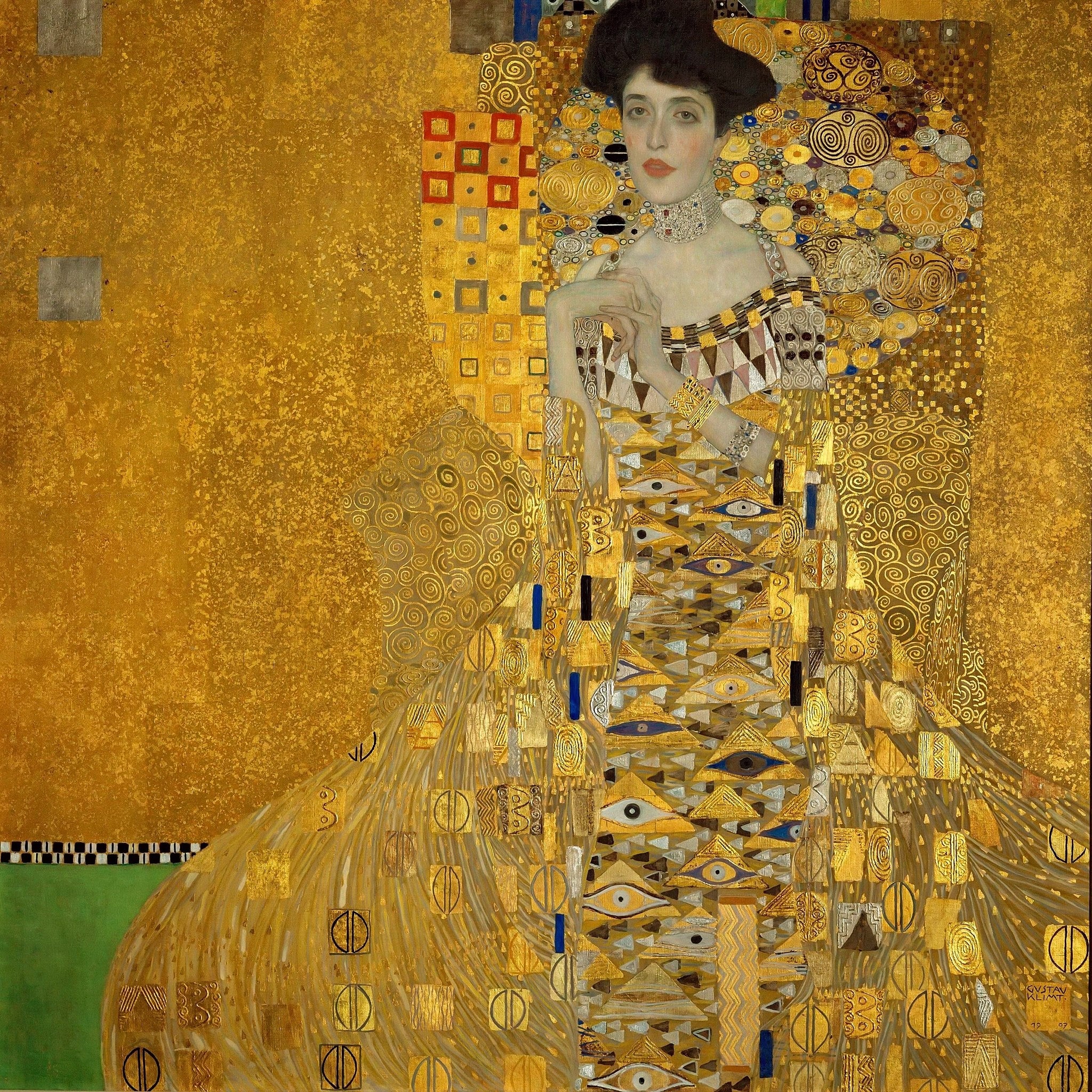
Gustav Klimt’s Portrait of Adele Bloch-Bauer I stages its sitter as a <strong>secular icon</strong>—a living presence suspended in a field of gold that converts space into <strong>pattern and power</strong>. The naturalistic face and hands emerge from a reliquary-like cascade of eyes, triangles, and tesserae, turning light, ornament, and status into the painting’s true subjects <sup>[1]</sup><sup>[2]</sup>.
Sunflower by Gustav Klimt

Sunflower

Gustav Klimt (1907/1908)

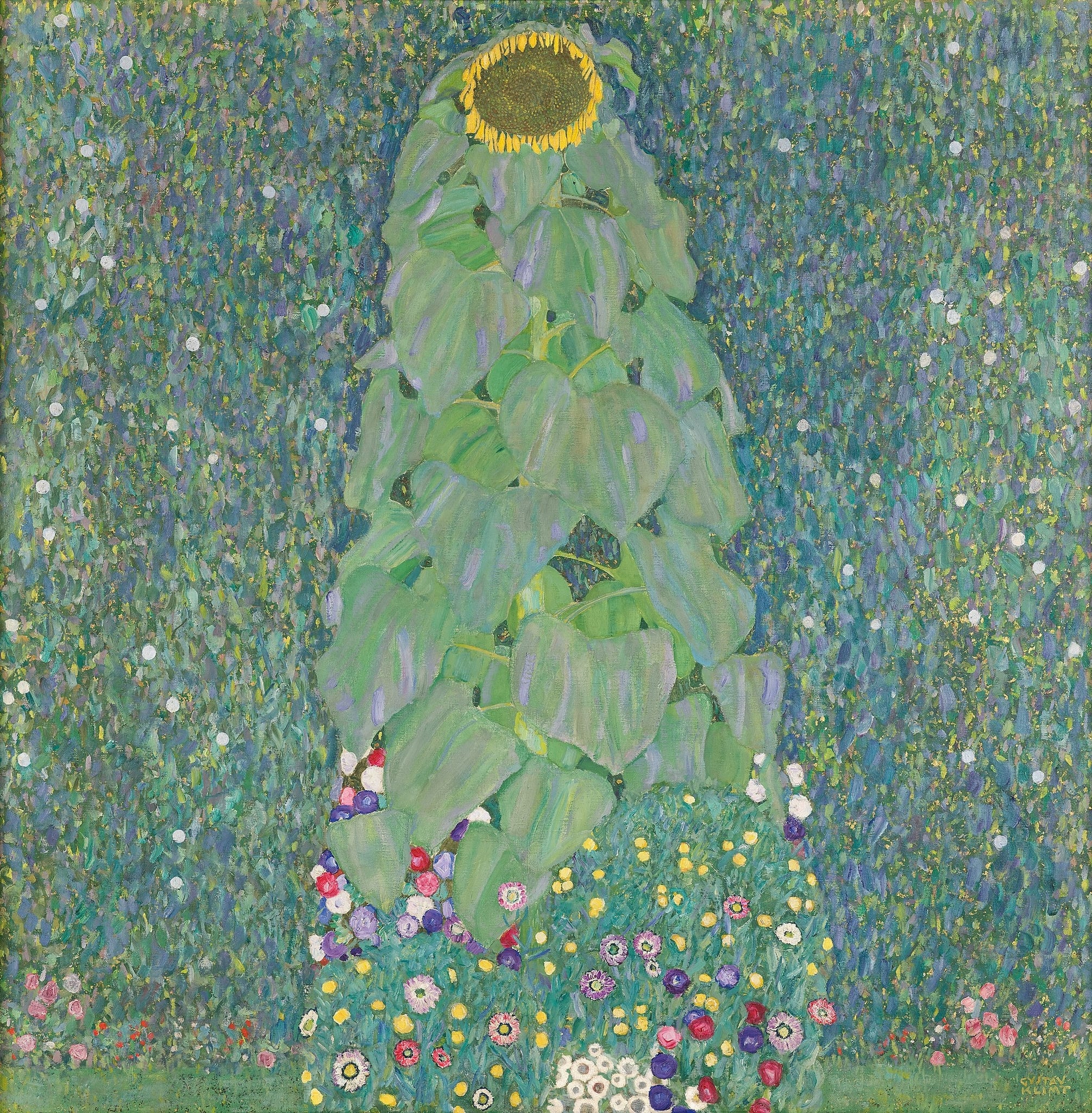
Gustav Klimt’s Sunflower turns a single bloom into a <strong>monumental, figure-like presence</strong>. A tapering stack of broad, drooping leaves rises from a <strong>mosaic-like carpet of round blossoms</strong>, crowned by a gold-flecked disc that glows against a cool, stippled field. The work fuses <strong>portrait, icon, and landscape</strong> into one emblem of vitality and quiet sanctity <sup>[1]</sup><sup>[2]</sup>.
Cottage Garden with Sunflowers by Gustav Klimt

Cottage Garden with Sunflowers

Gustav Klimt (1906–1907 (signed 1907))

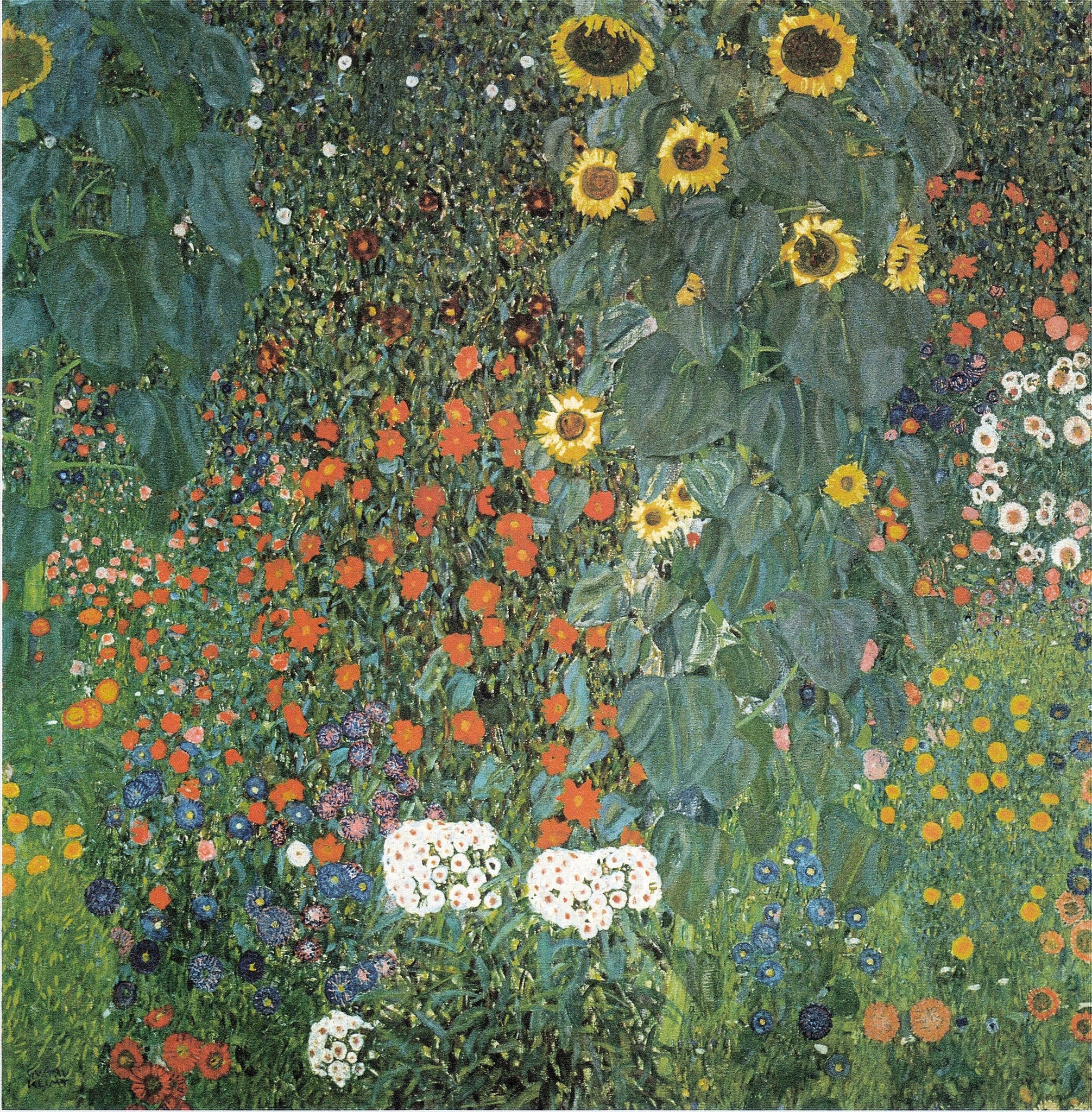
Cottage Garden with Sunflowers is a square, horizonless field of blooms where a vertical column of <strong>sunflowers</strong> anchors an all-over weave of color and pattern. Klimt fuses <strong>ornament and nature</strong>, turning a humble Litzlberg cottage plot into a radiant matrix of cyclical life and renewal <sup>[1]</sup><sup>[4]</sup><sup>[5]</sup>.
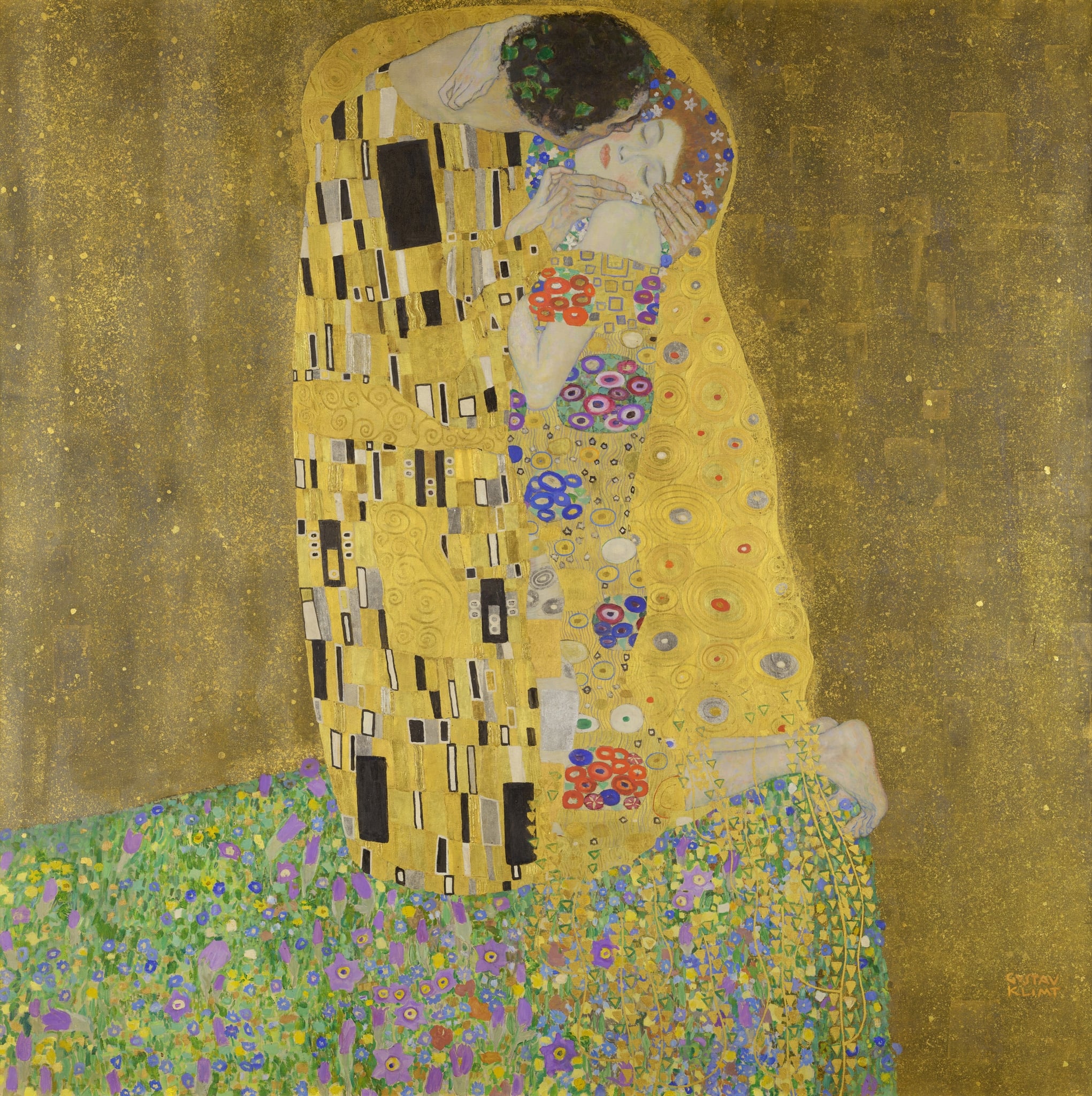
The Kiss by Gustav Klimt

The Kiss

Gustav Klimt (1908 (completed 1909))

The Kiss stages human love as a <strong>sacred union</strong>, fusing two figures into a single, gold-clad form against a timeless field. Klimt opposes <strong>masculine geometry</strong> (black-and-white rectangles) to <strong>feminine organic rhythm</strong> (spirals, circles, flowers), then resolves them in radiant harmony <sup>[1]</sup><sup>[2]</sup>.
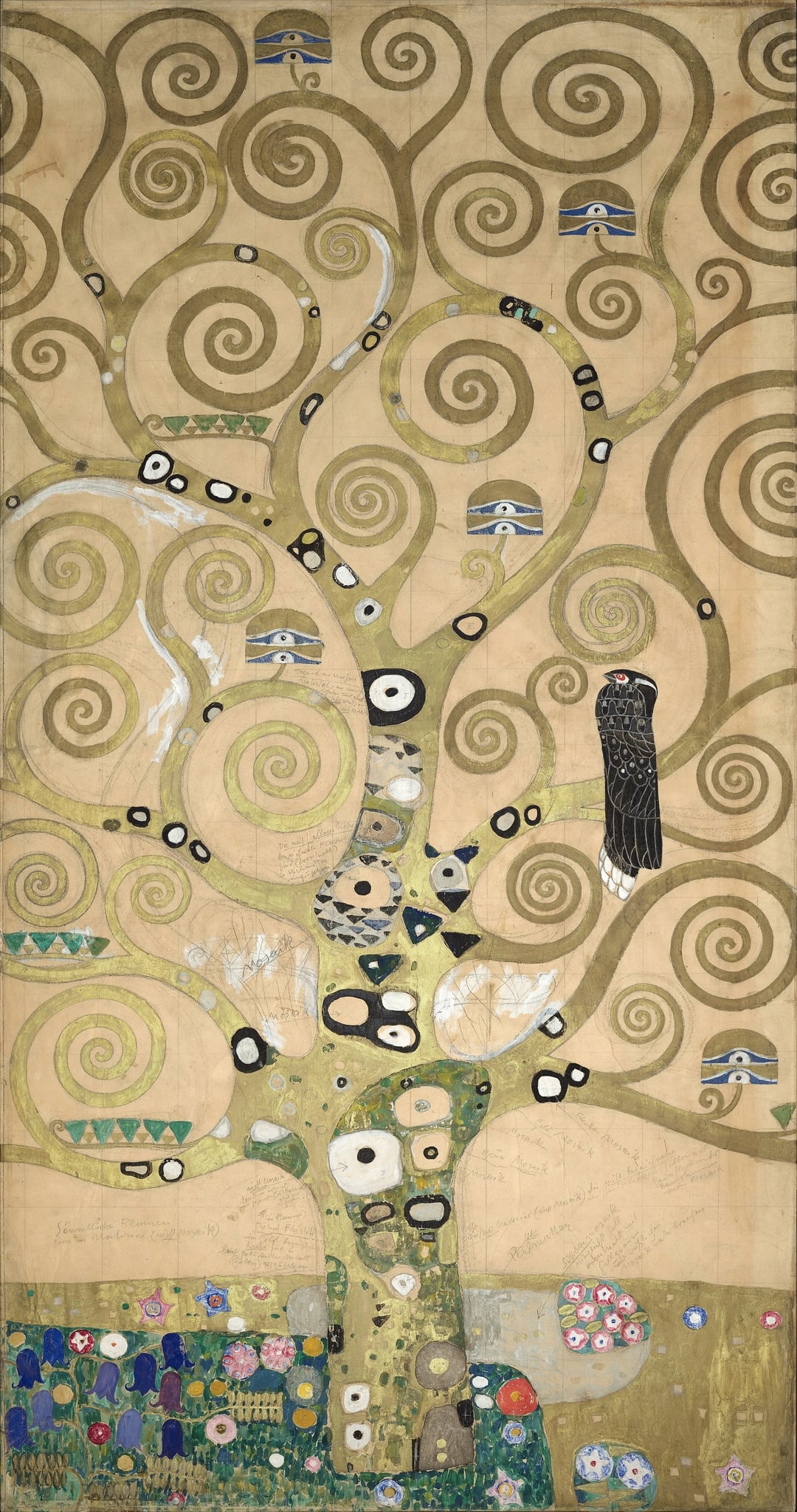
The Tree of Life by Gustav Klimt

The Tree of Life

Gustav Klimt (1910–1911 (design; mosaic installed 1911))

Gustav Klimt’s The Tree of Life crystallizes a <strong>cosmological axis</strong> in a gilded ornamental language: a rooted trunk erupts into <strong>endless spirals</strong>, embedded with <strong>eye-like rosettes</strong> and shadowed by a black, red‑eyed bird. Designed as part of the Stoclet dining‑room frieze, it fuses <strong>symbolism and luxury materials</strong> to link earthly abundance with timeless transcendence <sup>[1]</sup><sup>[2]</sup>.
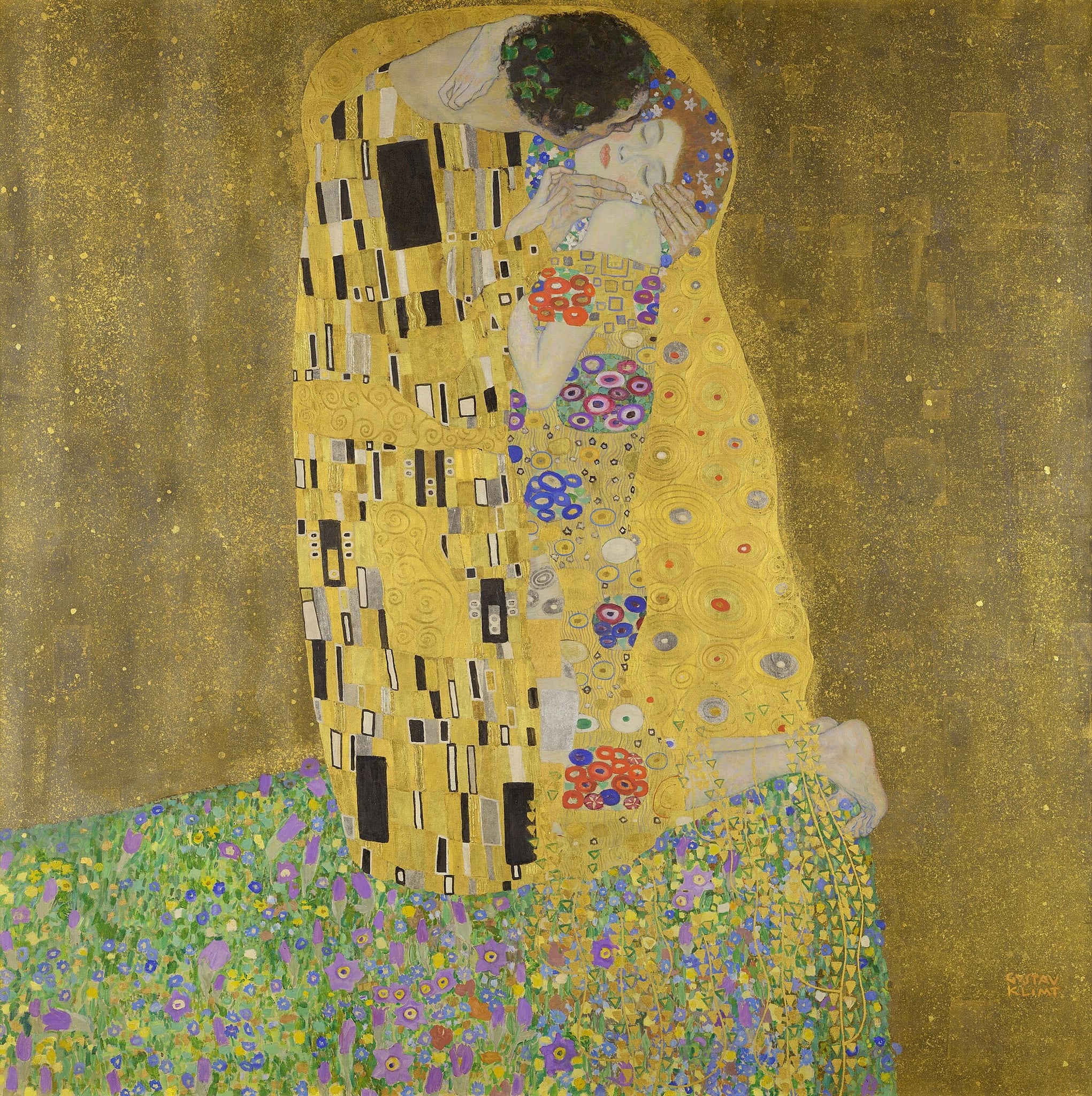
The Kiss (Lovers) by Gustav Klimt

The Kiss (Lovers)

Gustav Klimt (1907–1908 (Belvedere lists 1908/09))

The Kiss (Lovers) crystallizes Klimt’s <strong>Golden Period</strong> ideal: erotic union staged as a sacred vision. Two bodies fuse beneath a single golden mantle, poised on a flowered ledge at the brink of the unknown, where <strong>pattern becomes symbol</strong> and intimacy becomes icon.