A Morning by the Pond

by Gustav Klimt

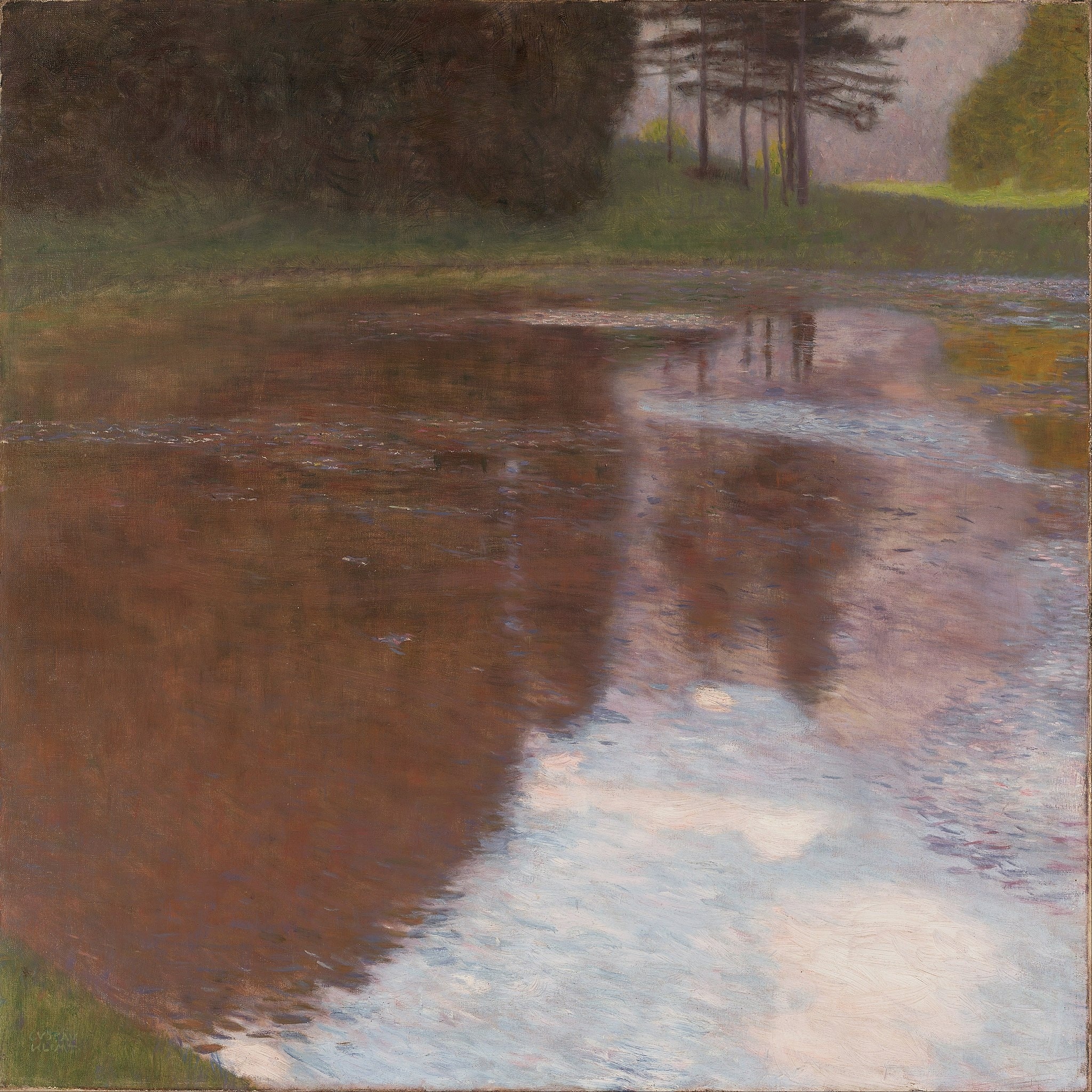
A Morning by the Pond turns a quiet Egelsee shoreline into a field of reflection where trees, bank, and sky dissolve into one surface. Klimt’s first square format landscape compresses depth and makes water the true subject, staging a luminous threshold between night and day. The work establishes perception itself—what we see and how—as Klimt’s modern theme.
💰

Market Value

$55-85 million

How much is A Morning by the Pond worth?

Study Print Studio

Create a personal study print

Build a companion study sheet around the part of this painting that speaks to you most. Choose a detail, shape an interpretation, and walk away with something personal and display-worthy.

Fast Facts

Year
1899
Medium
Oil on canvas
Dimensions
75.2 × 75.2 cm
Location
Leopold Museum, Vienna
See all Gustav Klimt paintings in Vienna
A Morning by the Pond by Gustav Klimt (1899) featuring Mirror-like water surface (reflection), Diagonal wedge of borrowed light, Luminous disc, Ghosted vertical pines (doubled forms)

Click on any numbered symbol to learn more about its meaning

Meaning & Symbolism

Klimt constructs the image as a proposition about sight. The square cuts away conventional horizon drama and gives the pond’s plane near-total sovereignty; our eye is held to a single, vibrating sheet where left-bank greens collapse into reddish-brown ripples and the far shore’s trunks appear only as doubled, violet smudges. The pale, silvery wedge at the lower right is not sky but sky-as-mirror, a diagonal of borrowed light that reads like a path. In this geometry the world is encountered indirectly, through its reflection; figure-ground hierarchies are canceled, and certainties—tree, bank, sky—are traded for probabilities—blur, tint, tremor. Klimt’s broken, feathery strokes stitch copper, mauve, and pearl into a woven skin, substituting pattern for perspective and optical vibration for topographic description 12. The result is not a record of a place at Egelsee so much as a proof that perception arrives in gradations, with morning’s first light coaxing forms out of ambiguity. The luminous disc near the lower center, half-swallowed by ripples, operates as a small thesis on this idea: where reflection is strongest, shape is weakest; where light intensifies, edges soften. Vision in this picture is always in the act of becoming. That becoming is Klimt’s modernism. Declaring the square for the first time in his landscapes, he iconizes nature—turning a view into an object for contemplation rather than a window—while simultaneously flattening space in the manner of contemporary photography and recent French precedents 1345. The high horizon and cropped bank perform a photographic crop, denying recession and compelling attention to surface effects; the far pines, attenuated and ghosted in the water, echo Pictorialist atmospherics and Monet’s late, square canvases, where reflection trumps depiction 235. Yet Klimt’s aim is distinct: he fuses atmosphere with the Secession’s decorative ethos, letting facture crystallize into ornament so that nature itself becomes a patterned mystery rather than an anecdote. The picture therefore occupies a liminal register—between night and day, solidity and liquidity, documentation and design. In that threshold, Klimt secures a new role for landscape within Viennese Art Nouveau: not pastoral subject, but modern surface where the world and its image meet and exchange properties. This is why A Morning by the Pond anchors his subsequent Attersee summers: it proves that the square can hold a universe of sensation; that reflection can carry symbolism without allegory; and that clarity, in modern vision, is not given but earned—arriving slowly with the sun and with looking itself 124.

Explore Deeper with AI

Ask questions about A Morning by the Pond

Popular questions:

Powered by AI • Get instant insights about this artwork

💬 Ask questions about this artwork!

Interpretations

Formal Analysis: The Square as Device and Discipline

Klimt’s first committed use of the square in landscape is not a novelty but a discipline: it neutralizes horizon drama, equalizes vertical and horizontal vectors, and turns the pond into a planar field where reflection displaces recession. The high horizon and left-bank crop behave like a camera’s viewfinder, compressing depth so that facture and micro-contrast—those tremulous, feathery strokes—carry the picture’s meaning. In this geometry, space is reconstructed as surface logic: adjacency, tessellation, and chromatic weave replace linear perspective. The format’s icon-like stasis slows the eye, soliciting a contemplative scan rather than a narrative read, while simultaneously signaling modernity through its photographic cropping. Klimt thus forges a grammar where format, edge, and brushwork co-author vision, making the square a generator of meaning rather than a neutral container 123.

Source: Leopold Museum; Neue Galerie (Klimt Landscapes)

Symbolic Reading: Reflection as Epistemology

Here, water is less motif than method: a reflective membrane that makes seeing inherently mediated. Forms reach us as echoes—“borrowed light” diffused by ripples—so that recognition arrives in gradations rather than certainties. This aligns Klimt with Symbolist concerns, where nature is a threshold and knowledge an atmospheric event. The luminous disc near the center dramatizes the rule: where reflection is strongest, contour dissolves, and identity becomes probabilistic. By dissolving figure–ground hierarchies into a single skin of vibration, Klimt models an ethics of attention: clarity must be earned by dwelling on surface, not assumed by naming forms. Reflection therefore becomes an image of cognition itself—modern, skeptical, yet rapt before the world’s mutable appearances 12.

Source: Leopold Museum (collection text and Google Arts feature)

Comparative Lens: Monet, Pictorialism, and Viennese Difference

The painting speaks to Monet’s late, often square canvases where reflection supersedes depiction, and to Pictorialist photography’s soft-focus atmospherics. Yet Klimt’s difference is decisive: he fuses those optics with the Secession’s decorative ethos, letting facture congeal into ornament so that nature reads as patterned mystery rather than pure sensation. If Monet dissolves the motif into light, Klimt crystallizes light into pattern—an aesthetic that would shape Viennese interiors and design culture. The result is a hybrid modernism: photographic crop and Impressionist light filtered through an Art Nouveau commitment to the decorative plane. In this synthesis, the pond becomes a prototype for a broader Viennese surface culture, where perception and design mutually determine one another 245.

Source: Klimt-Datenbank; Sotheby’s scholarship; Leopold Museum Google Arts text

Contextual Frame: Egelsee 1899 as Threshold

Painted during an August stay near Golling with the Flöge family, the work marks a hinge between Klimt’s academic past and his Attersee summers to come. The square, the elevated vantage, and the pastel-shifted palette anticipate his post‑1900 landscapes, where human figures recede and reflective surfaces dominate. This turn correlates with Secessionist ambitions: to renew art by rethinking format, surface, and the decorative as primary values. At Egelsee, the everyday pond becomes a laboratory—testing how much of “place” can be retained once depth is flattened and description is traded for optical vibration. The experiment succeeds, setting a template for the next decade: reflective waters, high horizons, and a woven facture that articulates a distinctly Viennese version of modern landscape-as-surface 12.

Source: Leopold Museum (object record and Google Arts feature)

Aesthetic Theory: Ornament as Knowledge

Far from mere embellishment, Klimt’s ornament functions epistemically: the world becomes legible as a patterned fabric where differences (tree, bank, sky) are negotiated by micro-intervals of hue and touch. This resonates with Secessionist ideals and scholarly readings of Klimt’s landscapes as tapping a “sacred spring” of nature—regenerative and mysterious—made graspable through stylized pattern. In A Morning by the Pond, ornament is how perception holds flux: a provisional net woven from copper, mauve, and pearl. The decorative thus acquires truth value, not by mimesis, but by registering change: ripples, light shifts, and atmospheric bleed. Klimt’s landscape argues that in modern vision, knowledge is patterned, not outlined; emergent, not asserted—an idea with roots in Viennese modern design and Symbolist thought alike 126.

Source: Leopold Museum; ‘The Sacred Spring of Nature…’ (academic study)

Related Themes

About Gustav Klimt

Gustav Klimt (1862–1918), co-founder of the Vienna Secession, pivoted from controversial public commissions to a decorative-symbolist language in his Golden Period. Drawing on Byzantine mosaics and modern design, he fused opulent surfaces with psychological intensity. By 1908–09, he transformed scandal into canon, and The Kiss became Vienna’s emblem of modern love.
View all works by Gustav Klimt

More by Gustav Klimt

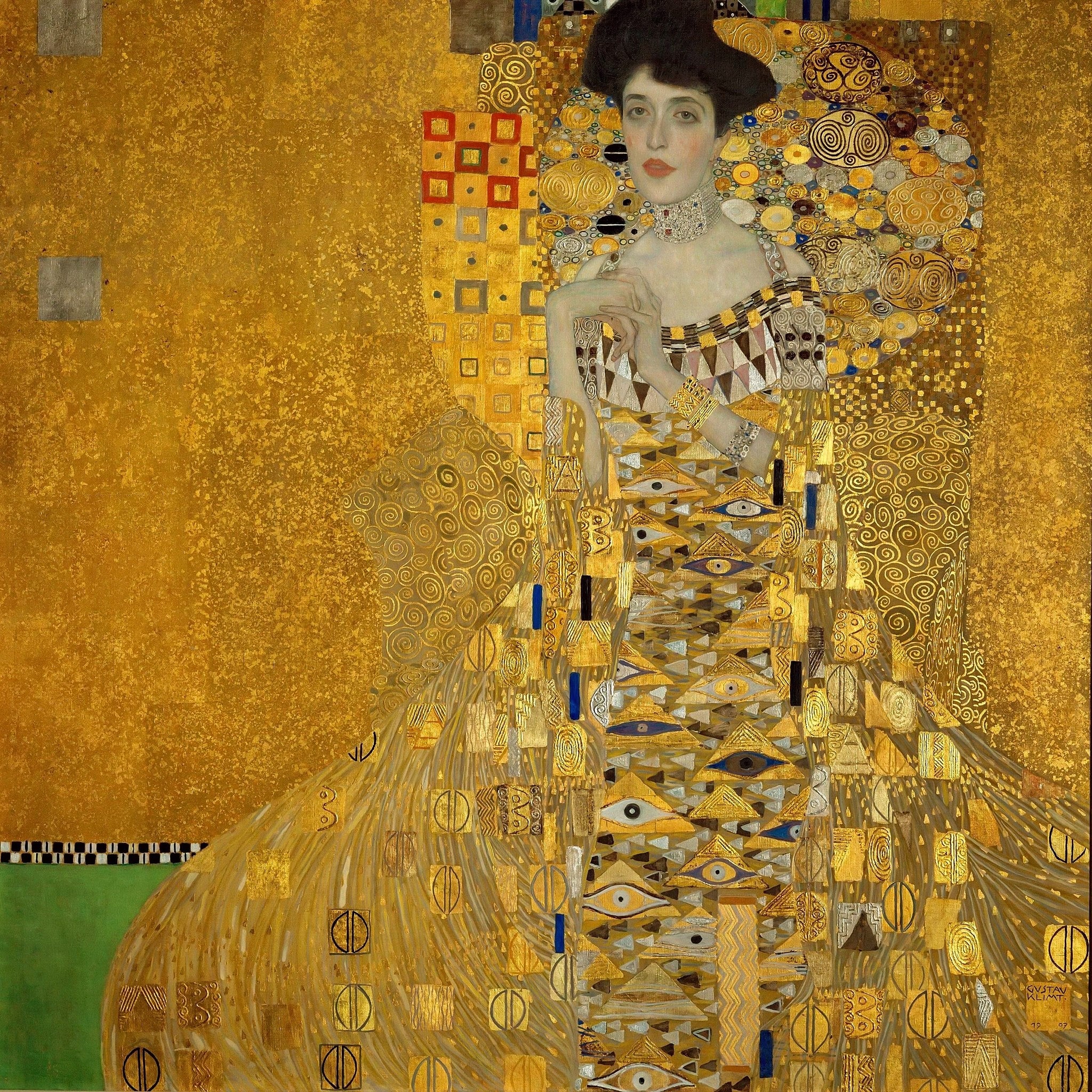
Portrait of Adele Bloch-Bauer I by Gustav Klimt

Portrait of Adele Bloch-Bauer I

Gustav Klimt (1907)

Gustav Klimt’s Portrait of Adele Bloch-Bauer I stages its sitter as a <strong>secular icon</strong>—a living presence suspended in a field of gold that converts space into <strong>pattern and power</strong>. The naturalistic face and hands emerge from a reliquary-like cascade of eyes, triangles, and tesserae, turning light, ornament, and status into the painting’s true subjects <sup>[1]</sup><sup>[2]</sup>.
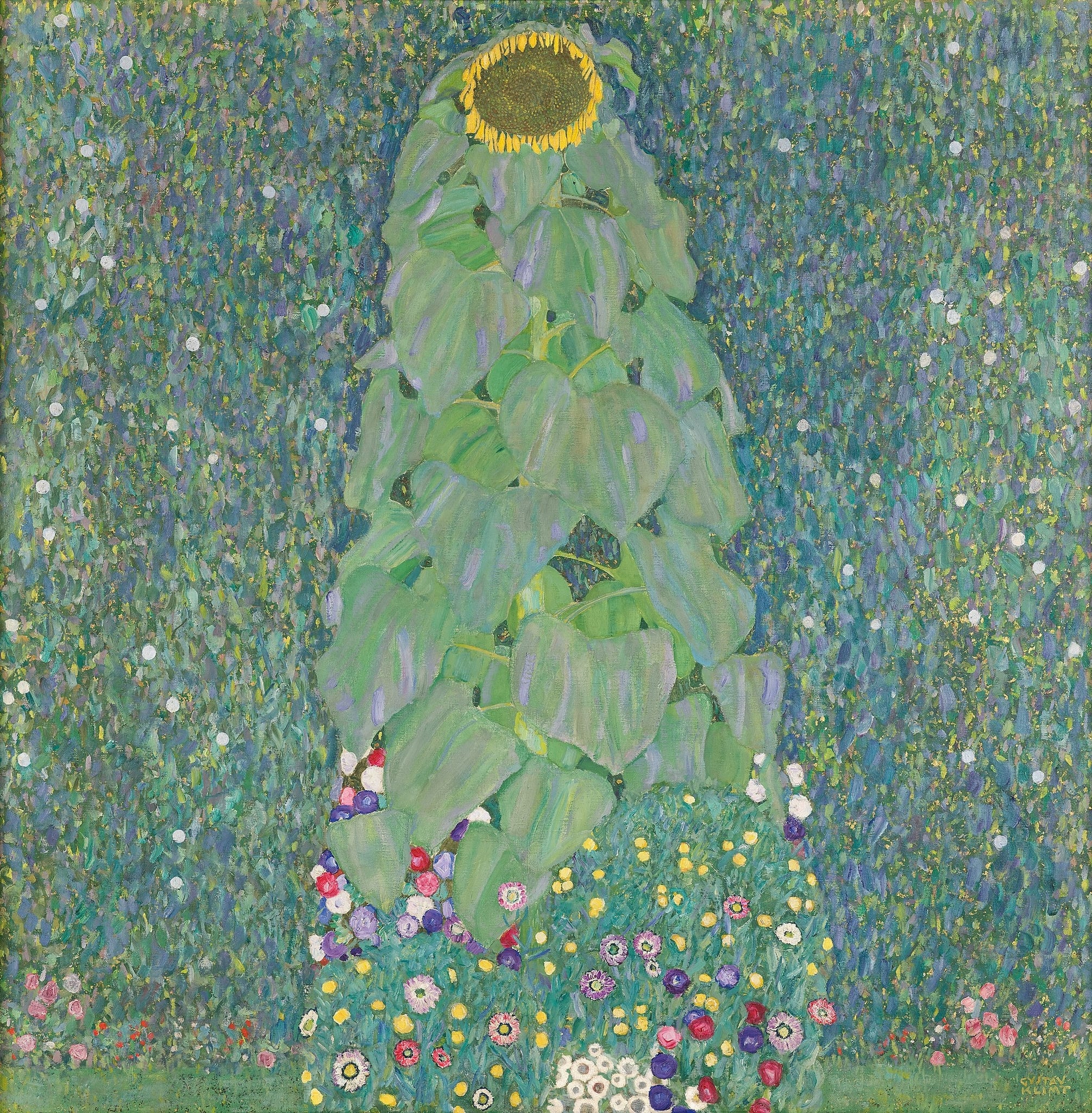
Sunflower by Gustav Klimt

Sunflower

Gustav Klimt (1907/1908)

Gustav Klimt’s Sunflower turns a single bloom into a <strong>monumental, figure-like presence</strong>. A tapering stack of broad, drooping leaves rises from a <strong>mosaic-like carpet of round blossoms</strong>, crowned by a gold-flecked disc that glows against a cool, stippled field. The work fuses <strong>portrait, icon, and landscape</strong> into one emblem of vitality and quiet sanctity <sup>[1]</sup><sup>[2]</sup>.
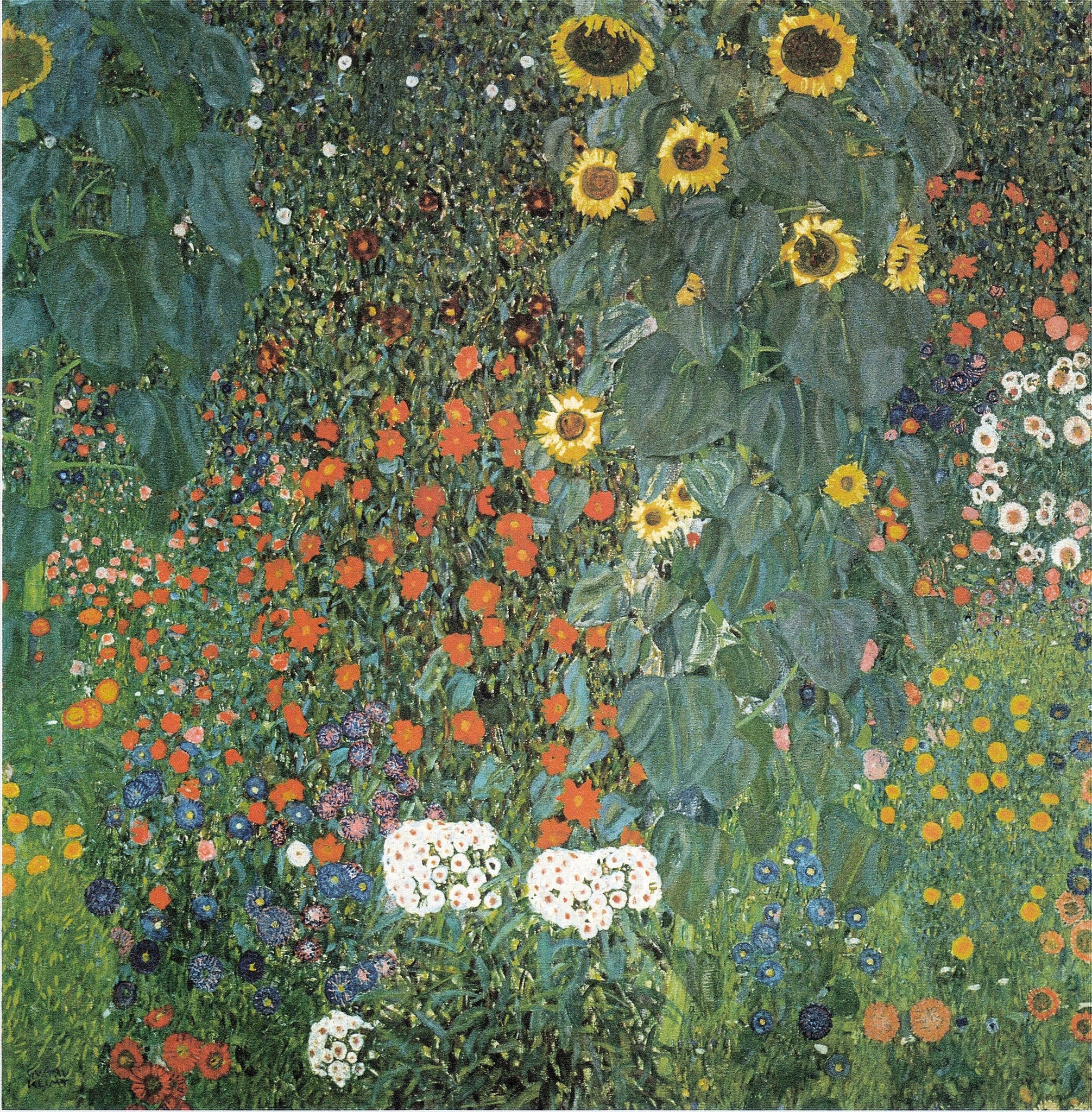
Cottage Garden with Sunflowers by Gustav Klimt

Cottage Garden with Sunflowers

Gustav Klimt (1906–1907 (signed 1907))

Cottage Garden with Sunflowers is a square, horizonless field of blooms where a vertical column of <strong>sunflowers</strong> anchors an all-over weave of color and pattern. Klimt fuses <strong>ornament and nature</strong>, turning a humble Litzlberg cottage plot into a radiant matrix of cyclical life and renewal <sup>[1]</sup><sup>[4]</sup><sup>[5]</sup>.
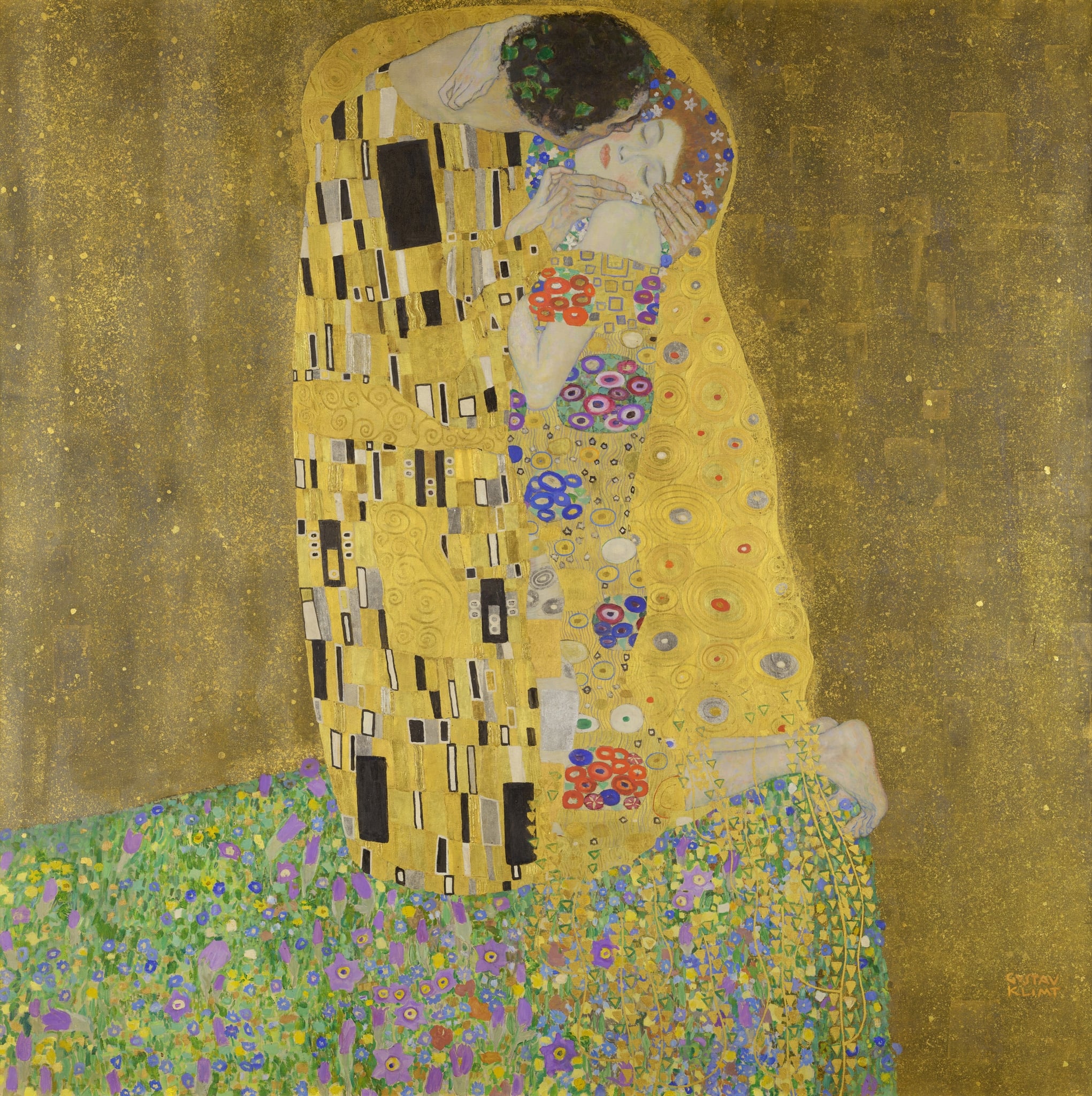
The Kiss by Gustav Klimt

The Kiss

Gustav Klimt (1908 (completed 1909))

The Kiss stages human love as a <strong>sacred union</strong>, fusing two figures into a single, gold-clad form against a timeless field. Klimt opposes <strong>masculine geometry</strong> (black-and-white rectangles) to <strong>feminine organic rhythm</strong> (spirals, circles, flowers), then resolves them in radiant harmony <sup>[1]</sup><sup>[2]</sup>.
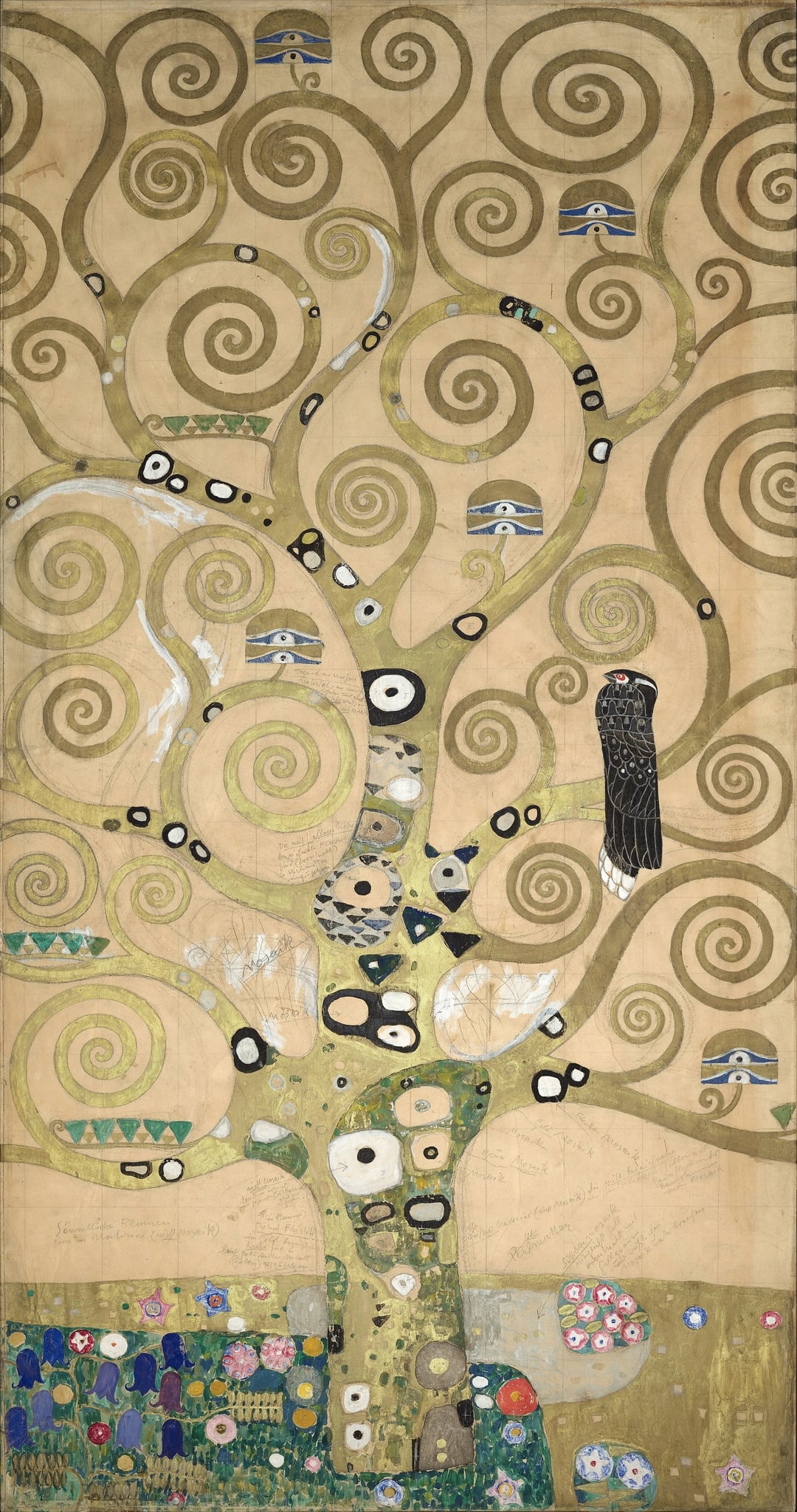
The Tree of Life by Gustav Klimt

The Tree of Life

Gustav Klimt (1910–1911 (design; mosaic installed 1911))

Gustav Klimt’s The Tree of Life crystallizes a <strong>cosmological axis</strong> in a gilded ornamental language: a rooted trunk erupts into <strong>endless spirals</strong>, embedded with <strong>eye-like rosettes</strong> and shadowed by a black, red‑eyed bird. Designed as part of the Stoclet dining‑room frieze, it fuses <strong>symbolism and luxury materials</strong> to link earthly abundance with timeless transcendence <sup>[1]</sup><sup>[2]</sup>.
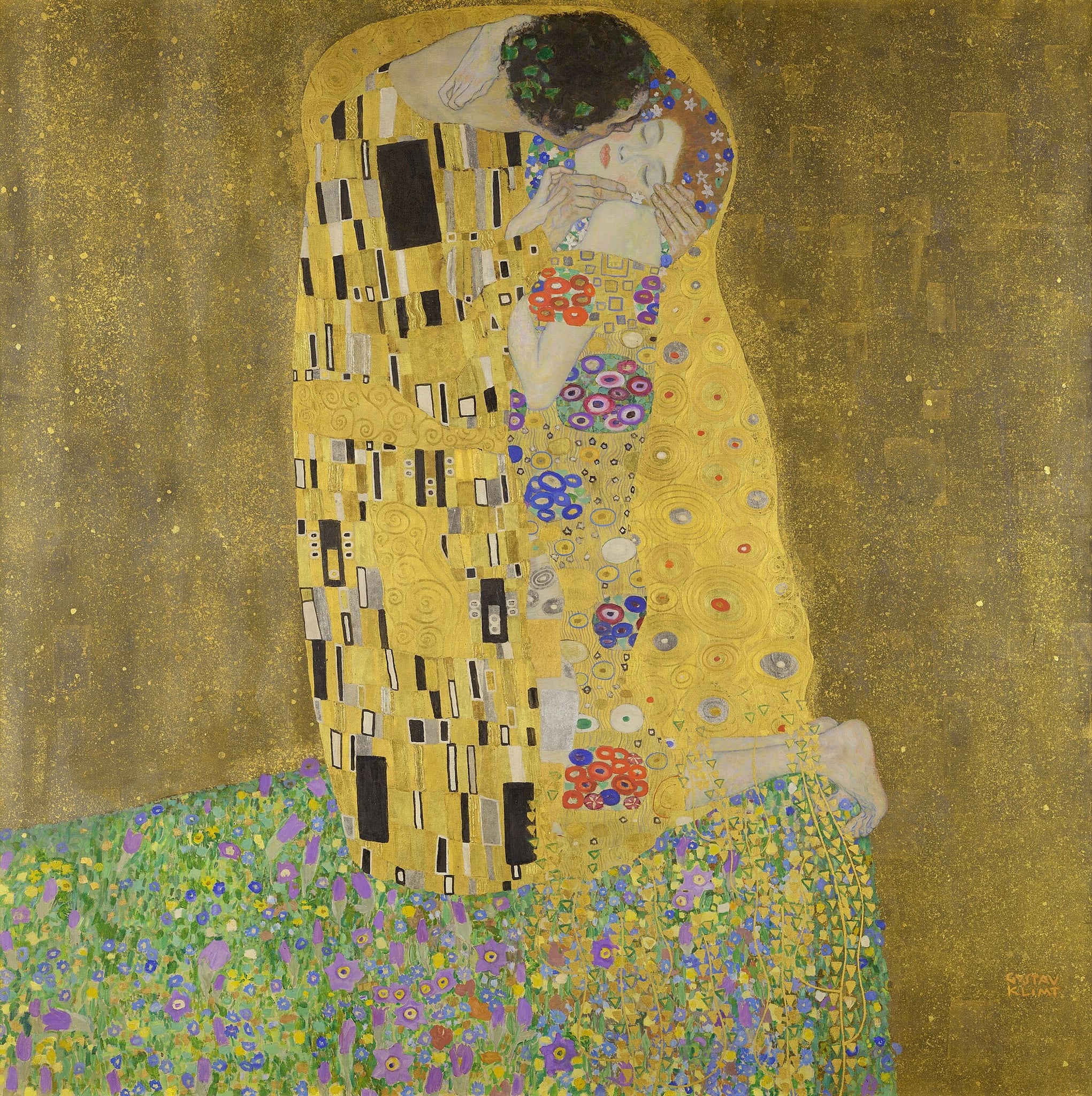
The Kiss (Lovers) by Gustav Klimt

The Kiss (Lovers)

Gustav Klimt (1907–1908 (Belvedere lists 1908/09))

The Kiss (Lovers) crystallizes Klimt’s <strong>Golden Period</strong> ideal: erotic union staged as a sacred vision. Two bodies fuse beneath a single golden mantle, poised on a flowered ledge at the brink of the unknown, where <strong>pattern becomes symbol</strong> and intimacy becomes icon.