Johanna Staude

by Gustav Klimt

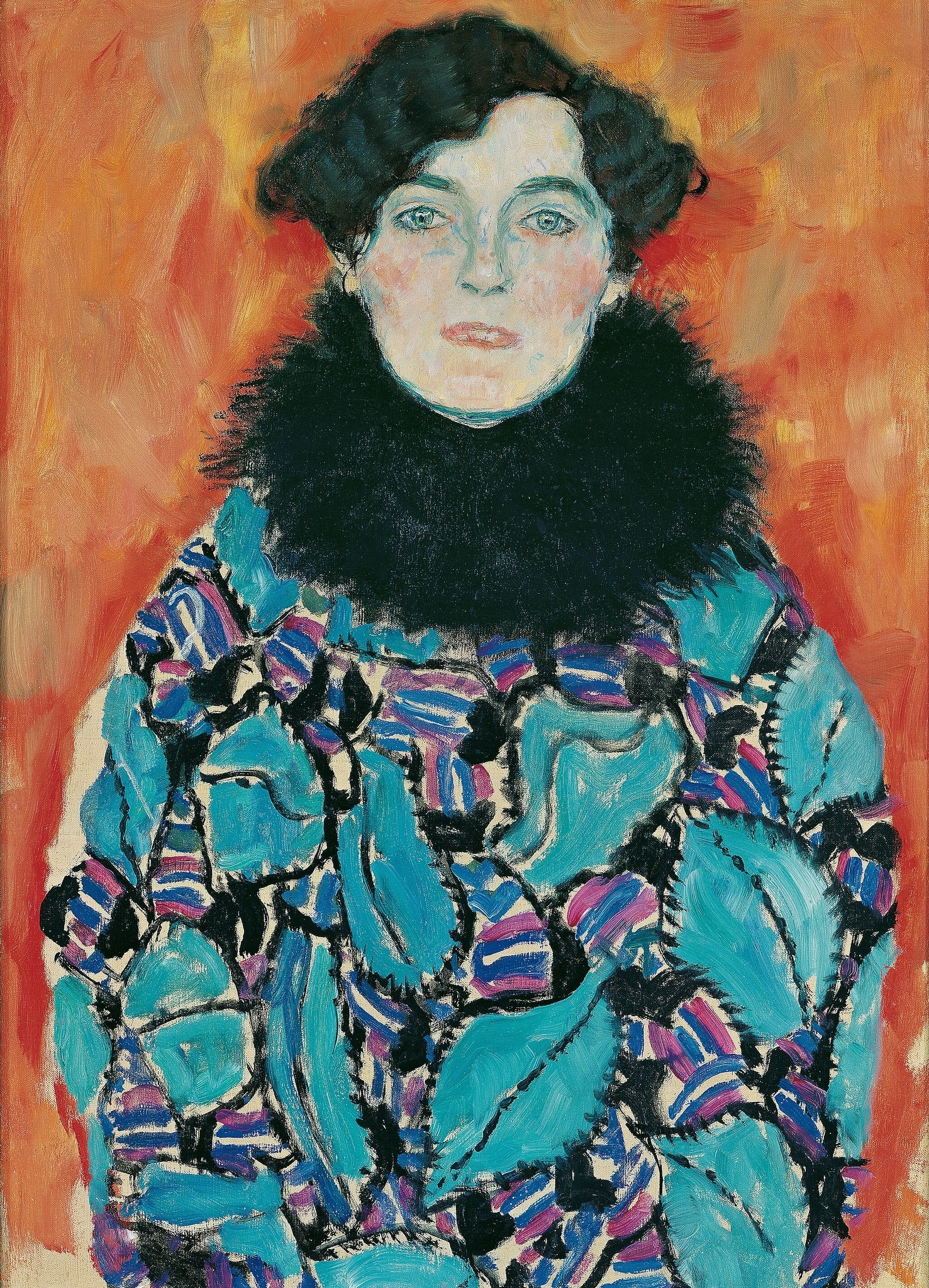
Johanna Staude distills Klimt’s late style into a charged encounter between a cool, impassive face and a blazing orange field. The sitter’s head is isolated by a black feather collar, while a Wiener Werkstätte blouse in turquoise leaves and violet stripes surges forward as a near-abstract surface [1][2]. Painted in 1917/1918 and left unfinished at the mouth, it becomes a poised emblem of modern identity in Vienna on the eve of Klimt’s death [1][2][5].
💰

Market Value

$70-100 million

How much is Johanna Staude worth?

Study Print Studio

Create a personal study print

Build a companion study sheet around the part of this painting that speaks to you most. Choose a detail, shape an interpretation, and walk away with something personal and display-worthy.

Fast Facts

Year
1917/1918
Medium
Oil on canvas
Dimensions
70 × 50 cm
Location
Österreichische Galerie Belvedere, Vienna
See all Gustav Klimt paintings in Vienna
Johanna Staude by Gustav Klimt (1917/1918) featuring Black feather collar (modern ruff/halo), Incandescent orange ground, Wiener Werkstätte blouse with leaf-and-stripe pattern, Unfinished mouth (non finito)

Click on any numbered symbol to learn more about its meaning

Meaning & Symbolism

Klimt builds Johanna Staude from purposeful oppositions. The incandescent orange ground agitates around the figure, not as setting but as psychological climate, a “hot” register against which the cool face and turquoise garment flare with clarity 12. Her head, ringed by a dark feather collar like a modern ruff, is magnetized toward the viewer; the collar’s inky halo both separates the visage from the garment’s turbulence and concentrates attention on a gaze that returns ours without yielding a narrative 12. The mouth, left visibly unfinished, suspends speech and certitude, intensifying the sitter’s reserve; the incompletion coheres with the work’s unsigned state and with Klimt’s final months, transforming contingency into meaning—identity in process rather than concluded fact 125. Against this still, masklike head, the blouse surges forward as a field of matter and sign. Its Wiener Werkstätte fabric—the Blätter (Leaves) pattern by Martha Alber—registers in thick, jagged strokes of turquoise, violet, and black, meticulously transcribed rather than generalized, as recent scholarship stresses for Klimt’s late “fashionable portraits” 23. The patterned surface does more than decorate: it asserts a modern, urban self fashioned through design, aligning sitter and painter with Vienna’s reformist craft culture 23. Klimt deliberately chooses the orange ground to amplify the blouse’s blue, converting complementary contrast into a portrait strategy that lets clothing speak as loudly as physiognomy 2. Edges remain roughly handled; passages of bare ground flicker at the margins; the figure’s contour frays where pattern meets background. These choices refuse the sealed completeness of an academic likeness and instead stage identity as a living negotiation between private inwardness and public display. Within the broader arc of Klimt’s oeuvre, Johanna Staude reframes ornament as realism. Far from a decorative fantasy, the work records a specific person, a specific textile, and the social meanings those choices carried in wartime Vienna, when fashion and self-presentation could index autonomy, resilience, and cosmopolitan belonging 123. The portrait also condenses Klimt’s late synthesis—organic motifs supplant the hard geometries of the Golden Period; contour grows emphatic; material description becomes the bearer of psychological charge 25. Studies at the Albertina confirm the portrait’s drawing-led conception and anchor the sitter’s identity within Klimt’s methodical practice 4. Finally, its temporal proximity to the artist’s death and the visible signs of non finito do not diminish the image; they heighten it. The work becomes a modern icon of selfhood balanced on the edge of flux: a woman at once vividly present and purposely withheld, her persona articulated through color, cloth, and composure. In that balance lies the meaning of Johanna Staude—and its importance as one of Klimt’s clearest statements that in the modern city, surface is substance, and style is a form of truth 1235.

Explore Deeper with AI

Ask questions about Johanna Staude

Popular questions:

Powered by AI • Get instant insights about this artwork

💬 Ask questions about this artwork!

Interpretations

Historical Context: War, Modernity, and Self-Fashioning

Painted in 1917–18 as the Habsburg world unraveled, the portrait leverages fashion as a language of autonomy. In WWI Vienna, access to Wiener Werkstätte design and a short, urbane coiffure indexed modern belonging amid scarcity and censorship; Klimt intensifies this by staging Staude against a heated orange ground that reads as urban “weather” rather than place. The result is a modebildnis in which sartorial choice becomes civic identity—cosmopolitan, reformist, resilient—at a moment when national narratives were failing. Rather than allegorize war, Klimt documents how a woman’s patterned blouse and self-possessed gaze act as micro-politics of presence in crisis, a subtle but pointed counterpart to Vienna’s collapsing imperial order 352.

Source: Belvedere Museum (Google Arts & Culture); Encyclopaedia Britannica; Franz Smola, Belvedere Research Journal

Material Culture & Design History: The Blätter Textile as Evidence

The blouse in Martha Alber’s Wiener Werkstätte fabric, “Blätter,” is not generic décor but a verifiable object with a museum-traceable twin, allowing the portrait to function as material documentation. Klimt’s thick, jagged strokes transcribe the print’s repeat and tonality with a near-ethnographic attention to pattern morphology, aligning his late portraiture with design reform rather than salon fantasy. This connects Staude to a women-led design economy and positions the garment as a co-author of identity. The Belvedere’s display of a matching blouse and Smola’s reclassification of such portraits as “realistic rather than fictional” shift interpretation from ornament to indexical realism—the painting records a person embedded in a concrete network of Viennese craft, commerce, and taste 372.

Source: Belvedere Museum (Google Arts & Culture); MAK-related press on Women of the Wiener Werkstätte; Franz Smola, Belvedere Research Journal

Formal/Chromatic Analysis: Heat vs. Cool and the Engine of Contrast

Klimt orchestrates a high-key complementary contrast: incandescent orange ground versus turquoise-violet garment. This temperature dialectic throws the blouse forward while the feather collar acts as a tonal baffle, a modern ruff concentrating the face’s luminosity. Edges are deliberately porous—pattern frays into the field, with flickers of bare ground—so contour becomes an active threshold where self meets world. The strategy transforms color into rhetoric: orange reads as an agitated atmosphere, blue as composed self-fashioning. Facture remains legible—brushwork that refuses optical sealing—making color and touch co-protagonists of meaning. The portrait thus models how late Klimt wields chroma, contour, and non finito edges to produce a poised but vibrating presence without recourse to narrative 13.

Source: Belvedere Museum (object record and curatorial story)

Authorship & Process: Non Finito as Modern Strategy

The visibly unfinished mouth, absent signature, and documented studio practice (drawings at the Albertina) shift the portrait from product to process. The famous quip—leaving the work incomplete to keep the sitter returning—reads, beyond anecdote, as a poetics of withheld closure, where identity is staged as emergent rather than fixed. In late Klimt, non finito is neither failure nor indecision; it is an index of time and encounter, akin to a photographic “open shutter.” The studies anchor sitter identity while the canvas preserves contingency, producing a double-authorship between drawing’s certitude and painting’s provisional truth. In the face of the artist’s imminent death, this suspended completion becomes a modern ethics of portraiture: to show becoming, not conclusion 431.

Source: Albertina, Vienna; Belvedere Museum (Google Arts & Culture); Belvedere Museum (object record)

Ornament as Realism: Late Secession Synthesis

Johanna Staude exemplifies Klimt’s late synthesis in which organic motifs and emphatic contour replace the Golden Period’s hard geometries, while ornament assumes evidentiary weight. Smola’s reassessment of the “fashionable portraits” as realistic punctures the cliché of decorative escapism: pattern is not fantasy but data—about classed taste, gendered agency, and Viennese design culture. Belvedere’s portrait scholarship shows how material description bears psychological charge, with garment and gaze co-constituting persona. In this light, the painting operates at the hinge of mimesis and style: it is a secular icon whose radiance issues from specific textiles, not gold leaf; whose aura comes from modern design’s promise that surface can hold truth about the self 28.

Source: Franz Smola, Belvedere Research Journal; Belvedere, Klimt’s Female Portraits (Google Arts & Culture)

Gendered Gaze & Agency: Composure Without Concession

Staude’s frontal look—framed by the inky collar—meets ours without narrative yield. The unfinished mouth suspends speech, denying the viewer the comfort of anecdote or coquettish script. Belvedere’s media commentary stresses the confident gaze while the dissolving contours refuse a pin-downable silhouette, articulating a self-possessed modernity distinct from earlier society-portrait flirtation. This is not the ornamentalized muse of the Golden Period but a woman who styles herself through design culture and looks back on equal terms. The portrait posits a gendered ethics of seeing in which adornment is not passive spectacle but an instrument of agency, calibrating how much of the self is offered—or withheld—to public view 193.

Source: Belvedere Museum (object record); Museumsfernsehen/Belvedere video feature; Belvedere Museum (Google Arts & Culture)

Related Themes

About Gustav Klimt

Gustav Klimt (1862–1918), co-founder of the Vienna Secession, pivoted from controversial public commissions to a decorative-symbolist language in his Golden Period. Drawing on Byzantine mosaics and modern design, he fused opulent surfaces with psychological intensity. By 1908–09, he transformed scandal into canon, and The Kiss became Vienna’s emblem of modern love.
View all works by Gustav Klimt

More by Gustav Klimt

Portrait of Adele Bloch-Bauer I by Gustav Klimt

Portrait of Adele Bloch-Bauer I

Gustav Klimt (1907)

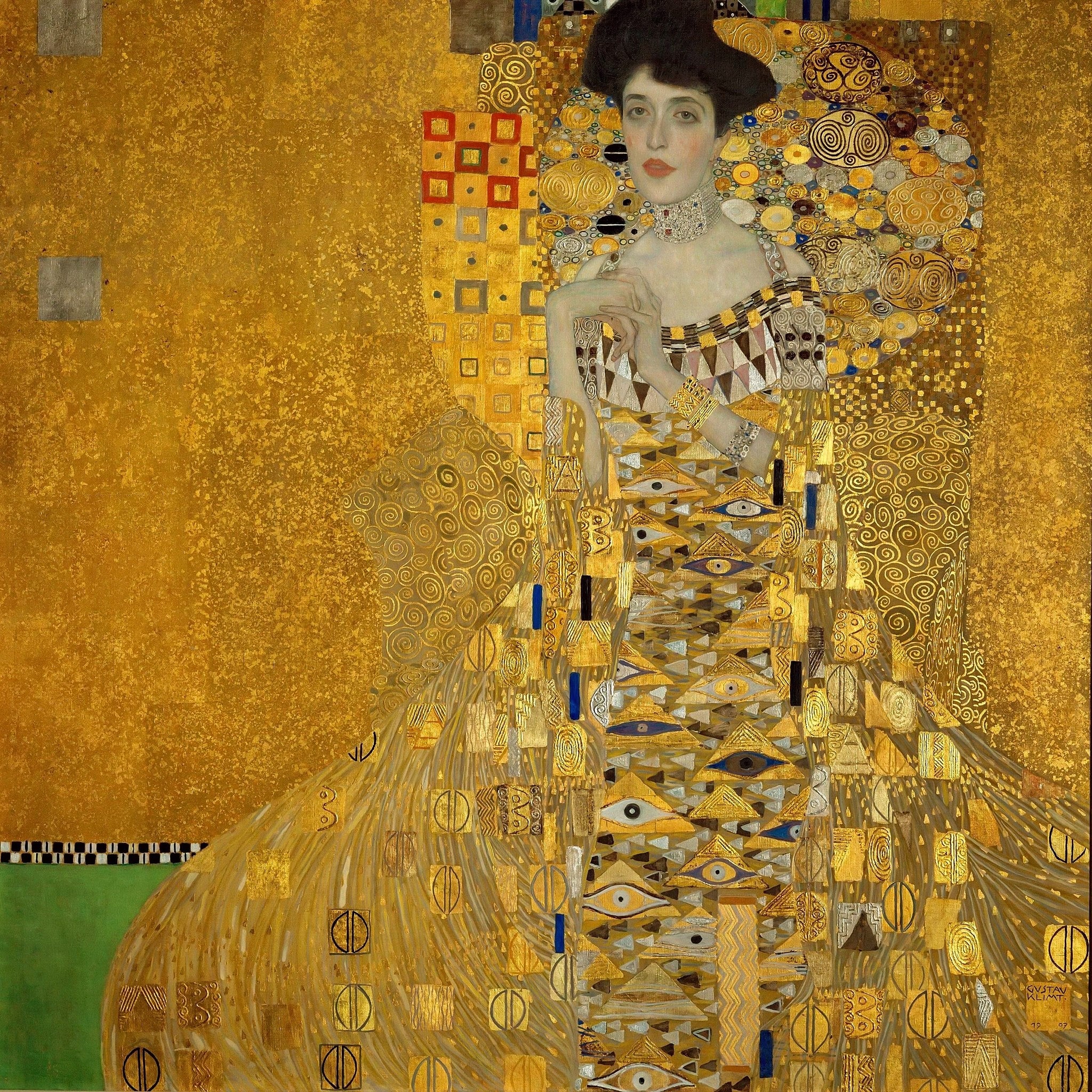
Gustav Klimt’s Portrait of Adele Bloch-Bauer I stages its sitter as a <strong>secular icon</strong>—a living presence suspended in a field of gold that converts space into <strong>pattern and power</strong>. The naturalistic face and hands emerge from a reliquary-like cascade of eyes, triangles, and tesserae, turning light, ornament, and status into the painting’s true subjects <sup>[1]</sup><sup>[2]</sup>.
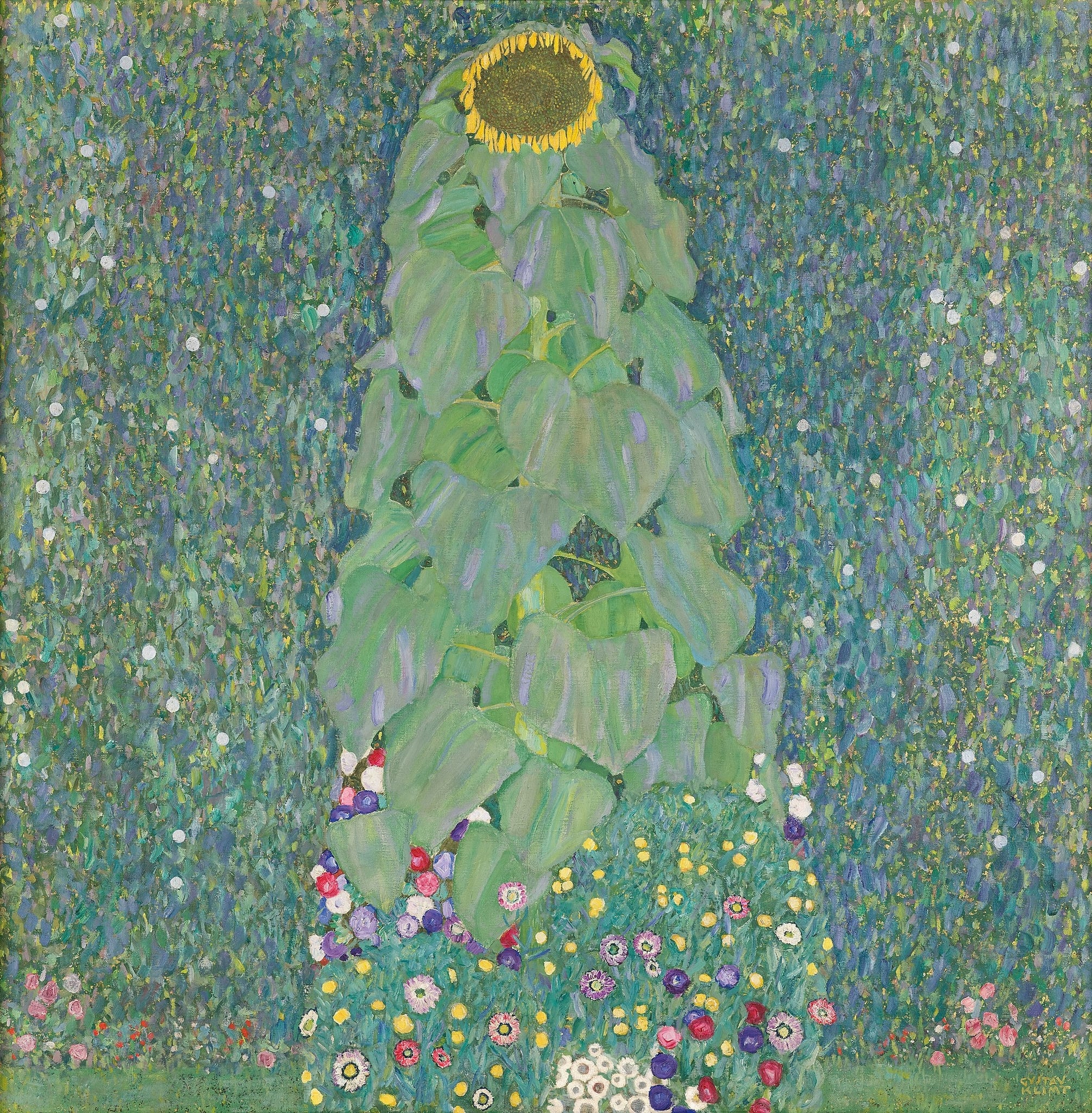
Sunflower by Gustav Klimt

Sunflower

Gustav Klimt (1907/1908)

Gustav Klimt’s Sunflower turns a single bloom into a <strong>monumental, figure-like presence</strong>. A tapering stack of broad, drooping leaves rises from a <strong>mosaic-like carpet of round blossoms</strong>, crowned by a gold-flecked disc that glows against a cool, stippled field. The work fuses <strong>portrait, icon, and landscape</strong> into one emblem of vitality and quiet sanctity <sup>[1]</sup><sup>[2]</sup>.
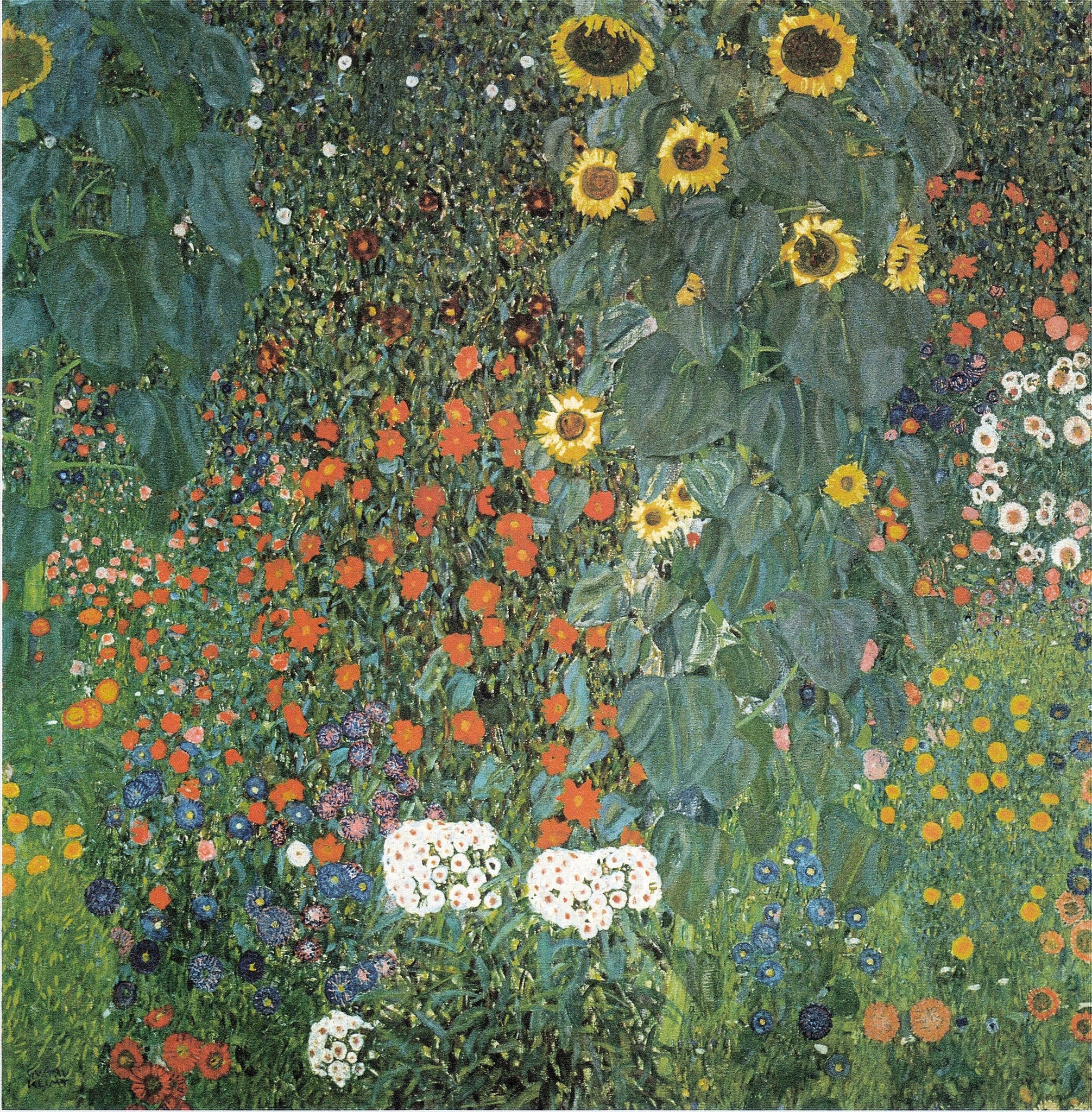
Cottage Garden with Sunflowers by Gustav Klimt

Cottage Garden with Sunflowers

Gustav Klimt (1906–1907 (signed 1907))

Cottage Garden with Sunflowers is a square, horizonless field of blooms where a vertical column of <strong>sunflowers</strong> anchors an all-over weave of color and pattern. Klimt fuses <strong>ornament and nature</strong>, turning a humble Litzlberg cottage plot into a radiant matrix of cyclical life and renewal <sup>[1]</sup><sup>[4]</sup><sup>[5]</sup>.
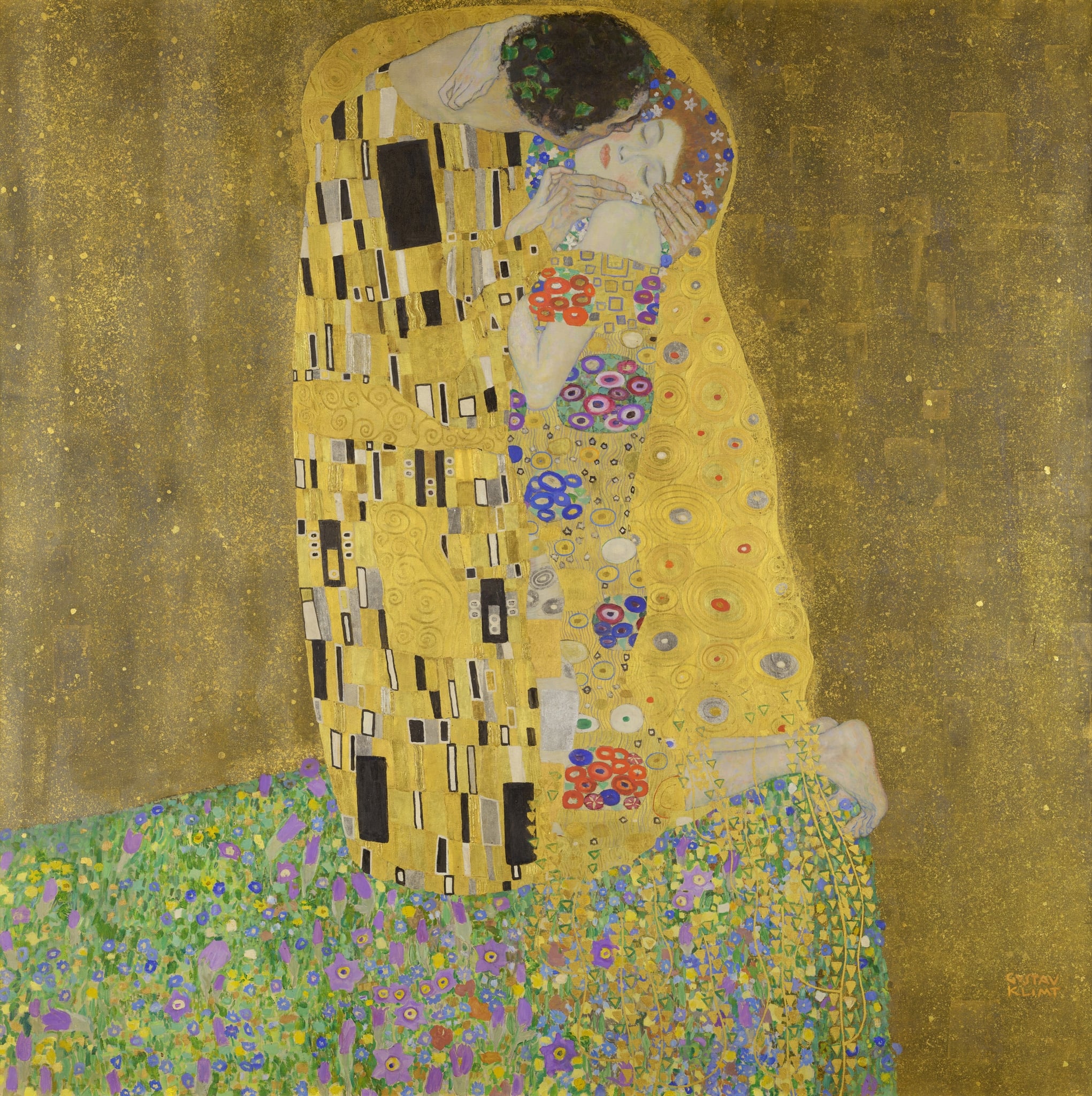
The Kiss by Gustav Klimt

The Kiss

Gustav Klimt (1908 (completed 1909))

The Kiss stages human love as a <strong>sacred union</strong>, fusing two figures into a single, gold-clad form against a timeless field. Klimt opposes <strong>masculine geometry</strong> (black-and-white rectangles) to <strong>feminine organic rhythm</strong> (spirals, circles, flowers), then resolves them in radiant harmony <sup>[1]</sup><sup>[2]</sup>.
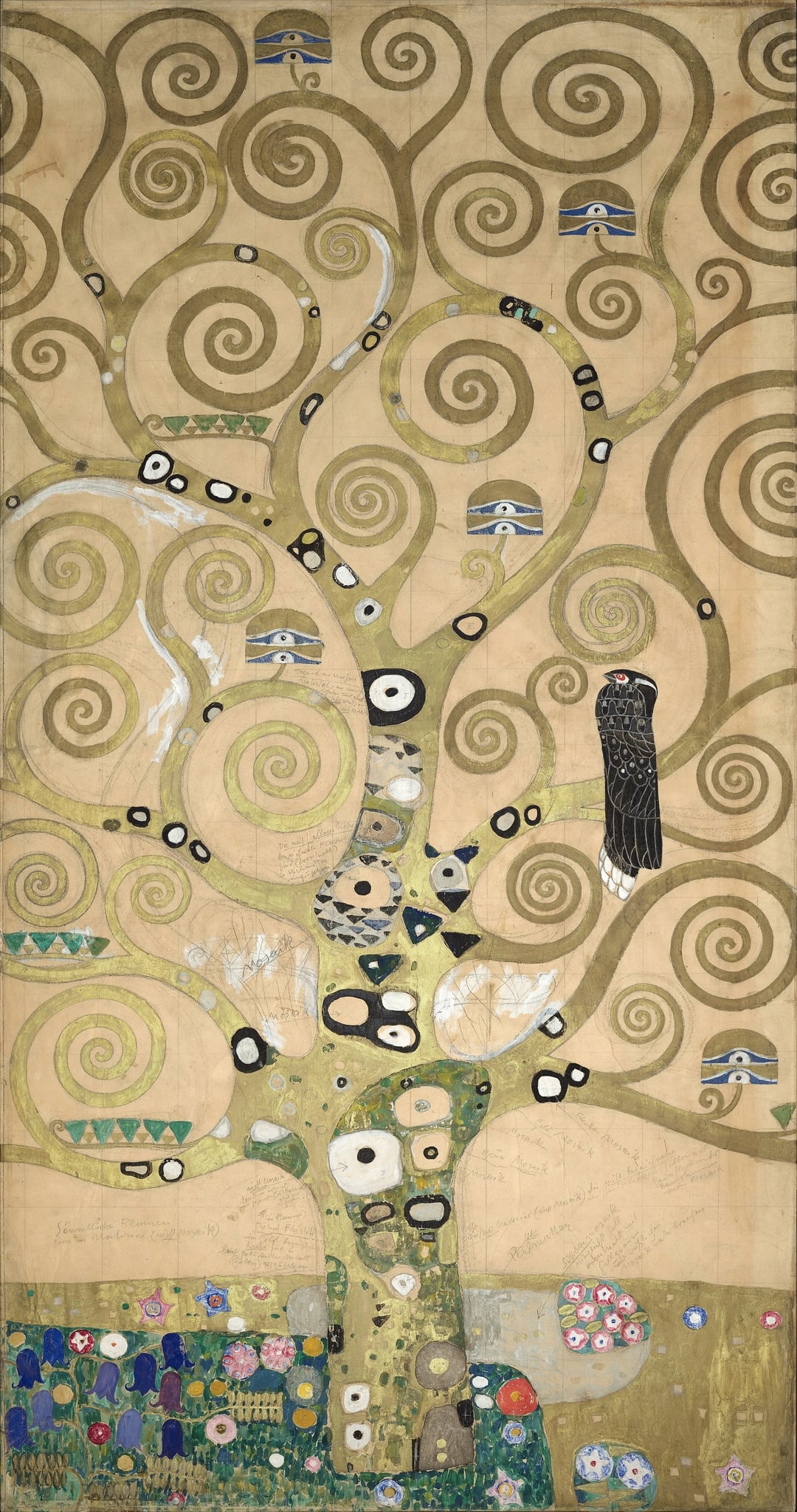
The Tree of Life by Gustav Klimt

The Tree of Life

Gustav Klimt (1910–1911 (design; mosaic installed 1911))

Gustav Klimt’s The Tree of Life crystallizes a <strong>cosmological axis</strong> in a gilded ornamental language: a rooted trunk erupts into <strong>endless spirals</strong>, embedded with <strong>eye-like rosettes</strong> and shadowed by a black, red‑eyed bird. Designed as part of the Stoclet dining‑room frieze, it fuses <strong>symbolism and luxury materials</strong> to link earthly abundance with timeless transcendence <sup>[1]</sup><sup>[2]</sup>.
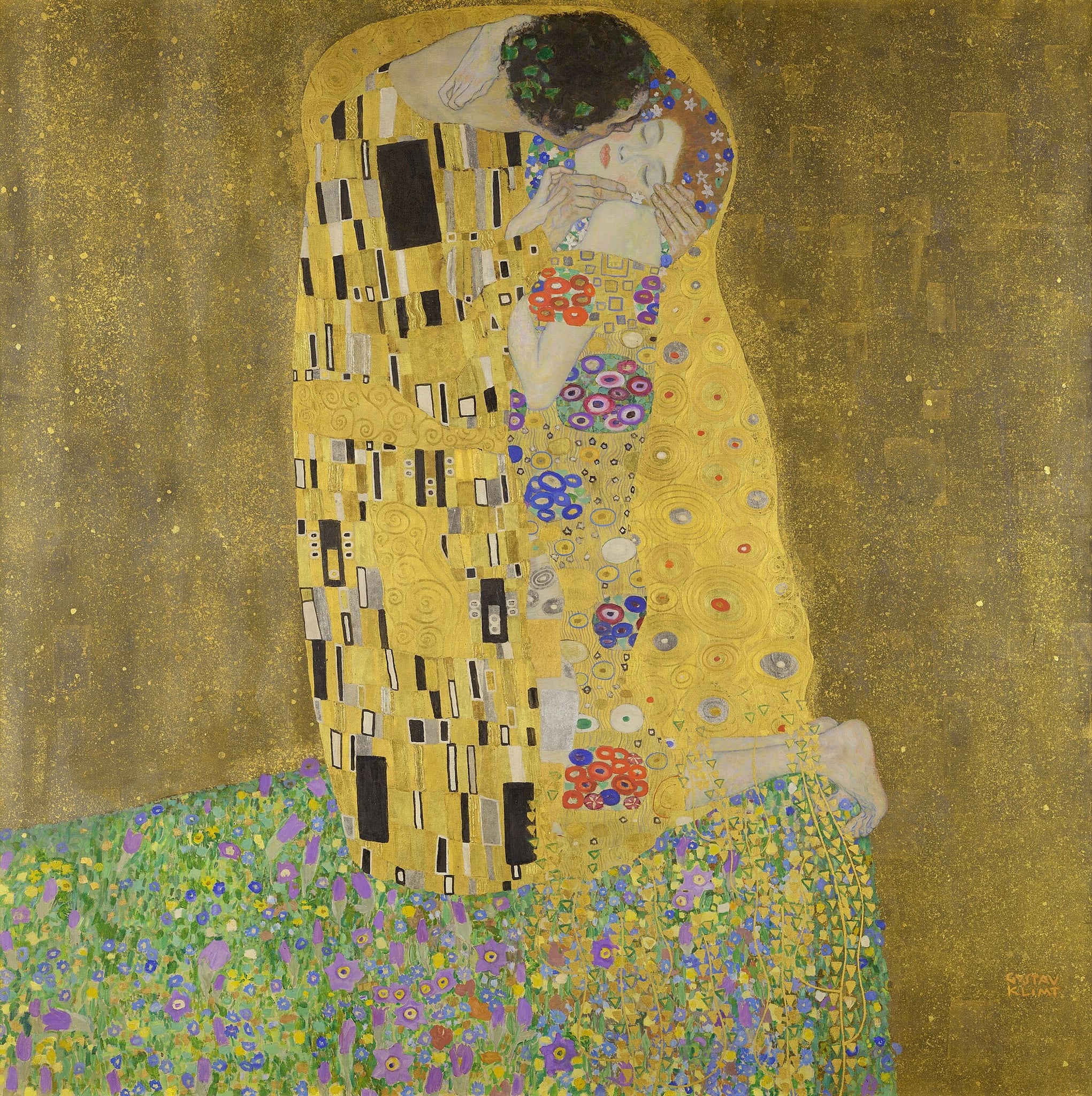
The Kiss (Lovers) by Gustav Klimt

The Kiss (Lovers)

Gustav Klimt (1907–1908 (Belvedere lists 1908/09))

The Kiss (Lovers) crystallizes Klimt’s <strong>Golden Period</strong> ideal: erotic union staged as a sacred vision. Two bodies fuse beneath a single golden mantle, poised on a flowered ledge at the brink of the unknown, where <strong>pattern becomes symbol</strong> and intimacy becomes icon.