Identity
The “Identity” symbolism category traces how modern and early modern artists encode social role, class, gender, and selfhood in clothing, pose, and gaze, turning the human figure into a densely signifying site where personal agency and institutional structures intersect.
Member Symbols
Featured Artworks
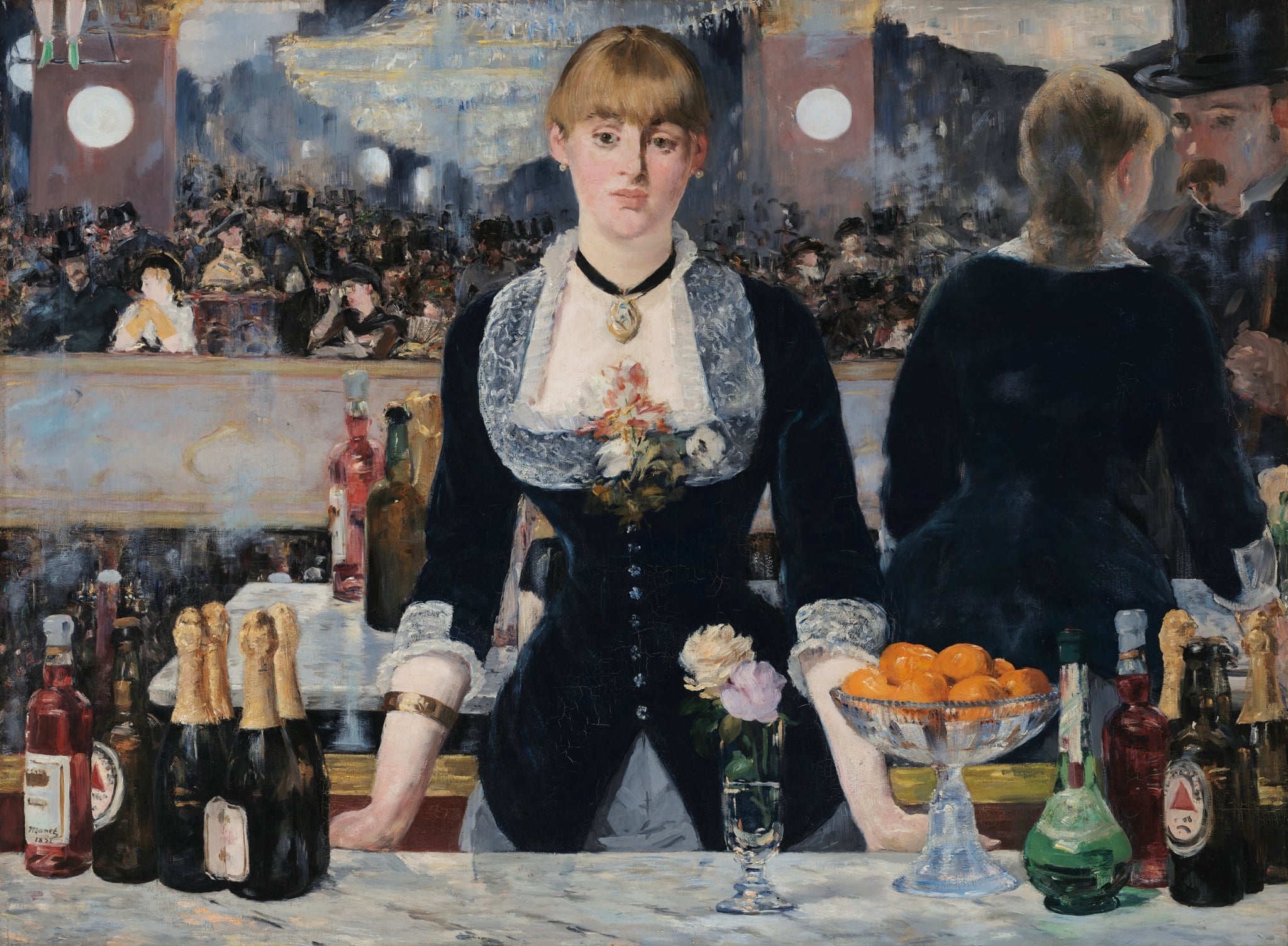
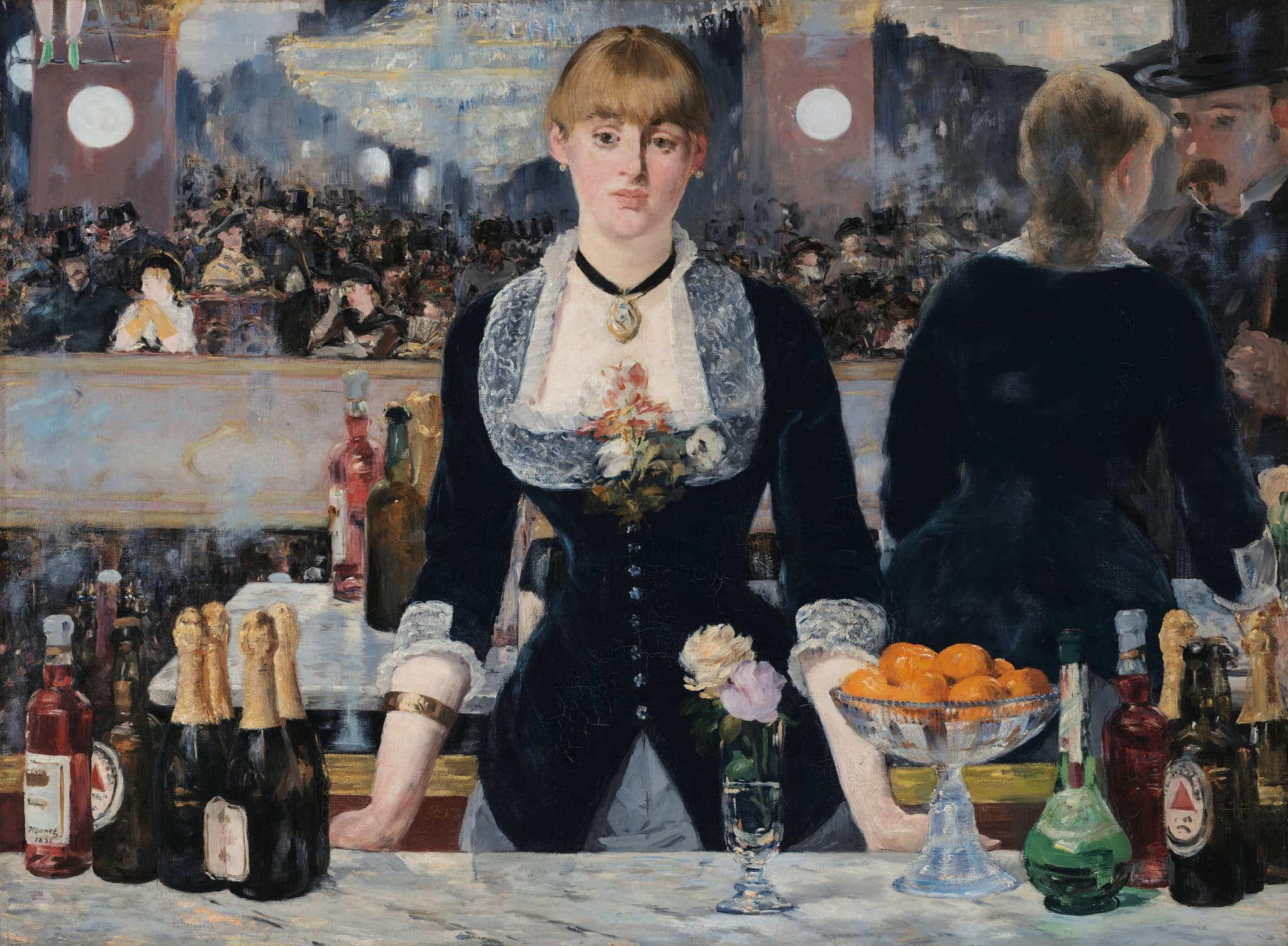
A Bar at the Folies-Bergère
Édouard Manet (1882)
Édouard Manet’s A Bar at the Folies-Bergère stages a face-to-face encounter with modern Paris, where <strong>commerce</strong>, <strong>spectacle</strong>, and <strong>alienation</strong> converge. A composed barmaid fronts a marble counter loaded with branded bottles, flowers, and a brimming bowl of oranges, while a disjunctive <strong>mirror</strong> unravels stable viewing and certainty <sup>[1]</sup><sup>[2]</sup>.
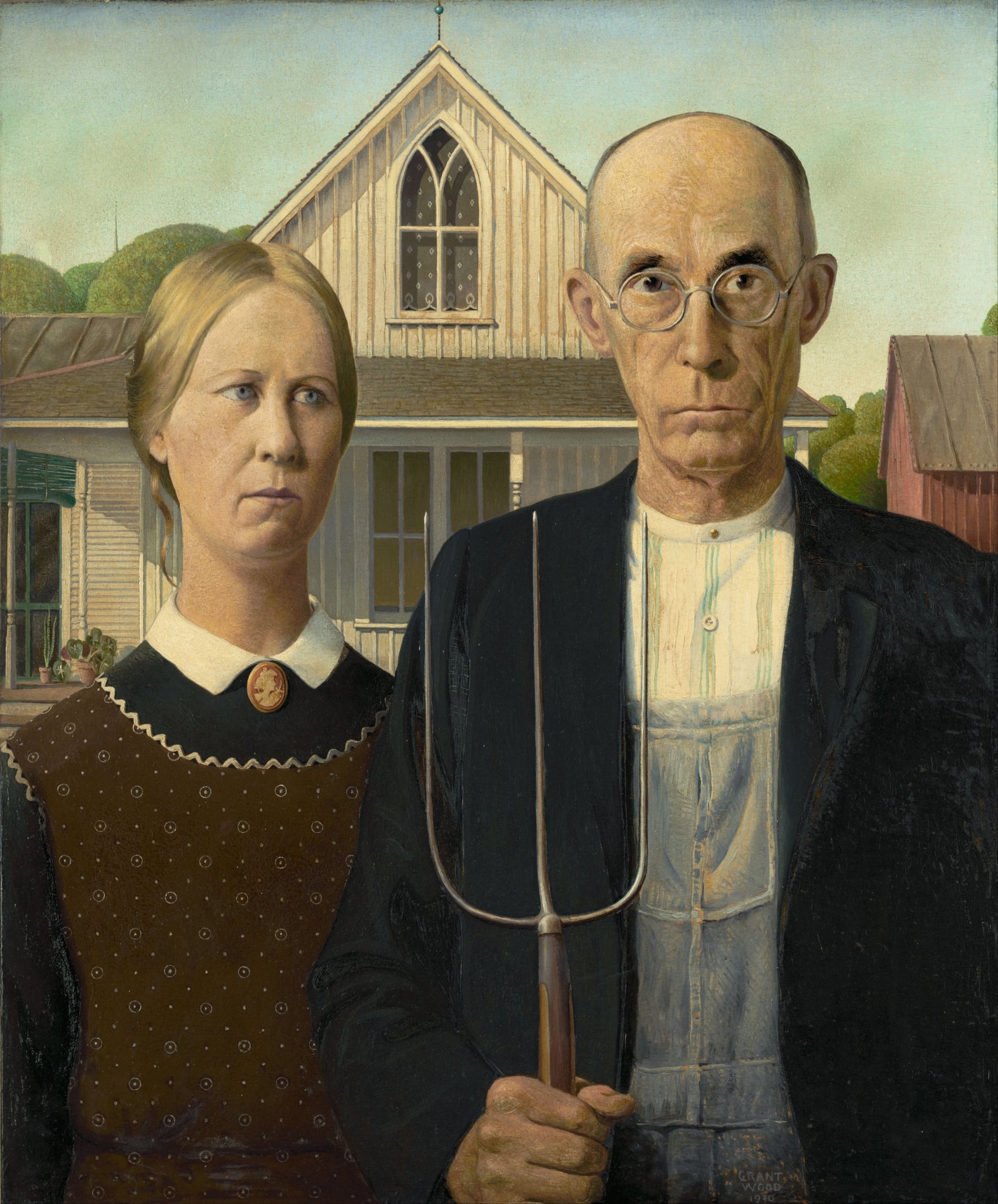
American Gothic
Grant Wood (1930)
Grant Wood’s American Gothic (1930) turns a plain Midwestern homestead into a <strong>moral emblem</strong> by binding two flinty figures to the strict geometry of a Carpenter Gothic gable and a three‑tined pitchfork. The painting’s cool precision and echoing verticals create a <strong>compressed ethic of work, order, and restraint</strong> that can read as both tribute and critique <sup>[1]</sup><sup>[2]</sup><sup>[3]</sup>.
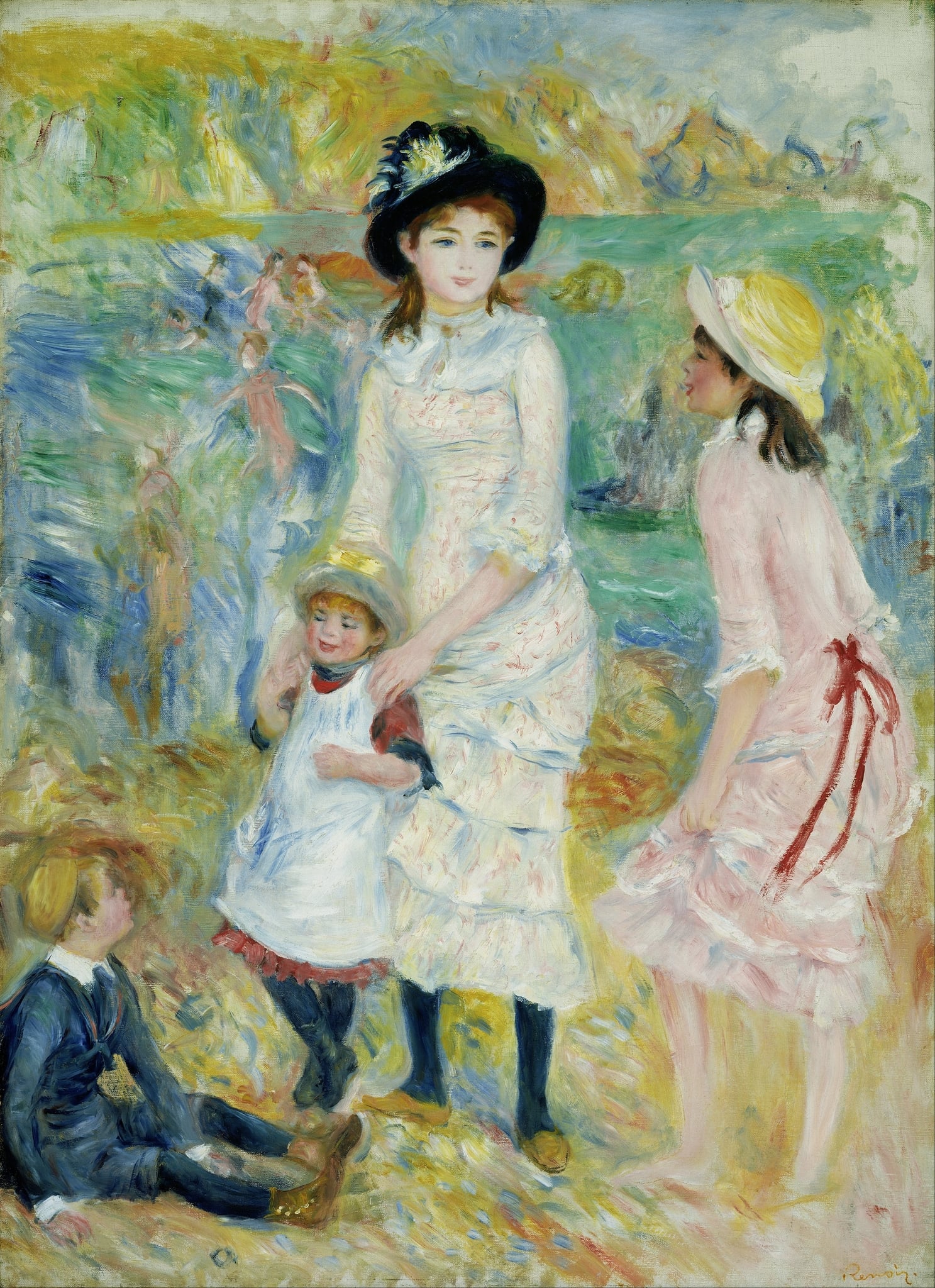
Children on the Seashore, Guernsey
Pierre-Auguste Renoir (about 1883)
Renoir’s Children on the Seashore, Guernsey crystallizes a wind‑bright moment of modern leisure with <strong>flickering brushwork</strong> and a gently choreographed group of children. The central girl in a white dress and black feathered hat steadies a toddler while a pink‑clad companion leans in and a sailor‑suited boy rests on the pebbles—an intimate triangle set against a <strong>shimmering, populated sea</strong>. The canvas makes light and movement the protagonists, dissolving edges into <strong>pearly surf and sun‑washed cliffs</strong>.

Dance in the City
Pierre-Auguste Renoir (1883)
Pierre-Auguste Renoir’s Dance in the City stages an urban waltz where decorum and desire briefly coincide. A couple’s close embrace—his black tailcoat enclosing her luminous white satin gown—creates a <strong>cool, elegant</strong> harmony against potted palms and marble. Renoir’s refined, post‑Impressionist touch turns social ritual into <strong>sensual modernity</strong> <sup>[1]</sup><sup>[2]</sup>.
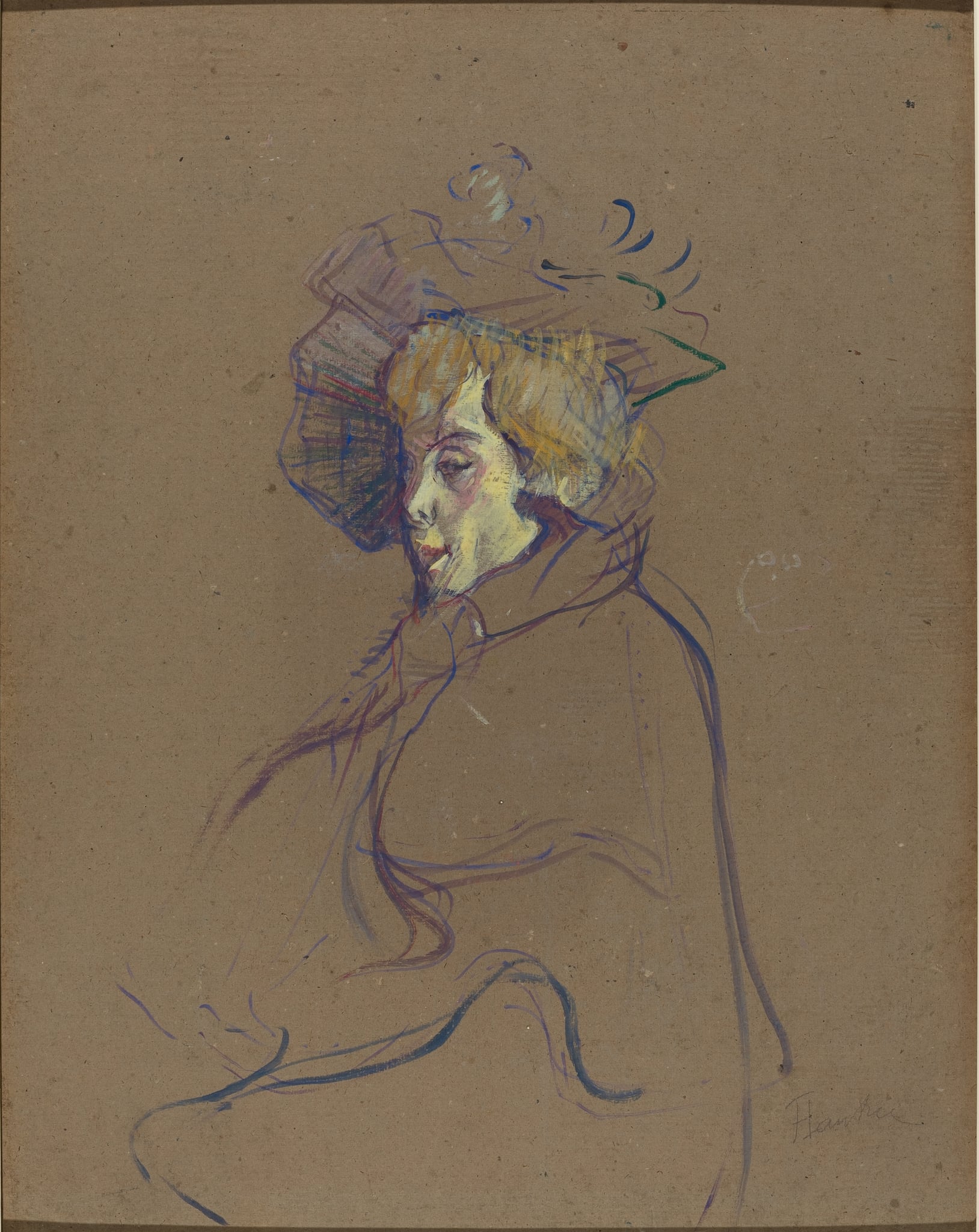
Jane Avril
Henri de Toulouse-Lautrec (c. 1891–1892)
In Jane Avril, Henri de Toulouse-Lautrec crystallizes a public persona from a few <strong>urgent, chromatic strokes</strong>: violet and blue lines whirl into a cloak, while green and indigo dashes crown a buoyant hat. Her face—sharply keyed in <strong>lemon yellow, lilac, and carmine</strong>—hovers between mask and likeness, projecting poise edged with fatigue. The raw brown ground lets her <strong>whiplash silhouette</strong> materialize like smoke from Montmartre’s nightlife.
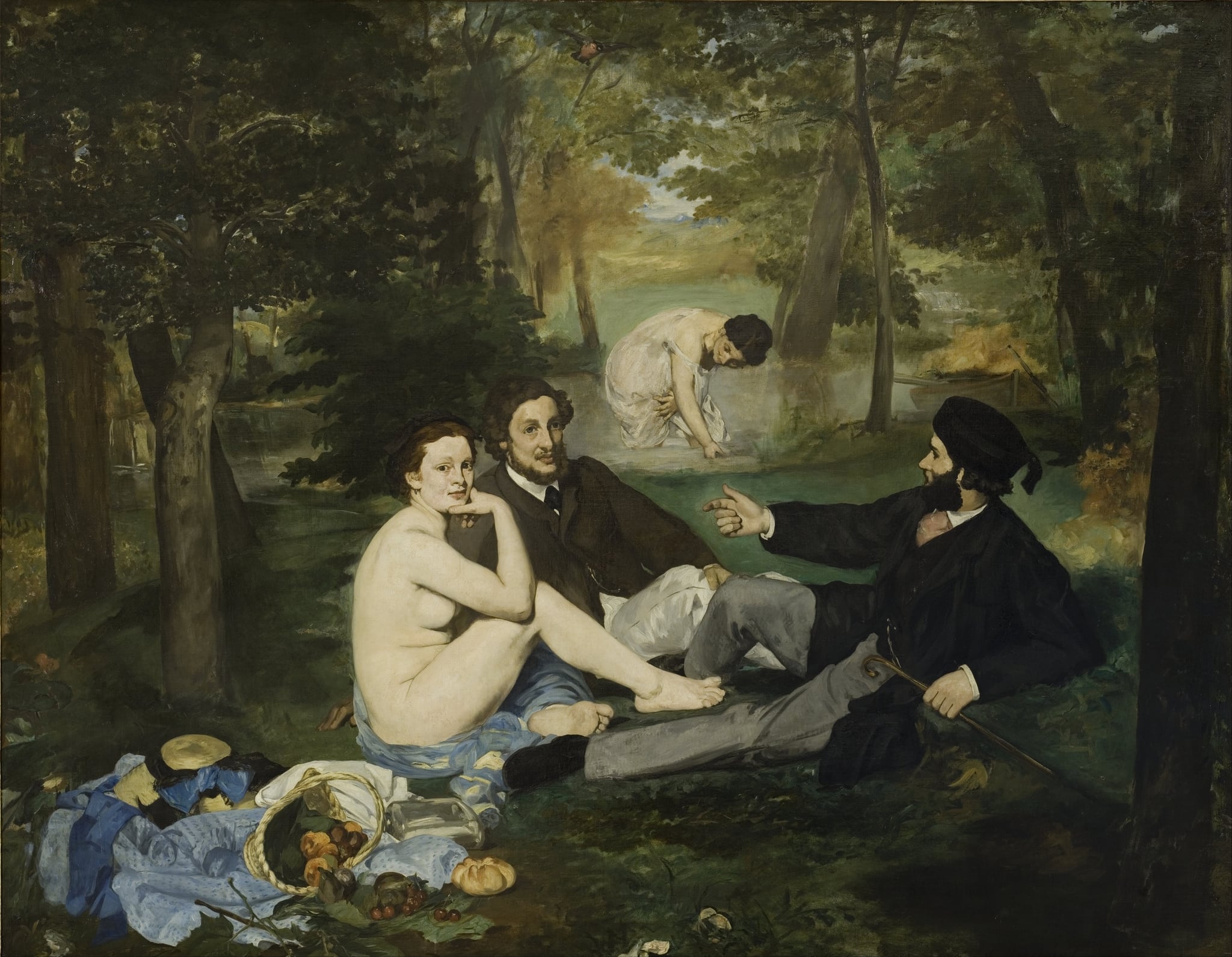
Luncheon on the Grass
Édouard Manet (1863)
Luncheon on the Grass stages a confrontation between <strong>modern Parisian leisure</strong> and <strong>classical precedent</strong>. A nude woman meets our gaze beside two clothed men, while a distant bather and an overturned picnic puncture naturalistic illusion. Manet’s scale and flat, studio-like light convert a park picnic into a manifesto of <strong>modern painting</strong> <sup>[1]</sup><sup>[2]</sup>.
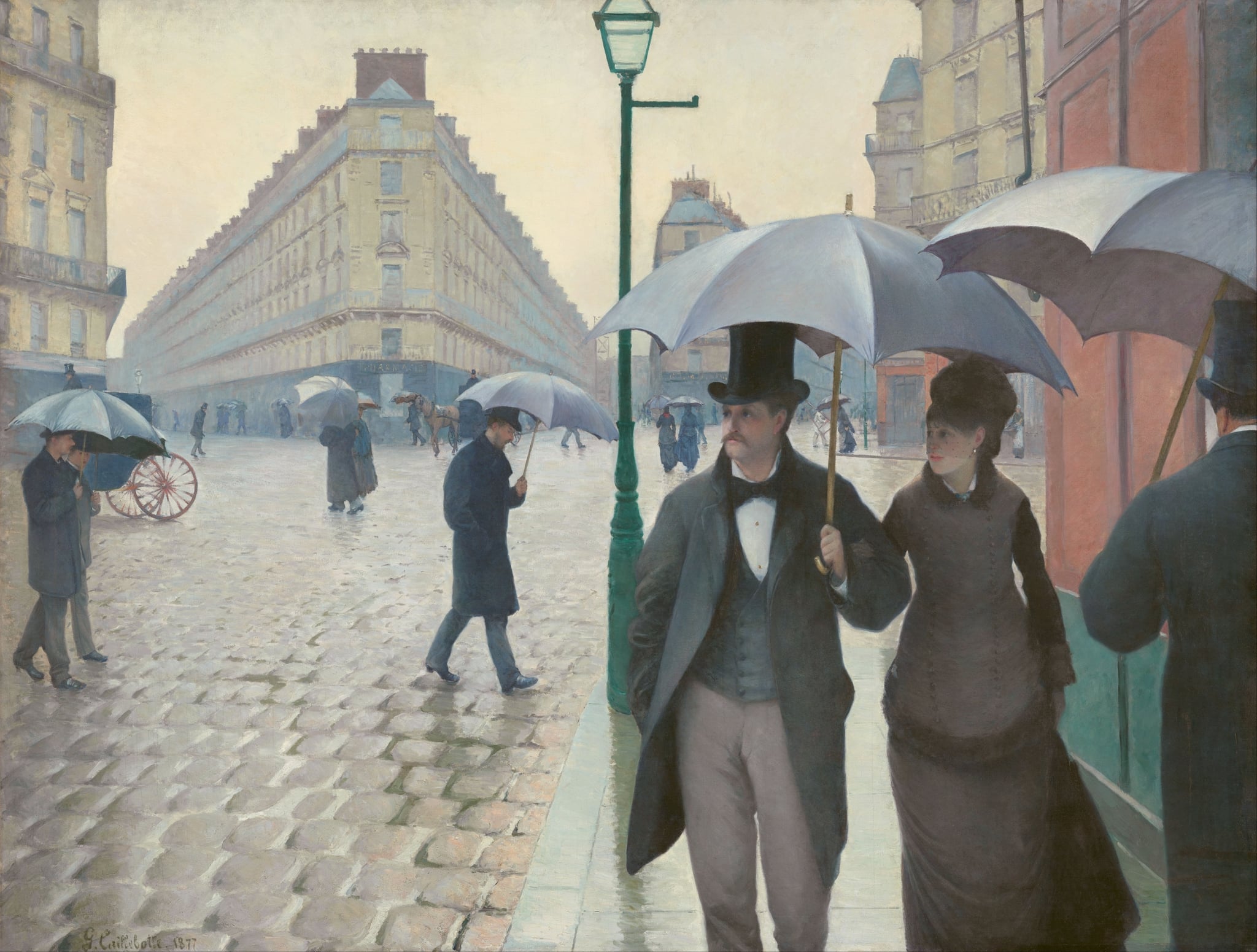
Paris Street; Rainy Day
Gustave Caillebotte (1877)
Gustave Caillebotte’s Paris Street; Rainy Day renders a newly modern Paris where <strong>Haussmann’s geometry</strong> meets the <strong>anonymity of urban life</strong>. Umbrellas punctuate a silvery atmosphere as a <strong>central gas lamp</strong> and knife-sharp façades organize the space into measured planes <sup>[1]</sup><sup>[2]</sup>.
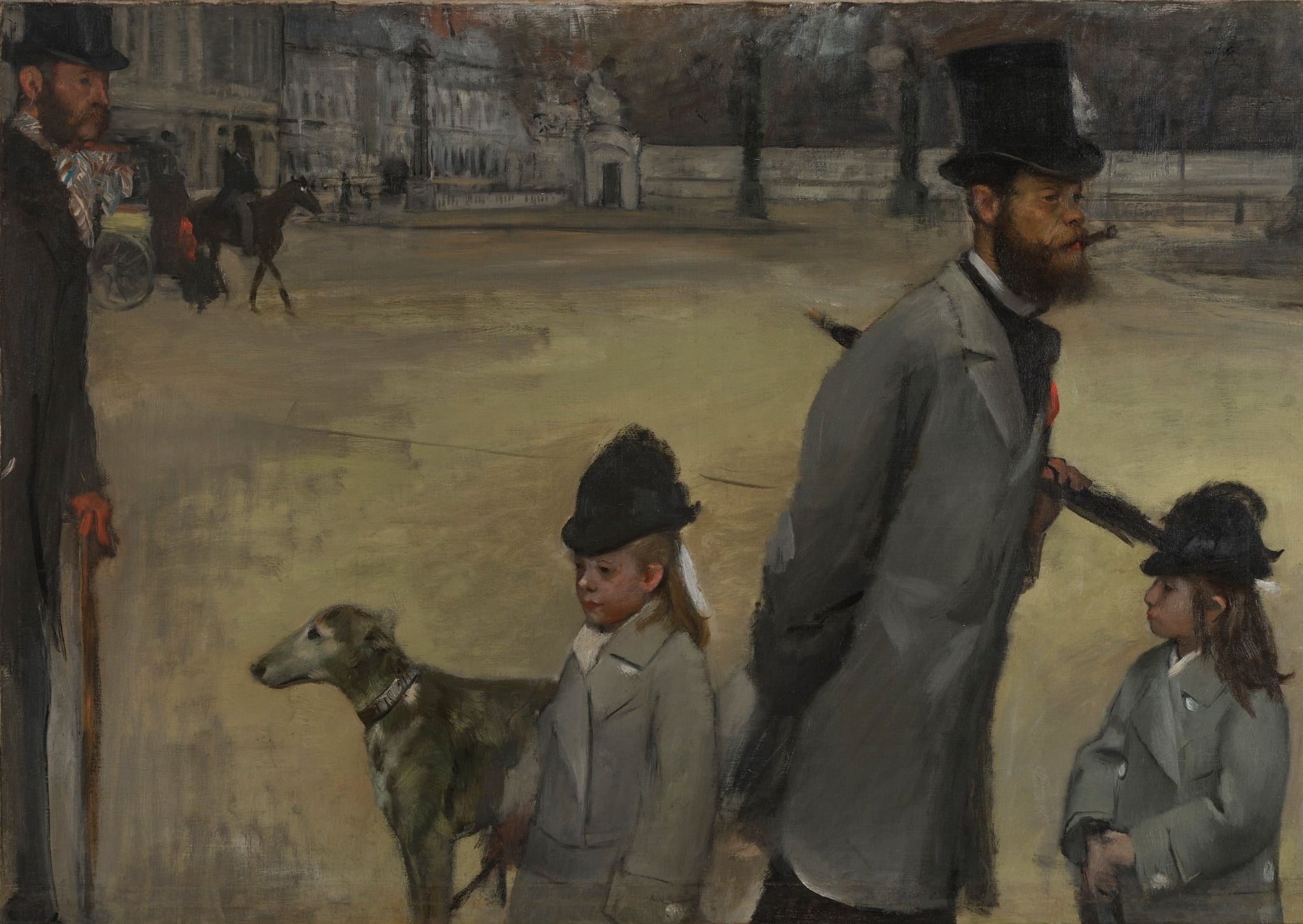
Place de la Concorde
Edgar Degas (1875)
Degas’s Place de la Concorde turns a famous Paris square into a study of <strong>modern isolation</strong> and <strong>instantaneous vision</strong>. Figures stride past one another without contact, their bodies abruptly <strong>cropped</strong> and adrift in a wide, airless plaza—an urban stage where elegance masks estrangement <sup>[1]</sup><sup>[2]</sup>.
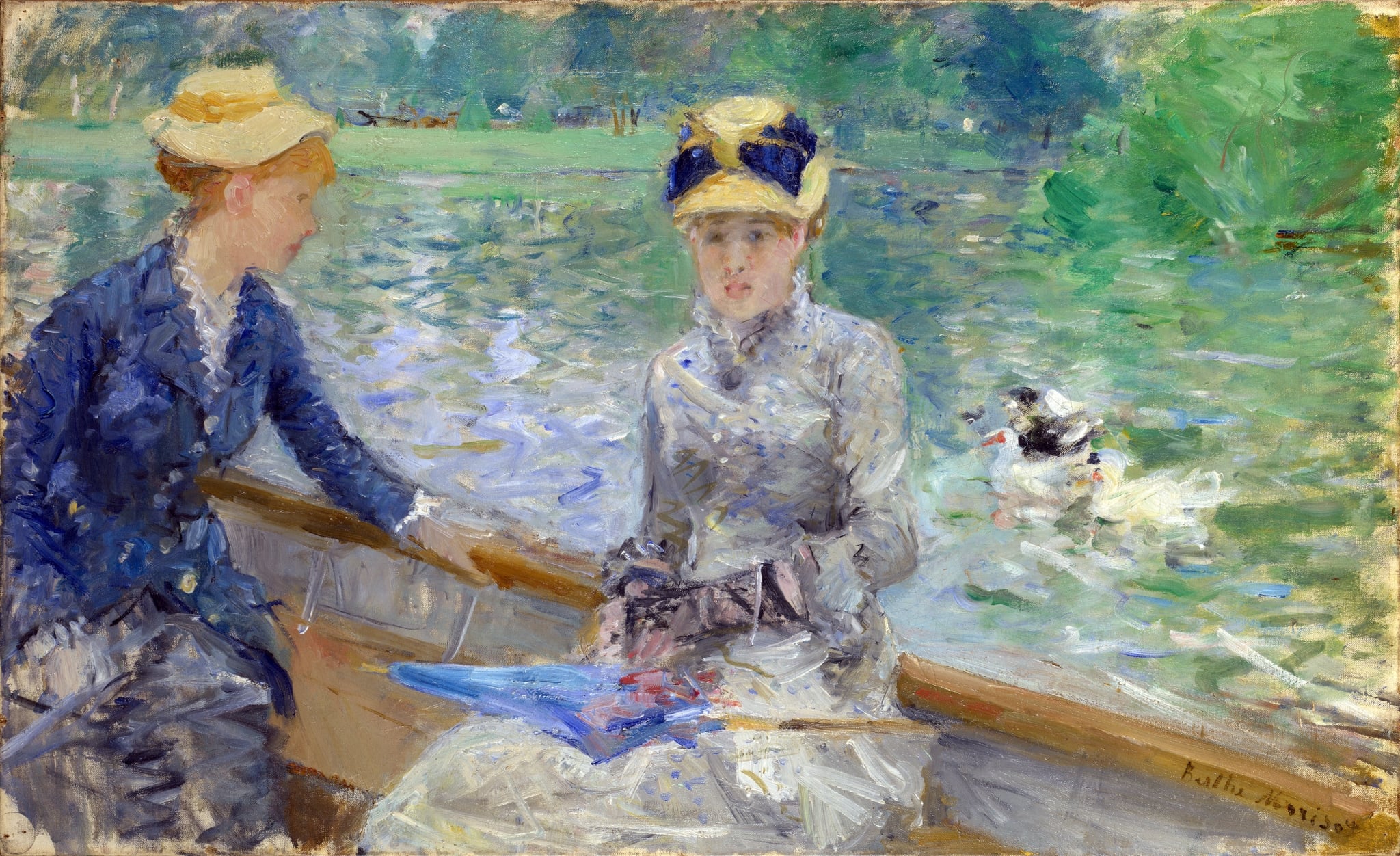
Summer's Day
Berthe Morisot (about 1879)
Two women drift on a boat in the Bois de Boulogne, their dresses, hats, and a bright blue parasol fused with the lake’s flicker by Morisot’s swift, <strong>zig‑zag brushwork</strong>. The scene turns a brief outing into a poised study of <strong>modern leisure</strong> and <strong>female companionship</strong> in public space <sup>[1]</sup>.

The Ballet Rehearsal
Edgar Degas (c. 1874)
In The Ballet Rehearsal, Edgar Degas turns a practice room into a modern drama where <strong>discipline and desire</strong> collide. A dark <strong>spiral staircase</strong> slices the space, scuffed floorboards yawn open, and clusters of dancers oscillate between poised effort and weary waiting <sup>[1]</sup><sup>[4]</sup>.
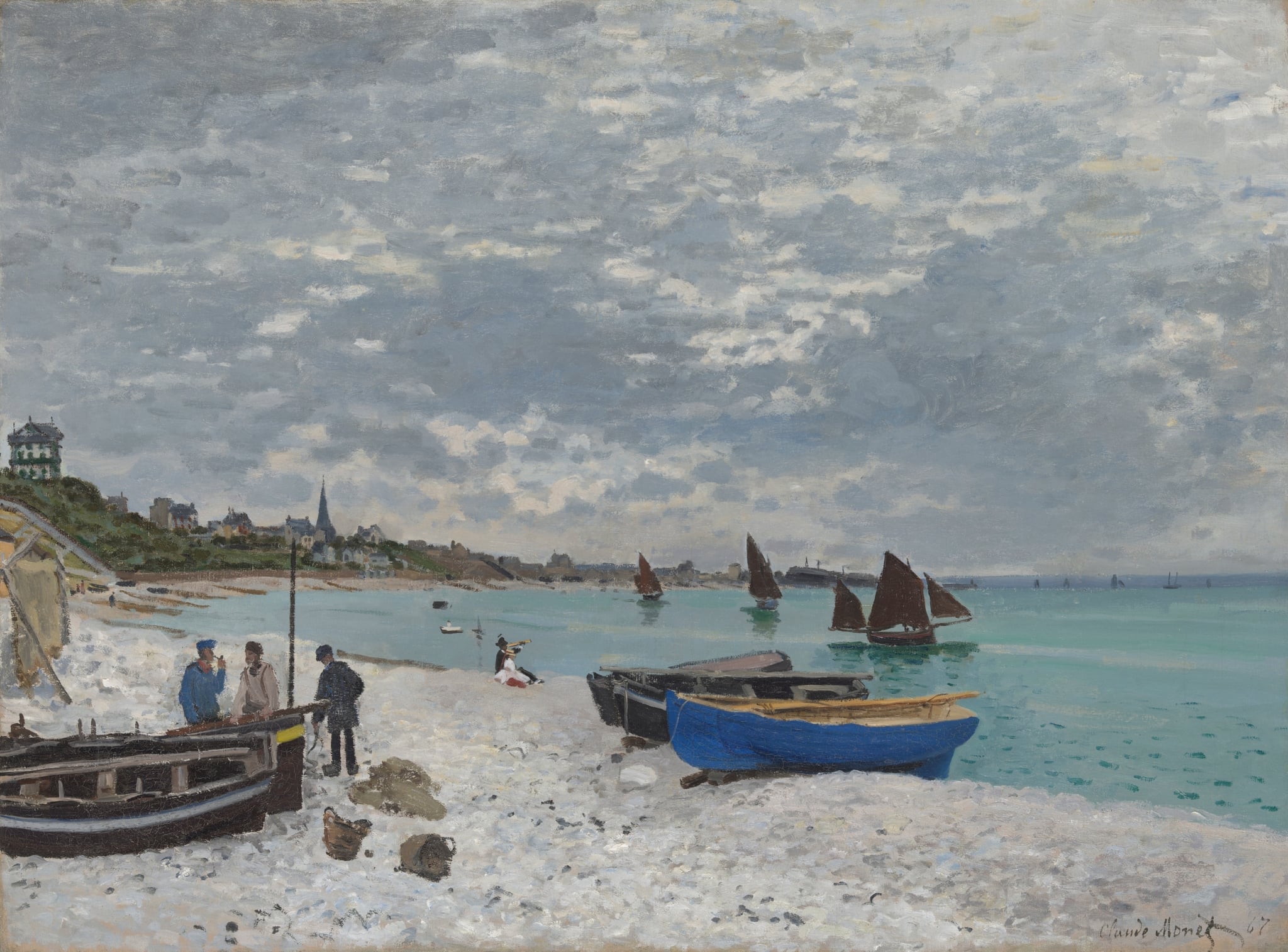
The Beach at Sainte-Adresse
Claude Monet (1867)
In The Beach at Sainte-Adresse, Claude Monet stages a modern shore where <strong>labor and leisure intersect</strong> under a broad, changeable sky. The bright <strong>blue beached boat</strong> and the flotilla of <strong>rust-brown working sails</strong> punctuate a turquoise channel, while a fashionably dressed pair sits mid-beach, spectators to the traffic of the port. Monet’s brisk, broken strokes make the scene feel <strong>caught between tides and weather</strong>, a momentary balance of work, tourism, and atmosphere <sup>[1]</sup><sup>[2]</sup>.
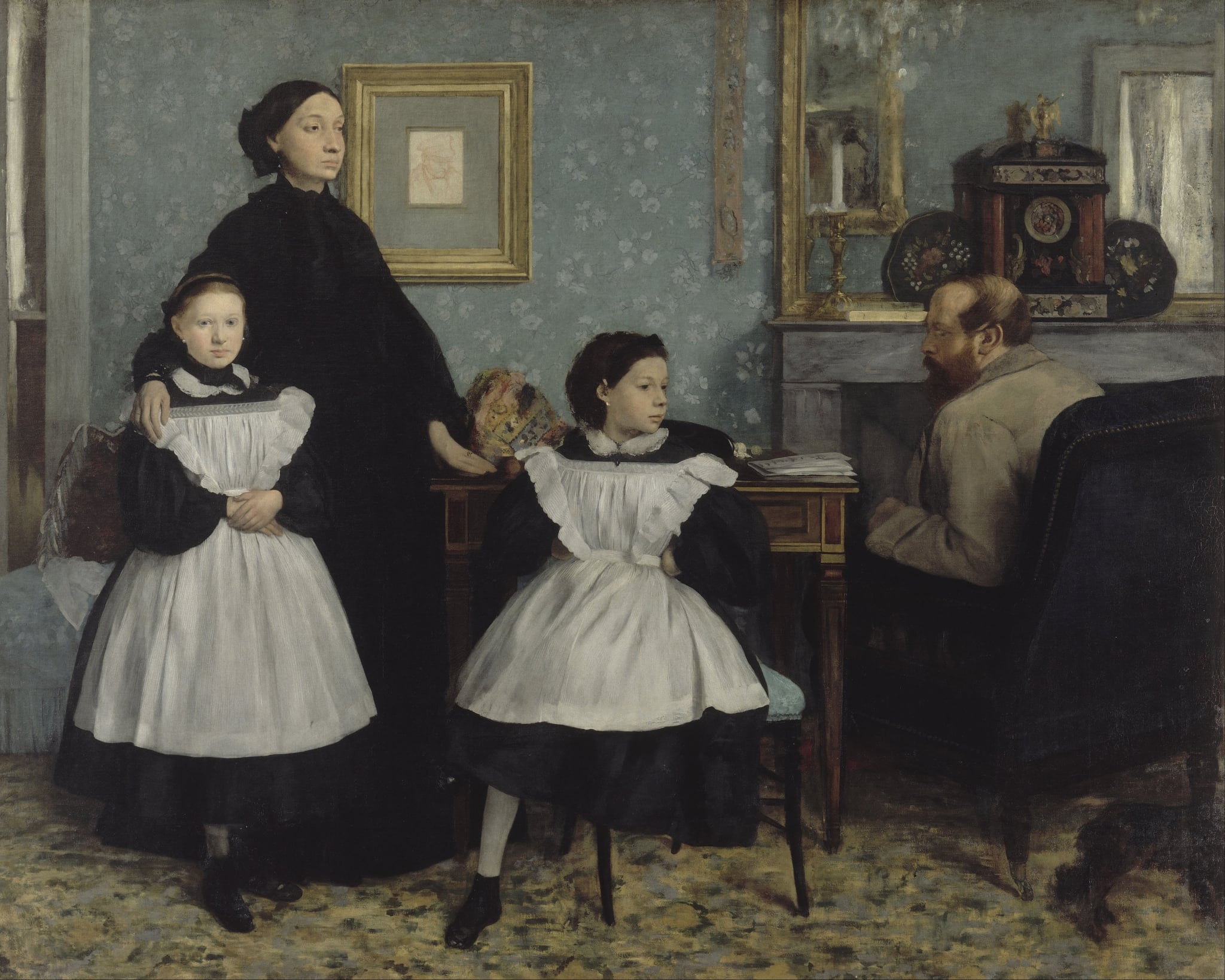
The Bellelli Family
Edgar Degas (1858–1869)
In The Bellelli Family, Edgar Degas orchestrates a poised domestic standoff, using the mother’s column of <strong>mourning black</strong>, the daughters’ <strong>mediating whiteness</strong>, and the father’s turned-away profile to script roles and distance. Rigid furniture lines, a gilt <strong>clock</strong>, and the ancestor’s red-chalk portrait create a stage where time, duty, and inheritance press on a family held in uneasy equilibrium.
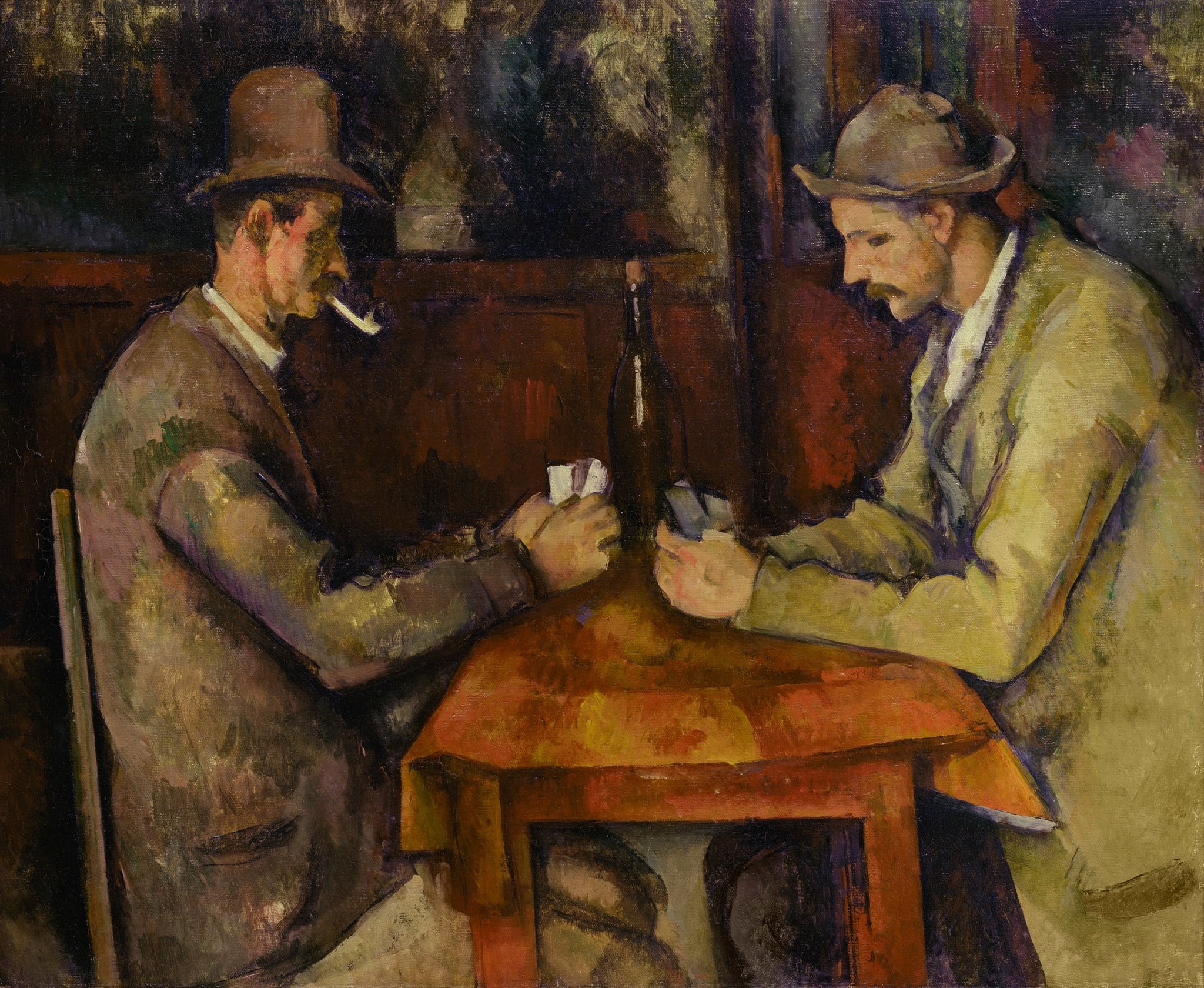
The Card Players by Paul Cézanne | Equilibrium and Form
Paul Cézanne
In The Card Players, Paul Cézanne turns a rural café game into a study of <strong>equilibrium</strong> and <strong>monumentality</strong>. Two hated peasants lean inward across an orange-brown table while a dark bottle stands upright between them, acting as a calm, vertical <strong>axis</strong> that stabilizes their mirrored focus <sup>[2]</sup><sup>[3]</sup>.

The Creation of Adam
Michelangelo (c.1511–1512)
Michelangelo’s The Creation of Adam crystallizes the instant before life is conferred, staging a charged interval between two nearly touching hands. The fresco turns Genesis into a study of <strong>imago Dei</strong>, bodily perfection, and the threshold between inert earth and <strong>active spirit</strong> <sup>[1]</sup><sup>[2]</sup>.
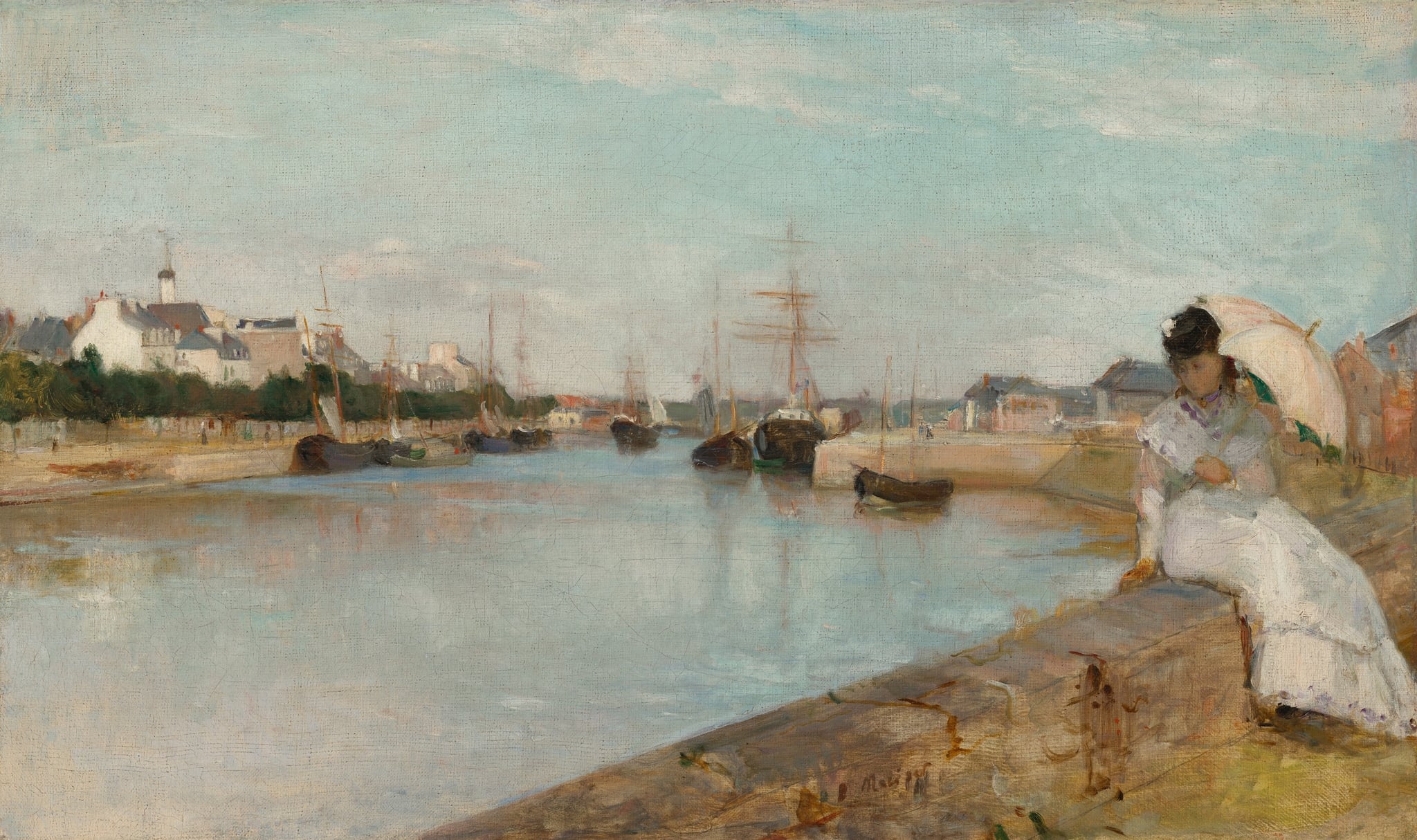
The Harbour at Lorient
Berthe Morisot (1869)
Berthe Morisot’s The Harbour at Lorient stages a quiet tension between <strong>private reverie</strong> and <strong>public movement</strong>. A woman under a pale parasol sits on the quay’s stone lip while a flotilla of masted boats idles across a silvery basin, their reflections dissolving into light. Morisot’s <strong>pearly palette</strong> and brisk brushwork make the water read as time itself, holding stillness and departure in the same breath <sup>[1]</sup>.
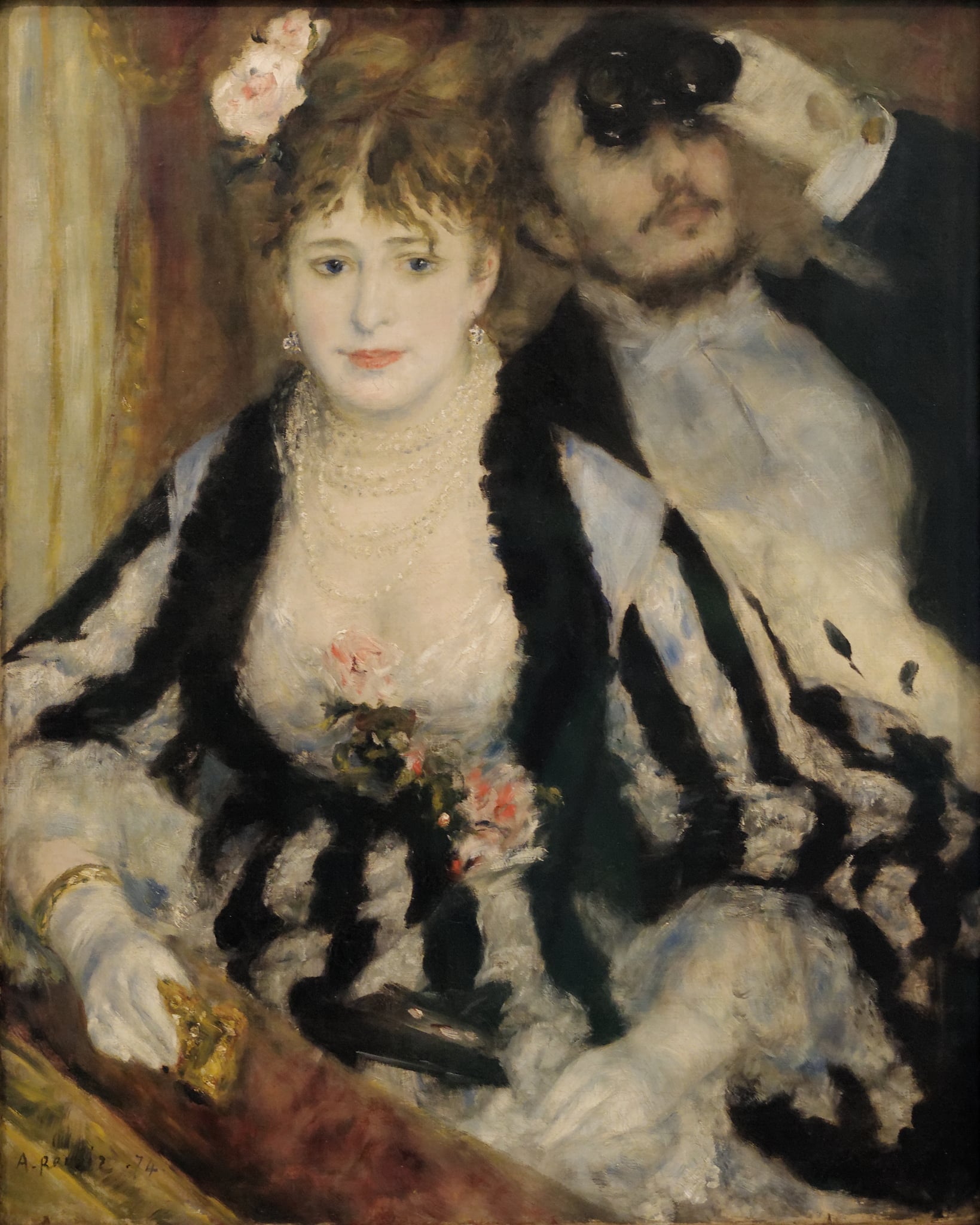
The Loge
Pierre-Auguste Renoir (1874)
Renoir’s The Loge (1874) turns an opera box into a <strong>stage of looking</strong>, where a woman meets our gaze while her companion scans the crowd through binoculars. The painting’s <strong>frame-within-a-frame</strong> and glittering fashion make modern Parisian leisure both alluring and self-conscious, turning spectators into spectacles <sup>[1]</sup><sup>[2]</sup>.

The Son of Man
Rene Magritte (1964)
Rene Magritte’s The Son of Man stages a crisp <strong>everyman</strong> in bowler hat and overcoat before a sea horizon while a <strong>green apple</strong> hovers to block his face. The tiny glimpse of one eye above the fruit turns a straightforward portrait into a <strong>riddle about seeing and knowing</strong> <sup>[1]</sup><sup>[2]</sup>.
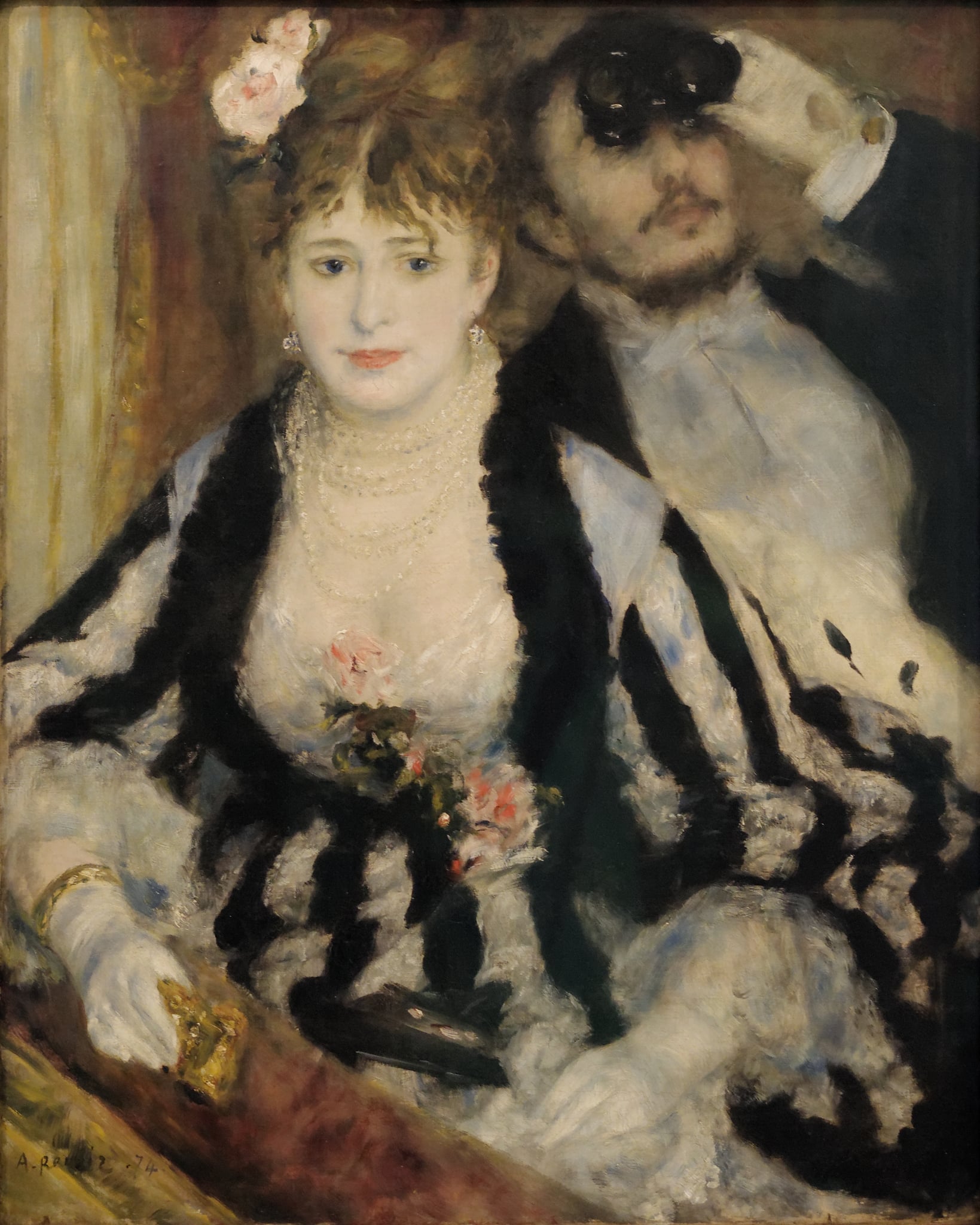
The Theater Box
Pierre-Auguste Renoir (1874)
Renoir’s The Theater Box turns a plush loge into a stage where seeing becomes the performance. A luminous woman—pearls, pale gloves, black‑and‑white stripes—faces us, while her companion scans the auditorium through opera glasses. The painting crystallizes Parisian <strong>modernity</strong> and the choreography of the <strong>gaze</strong> <sup>[1]</sup><sup>[5]</sup>.
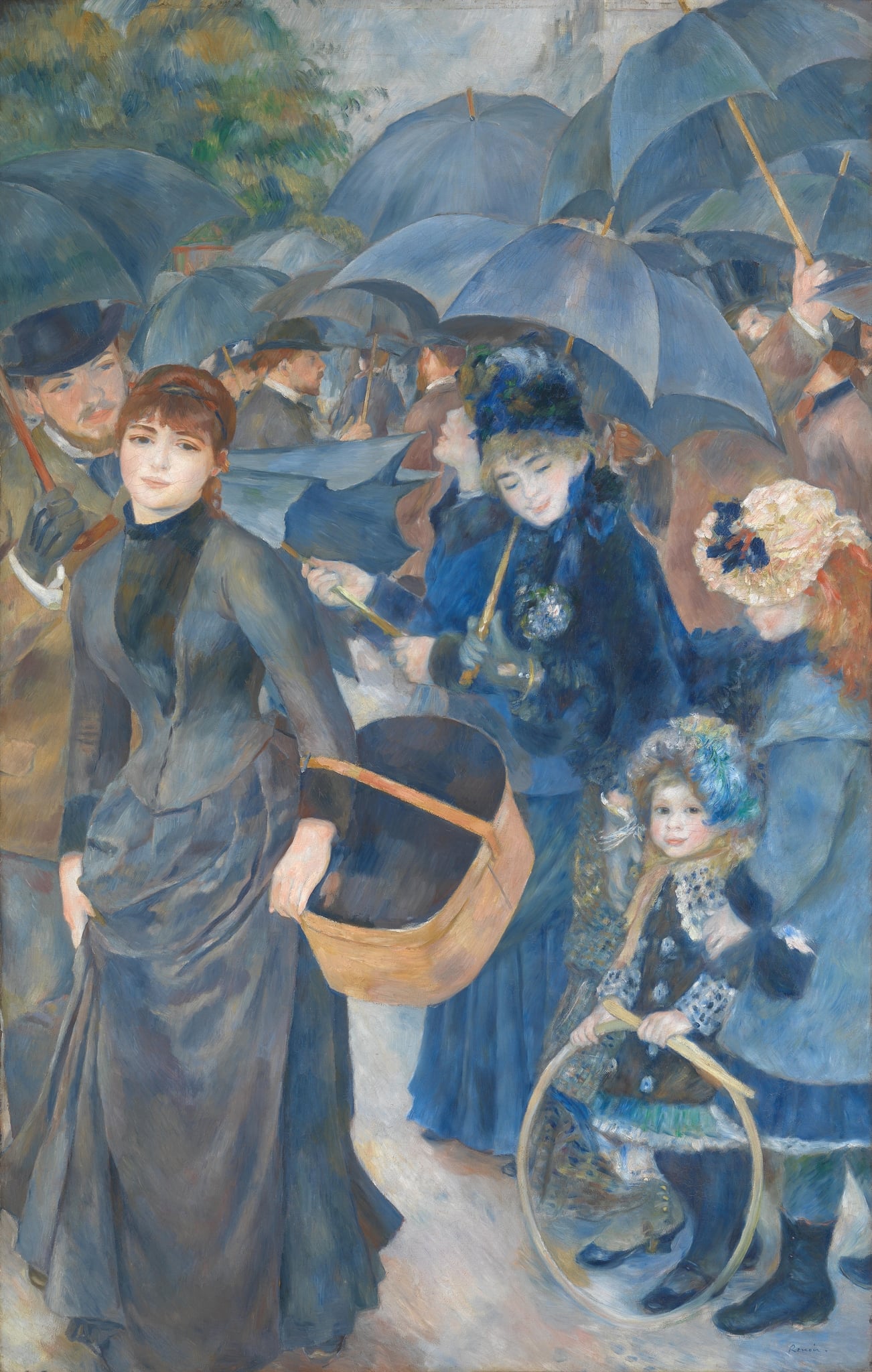
The Umbrellas
Pierre-Auguste Renoir (about 1881–86)
A sudden shower turns a Paris street into a lattice of <strong>slate‑blue umbrellas</strong>, knitting strangers into a single moving frieze. A bareheaded young woman with a <strong>bandbox</strong> strides forward while a bourgeois mother and children cluster at right, their <strong>hoop</strong> echoing the umbrellas’ arcs <sup>[1]</sup><sup>[5]</sup>.
Woman Reading
Édouard Manet (1880–82)
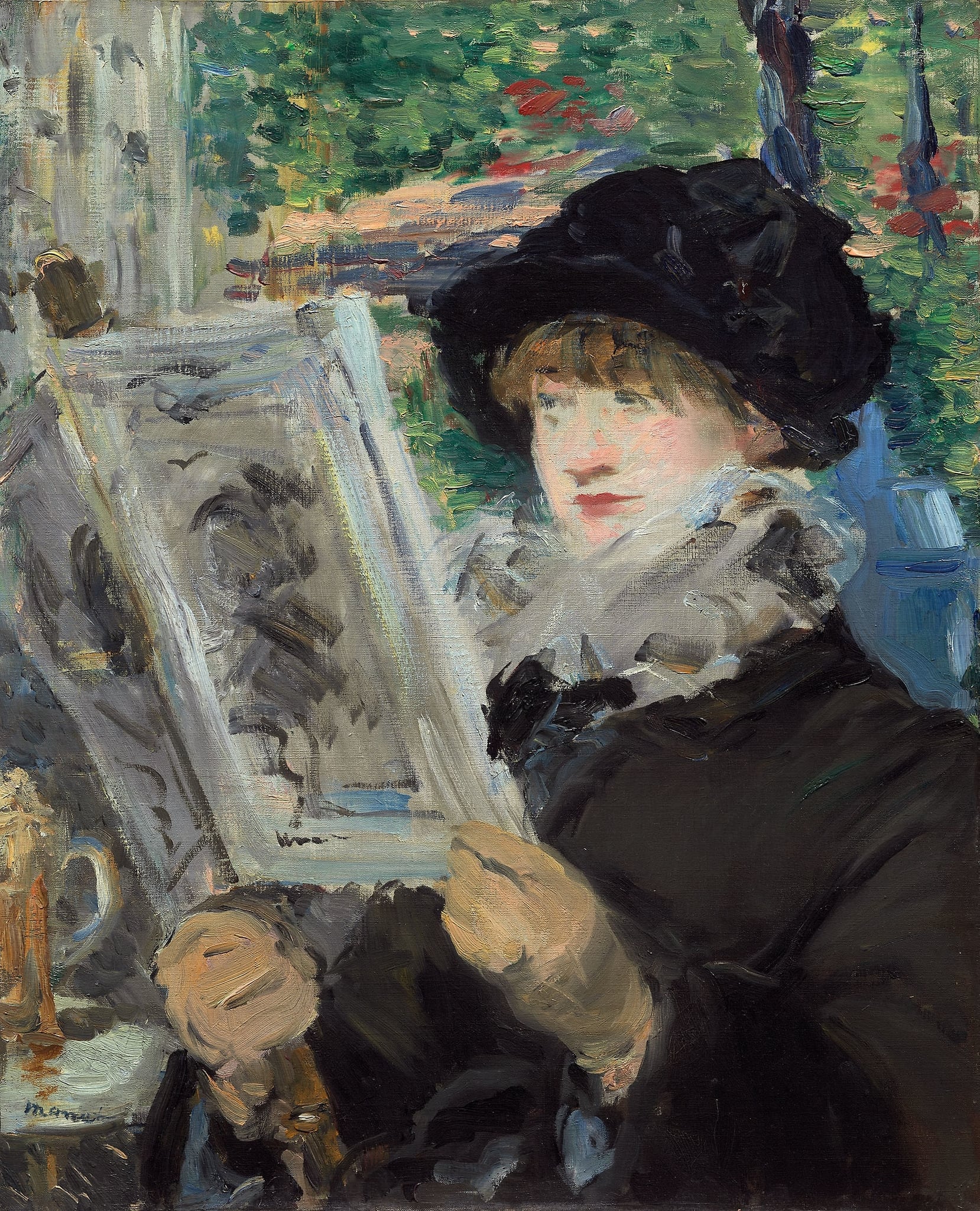
Manet’s Woman Reading distills a fleeting act into an emblem of <strong>modern self-possession</strong>: a bundled figure raises a journal-on-a-stick, her luminous profile set against a brisk mosaic of greens and reds. With quick, loaded strokes and a deliberately cropped <strong>beer glass</strong> and paper, Manet turns perception itself into subject—asserting the drama of a private mind within a public café world <sup>[1]</sup><sup>[2]</sup>.
Related Themes
Related Symbolism Categories
Interiority
“Interiority” symbols in modern painting transform gesture, gaze, and domestic props into visual indices of inward life, staging psychological depth, self-consciousness, and mediated subjectivity within scenes of everyday modernity.
Figure
Figure symbolism in modern painting turns the human body into a calibrated sign-system in which posture, gesture, and gaze encode shifting relations among desire, labor, authority, and spectatorship.
Symbolism
The Symbolism category here traces how modern and contemporary artists redeploy a heterogeneous repertoire of signs—from religious mirrors and dynastic portraits to tricolor flags and corporate emblems—to interrogate vision, power, national identity, and consumer culture across changing regimes of representation.
Within Western art history, the visualization of identity has shifted from heraldic and dynastic markers to the subtler, often unstable codes of modern subjectivity. If early portraiture grounded identity in lineage, office, or sacramental status, nineteenth- and twentieth-century images increasingly staged the self as something negotiated in public spaces, consumer culture, and spectacle. The symbols gathered under this category chart that transition. They show how a lace cap, a black suit, a beauty mark, or a direct gaze can operate not as mere accessory or likeness but as a semiotic device, articulating the tensions between individuality and the social scripts that constrain it.
Several motifs here signal identity as a function of class and social role rather than interior essence. In Gustave Caillebotte’s Paris Street; Rainy Day, the centrally placed couple crystallizes the type of the bourgeois flâneur and his companion. Their tailored overcoat, fitted dress, and shared umbrella transform them into emblems of middle-class modernity: they are not portraits in the narrow sense but embodiments of a class-coded way of moving and seeing in the Haussmannized city. The very anonymity of their faces, subordinated to the clear legibility of costume and carriage, aligns them with the bowler hat elsewhere in this category—sign of bourgeois anonymity and the “everyman” persona. Identity here is standardized; clothing and comportment absorb the subject into a regulated urban order reinforced by the gridded façades and the central gas lamp that “calibrates” the space.
A comparable logic governs the cameo brooch and high collar in Grant Wood’s American Gothic. The woman’s modest ornament and tightly fastened neckline encode inherited codes and propriety within the household, aligning her with a long genealogy of female domestic virtue. Semiologically, the cameo functions like a miniature ancestral portrait: it condenses lineage and moral expectation into a small, luminous node at the throat. Wood’s cool precision rhymes this ornament with the pitchfork’s tines and the Carpenter Gothic window, so that personal identity appears sutured to a broader regime of work, doctrine, and respectability. Unlike Caillebotte’s promenading couple, immobilized in motion, Wood’s pair is frozen in frontal declaration; yet both works show how sartorial details legislate the self in relation to class and region.
Other symbols foreground identity as performance on the porous boundary between public persona and commodity. Édouard Manet’s A Bar at the Folies-Bergère is exemplary in this respect. The barmaid Suzon stands as the human face of urban commerce: she is at once salesperson and potential commodity, the mediator between viewer and marketplace. Her lipstick-red mouth and carefully arranged coiffure operate as instantly legible brand cues, aligning the body with the branded bottles and oranges that surround her. The semiotics of identity here are transactional. Her bareheaded, frontal presence—unlike the fashionably hatted women in other modern sites of leisure—marks both an exposure and a stripping-away of bourgeois ornament, as though her social role must be visibly available for purchase. The skewed mirror behind her, in which a male customer appears only as reflection, further complicates authorship and agency: the artist’s inscription and virtual “signature” are displaced into the apparatus of looking itself, suggesting that modern subjectivity is something refracted by institutions of display and exchange.
Henri de Toulouse-Lautrec’s Jane Avril sharpens this logic of persona-as-construction. The sitter’s mask-like, high-keyed face—the lemon yellow, lilac, and carmine planes that hover between cosmetics and stage lighting—foregrounds theatrical identity, a face made to be seen from a distance. Her sweeping cloak and flamboyant hat, conjured with a minimum of strokes, reduce the celebrity performer to a silhouette that the viewer “completes” in the act of looking. Here identity is almost purely iconographic: Avril becomes a logo-like figure, akin to the beauty mark as “trademark-like identifier,” a cluster of cues that circulates in posters, gossip, and memory. Lautrec’s economy of means declares that this persona is not stable character but a repeatable image, a function of nightlife and publicity.
Against these public, often commodified selves, several symbols insist on interiority and a more autonomous modern subject. Berthe Morisot’s women—whether the seated figure in white at Lorient (cited in the definition) or the pair in Summer’s Day—are defined by a complex relation between visibility and inwardness. The seated woman in a white dress, in particular, embodies modern contemplative agency in a public setting. Her bright costume catches and reflects ambient light, making her conspicuous; yet her posture and absorbed gaze render that conspicuousness paradoxically private. White, traditionally associated with purity and decorum, becomes a reflective surface for thought, just as the ruff in early modern portraiture framed and spotlighted the attentive, reading subject. Here, however, the ruff’s rigid architecture is replaced by the mobile flicker of Impressionist brushwork. Identity is no longer guaranteed by fixed costume alone but by a shifting interplay of light, environment, and self-possession.
Gendered decorum and regulated touch form another axis within this symbolic system. In Renoir’s Dance in the City, the man’s black tailcoat embodies masculine decorum and restraint, literally framing the woman’s luminous white satin gown. The couple’s embrace is licensed, even choreographed, by etiquette: opera-length white gloves function as emblems of propriety and as instruments that both enable and limit touch. The symbols work in concert: gloves, tailcoat, and train articulate a choreography in which desire must pass through the filter of social codes. The woman’s identity is produced at the junction of these materials—satin, kid leather, polished black cloth—while the man’s more anonymous figure recalls the black suit and tight tie as an emblem of impersonal social role. Renoir’s painting thus stages ballroom ritual as a matrix in which individual feeling negotiates the demands of presentation.
Children’s dress and posture complicate these scripts of adulthood. In Renoir’s Children on the Seashore, Guernsey, the boy’s sailor suit and the central girl’s black feathered hat encode modern seaside leisure and up-to-date urban taste. The sailor suit, adapted from naval uniforms, grants the child a quasi-professional identity linked to maritime life, yet within a context of play. Similarly, the girl’s fashionable hat aligns her with adult femininity while her role—steadying a toddler—marks an emergent, not yet fully realized, social agency. Here symbols of identity operate prospectively: costume foreshadows the roles these children will inhabit, and the painting’s shimmering light underscores the provisional, transitional nature of that process.
Across these examples, one can trace an evolution in the function of identity symbols. Early modern devices such as ruffs, cameo brooches, and high collars assert continuity—lineage, doctrine, propriety—anchoring the subject within stable hierarchies. By the later nineteenth century, hats, gloves, black suits, and cosmetics mediate an increasingly fragmented urban experience, in which identity must be legible at a glance yet remains internally uncertain. The barmaid’s branded persona, the flâneur’s standardized silhouette, the theatrical mask of the performer, and the introspective woman in white all reveal identity as a field of negotiation between social codes and personal agency. As artists moved into modernity, these symbols ceased to be mere badges of status; they became tools for interrogating how selves are fashioned, displayed, disciplined, and, at times, estranged in the very act of being seen.