Gesture
Gesture in modern painting operates as a charged system of signs in which the smallest inflection of hand, arm, or posture encodes shifting relations of intimacy, labor, authority, and selfhood, reworking a long iconographic tradition for a newly self-conscious age of looking.
Member Symbols
Featured Artworks
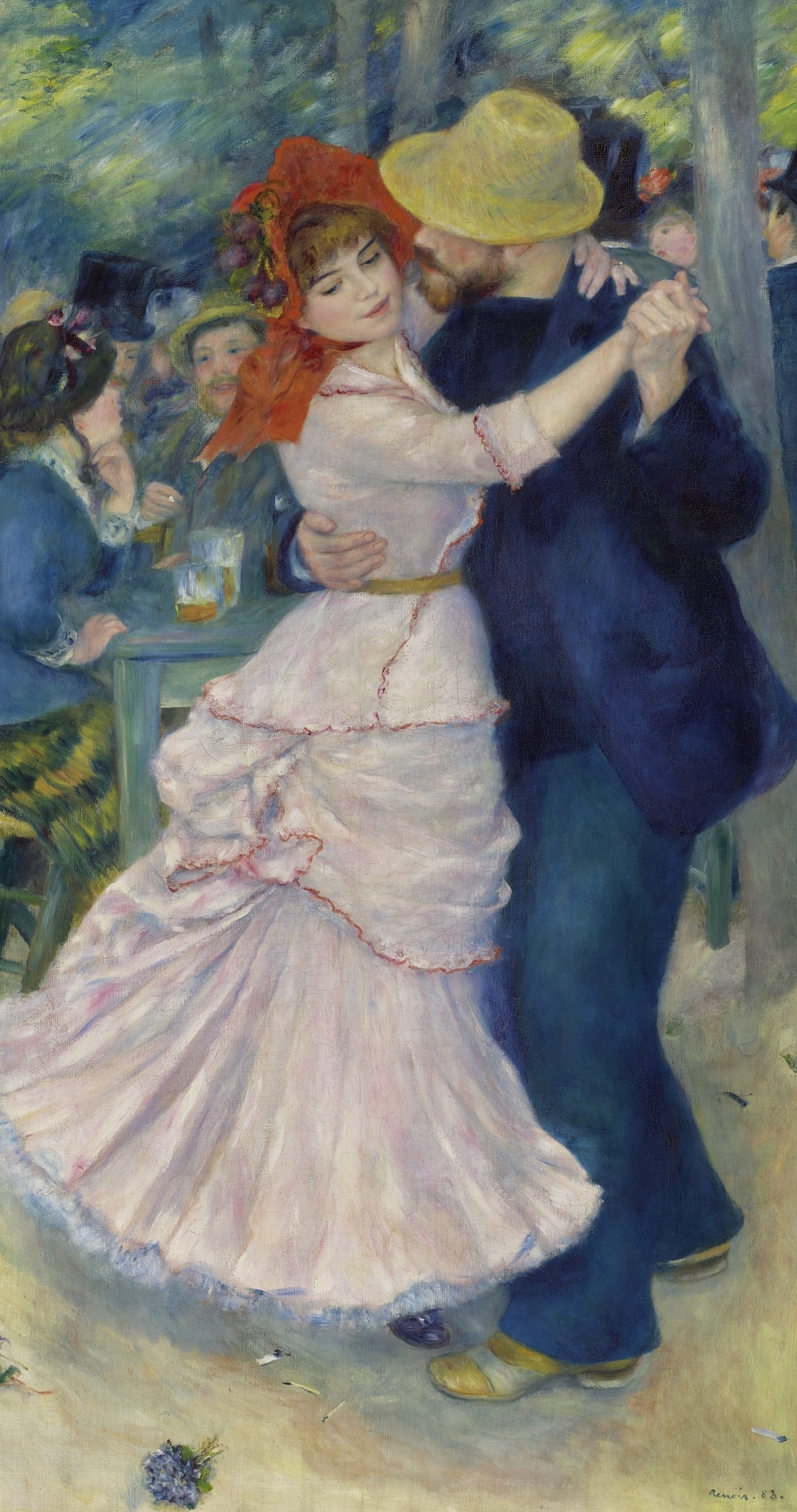
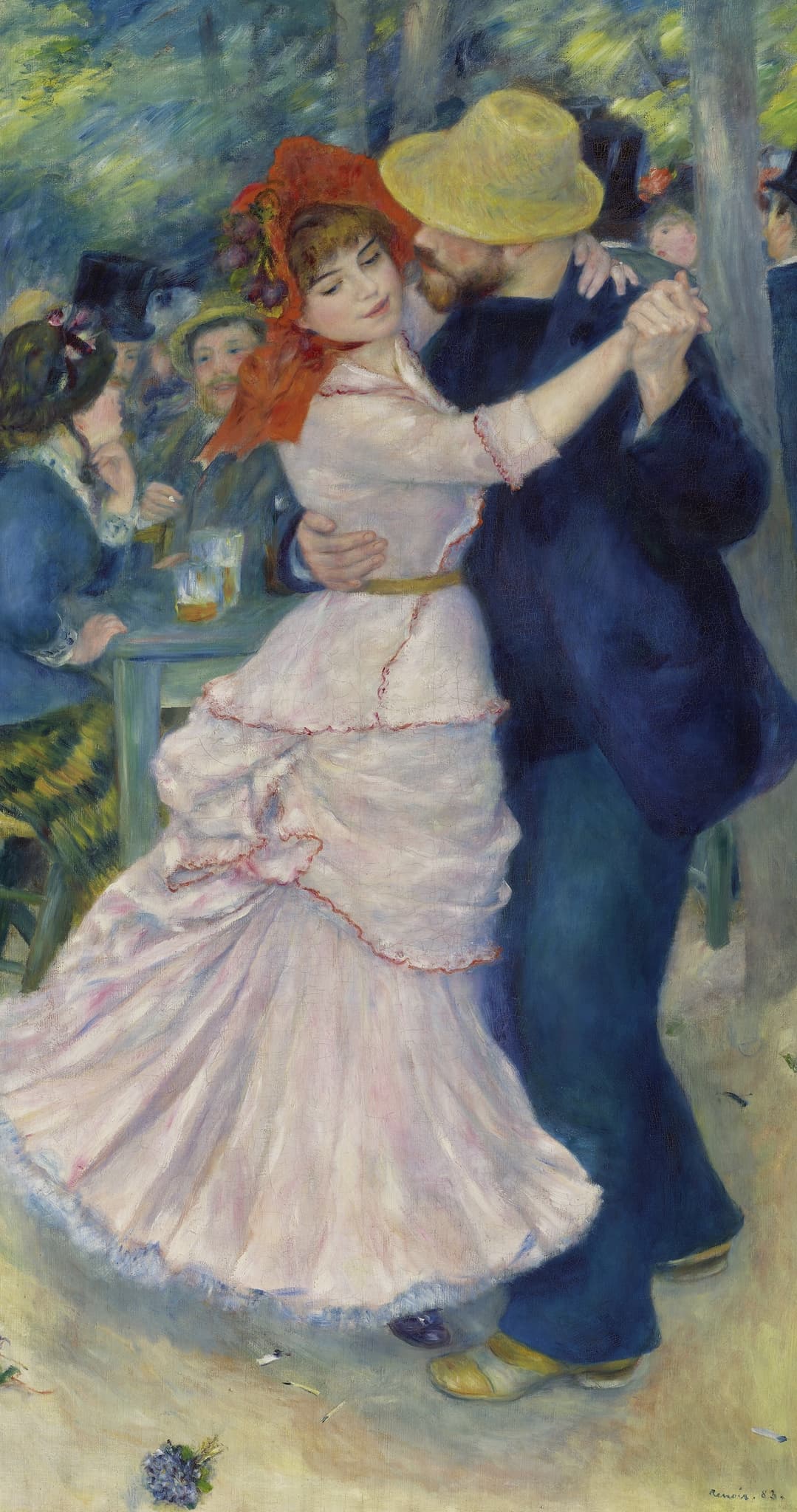
Dance at Bougival
Pierre-Auguste Renoir (1883)
In Dance at Bougival, Pierre-Auguste Renoir turns a crowded suburban dance into a <strong>private vortex of intimacy</strong>. Rose against ultramarine, skin against shade, and a flare of the woman’s <strong>scarlet bonnet</strong> concentrate the scene’s energy into a single turning moment—modern leisure made palpable as <strong>touch, motion, and light</strong> <sup>[1]</sup><sup>[2]</sup>.
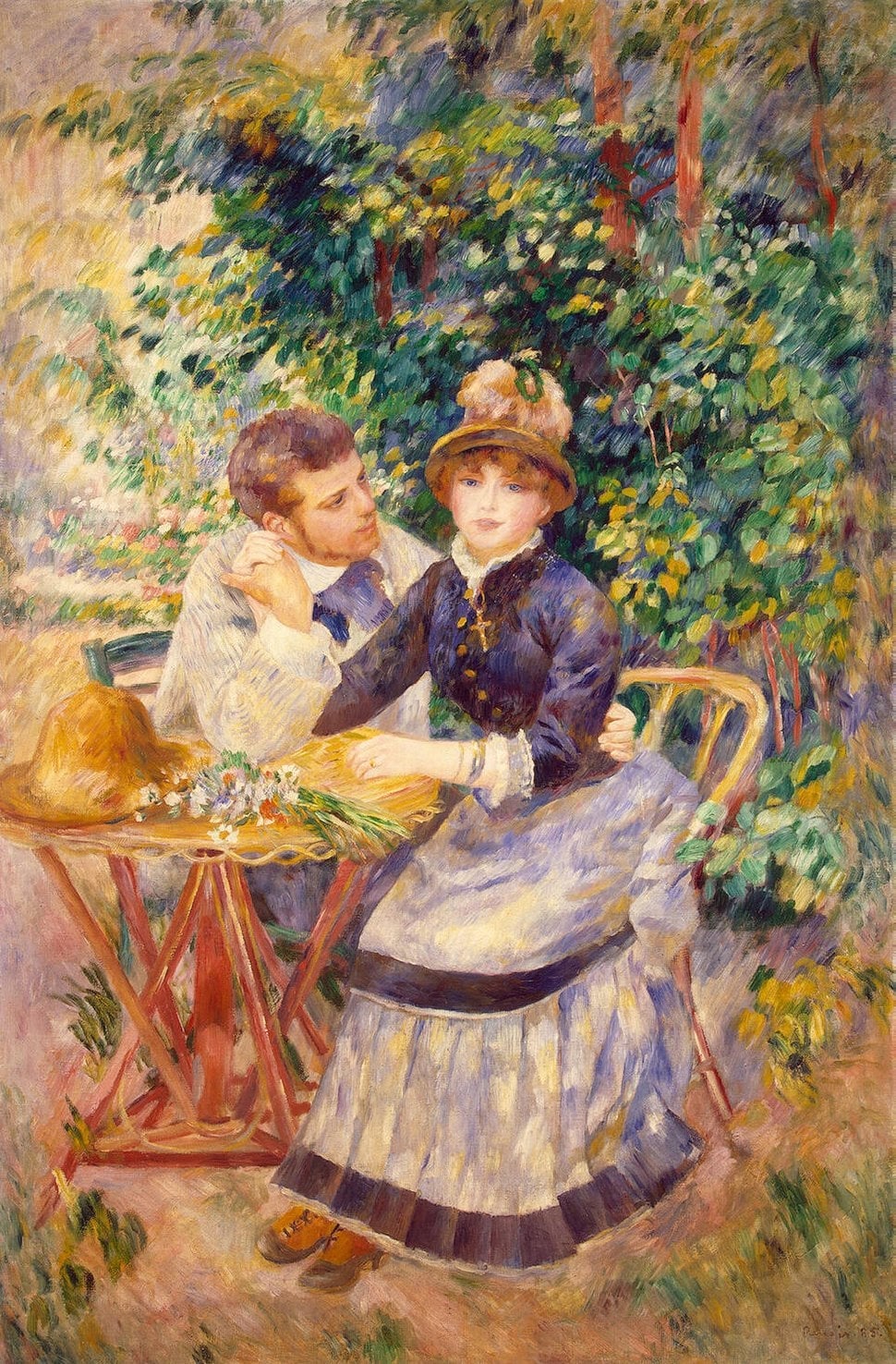
In the Garden
Pierre-Auguste Renoir (1885)
In the Garden presents a charged pause in modern leisure: a young couple at a café table under a living arbor of leaves. Their lightly clasped hands and the bouquet on the tabletop signal courtship, while her calm, front-facing gaze checks his lean. Renoir’s flickering brushwork fuses figures and foliage, rendering love as a <strong>transitory, luminous sensation</strong> <sup>[1]</sup><sup>[3]</sup>.
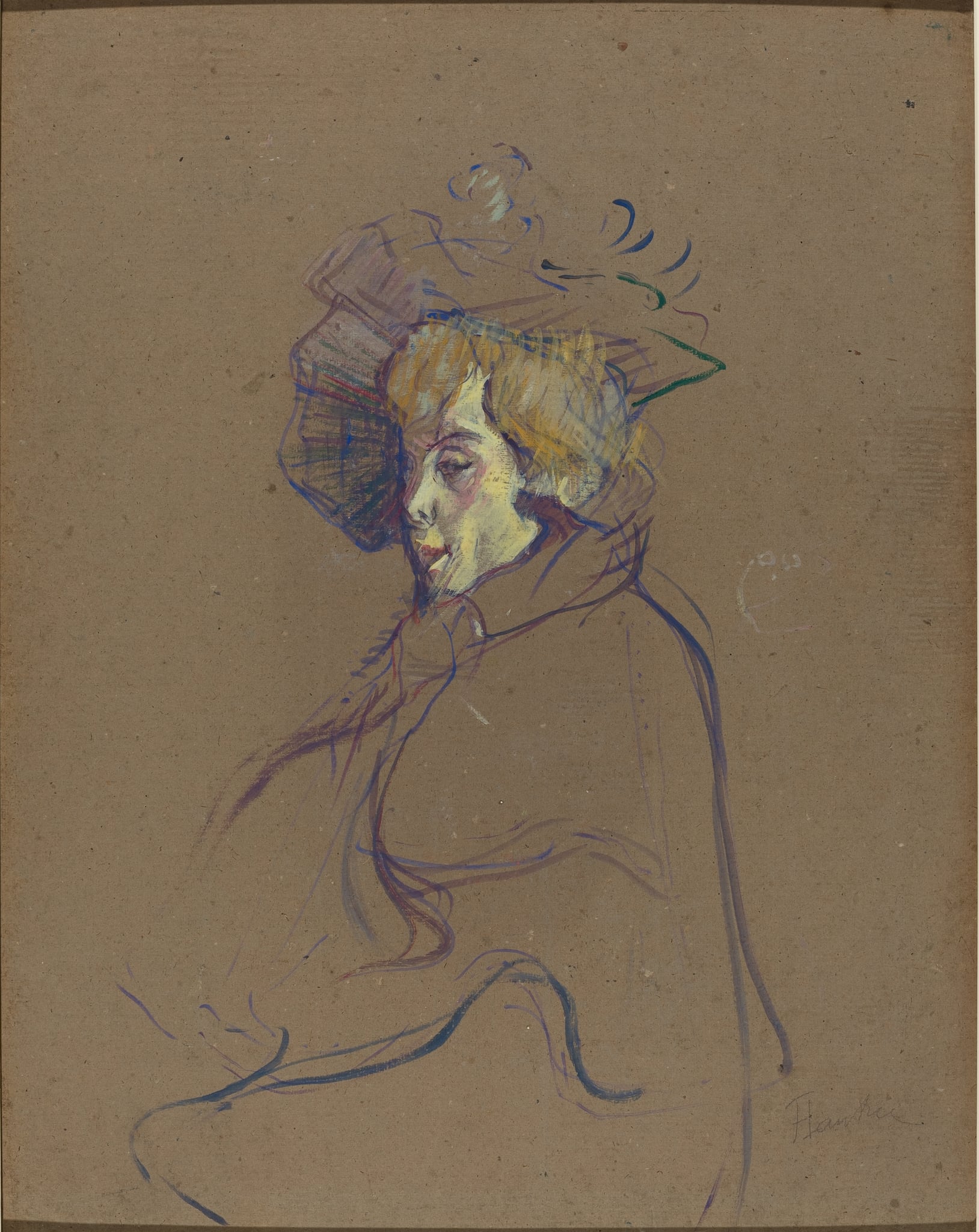
Jane Avril
Henri de Toulouse-Lautrec (c. 1891–1892)
In Jane Avril, Henri de Toulouse-Lautrec crystallizes a public persona from a few <strong>urgent, chromatic strokes</strong>: violet and blue lines whirl into a cloak, while green and indigo dashes crown a buoyant hat. Her face—sharply keyed in <strong>lemon yellow, lilac, and carmine</strong>—hovers between mask and likeness, projecting poise edged with fatigue. The raw brown ground lets her <strong>whiplash silhouette</strong> materialize like smoke from Montmartre’s nightlife.
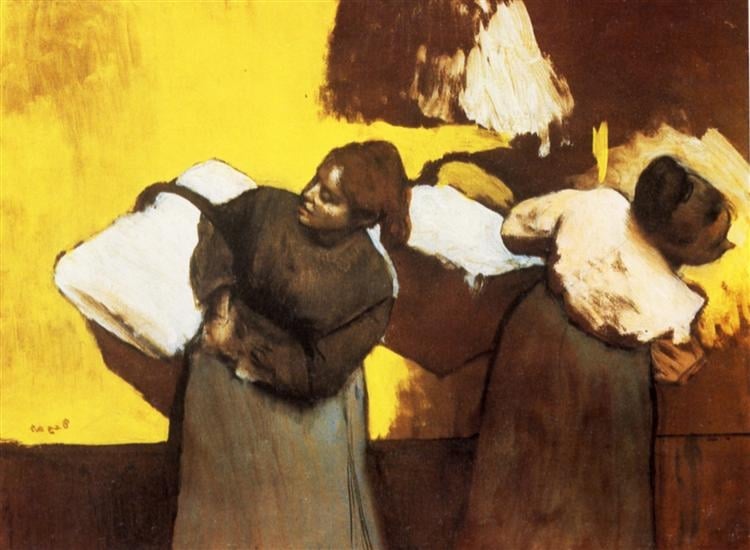
Laundresses Carrying Linen in Town
Camille Pissarro (1879)
In Laundresses Carrying Linen in Town, two working women strain under <strong>white bundles</strong> that flare against a <strong>flat yellow ground</strong> and a <strong>dark brown band</strong>. The abrupt cropping and opposing diagonals turn anonymous labor into a <strong>monumental, modern frieze</strong> of effort and motion.
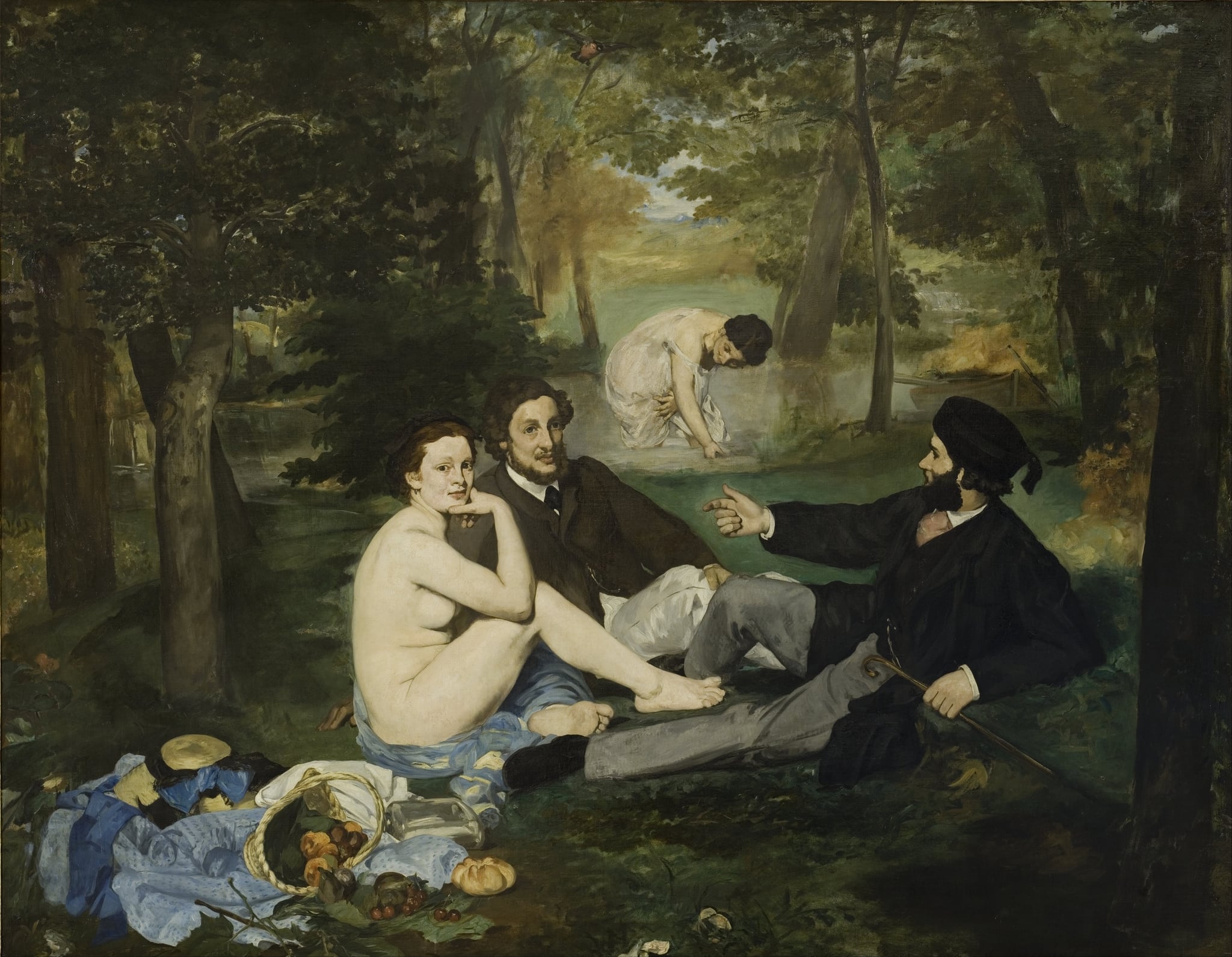
Luncheon on the Grass
Édouard Manet (1863)
Luncheon on the Grass stages a confrontation between <strong>modern Parisian leisure</strong> and <strong>classical precedent</strong>. A nude woman meets our gaze beside two clothed men, while a distant bather and an overturned picnic puncture naturalistic illusion. Manet’s scale and flat, studio-like light convert a park picnic into a manifesto of <strong>modern painting</strong> <sup>[1]</sup><sup>[2]</sup>.
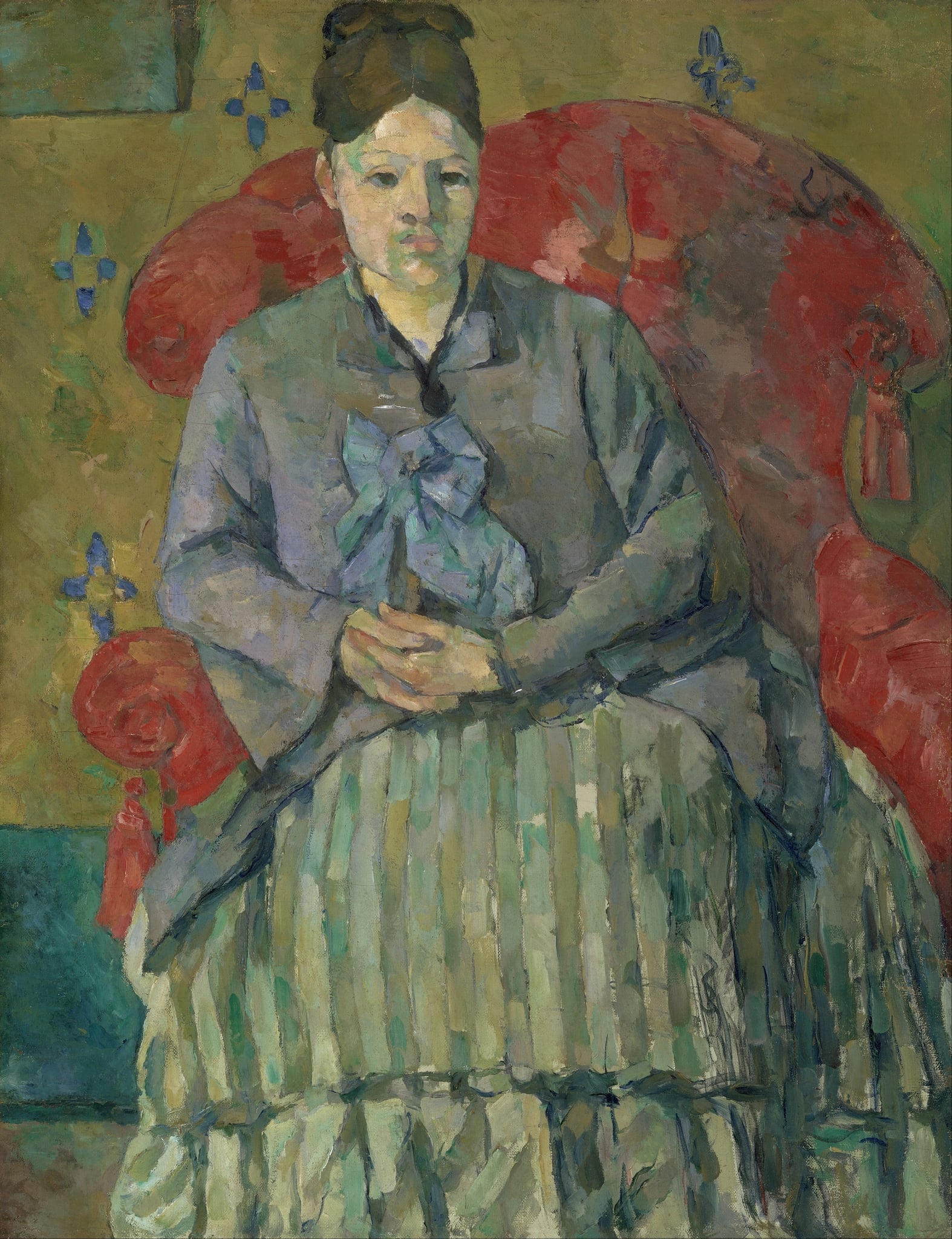
Madame Cézanne in a Red Armchair
Paul Cézanne (about 1877)
Paul Cézanne’s Madame Cézanne in a Red Armchair (about 1877) turns a domestic sit into a study of <strong>color-built structure</strong> and <strong>compressed space</strong>. Cool blue-greens of dress and skin lock against the saturated <strong>crimson armchair</strong>, converting likeness into an inquiry about how painting makes stability visible <sup>[1]</sup><sup>[3]</sup>.
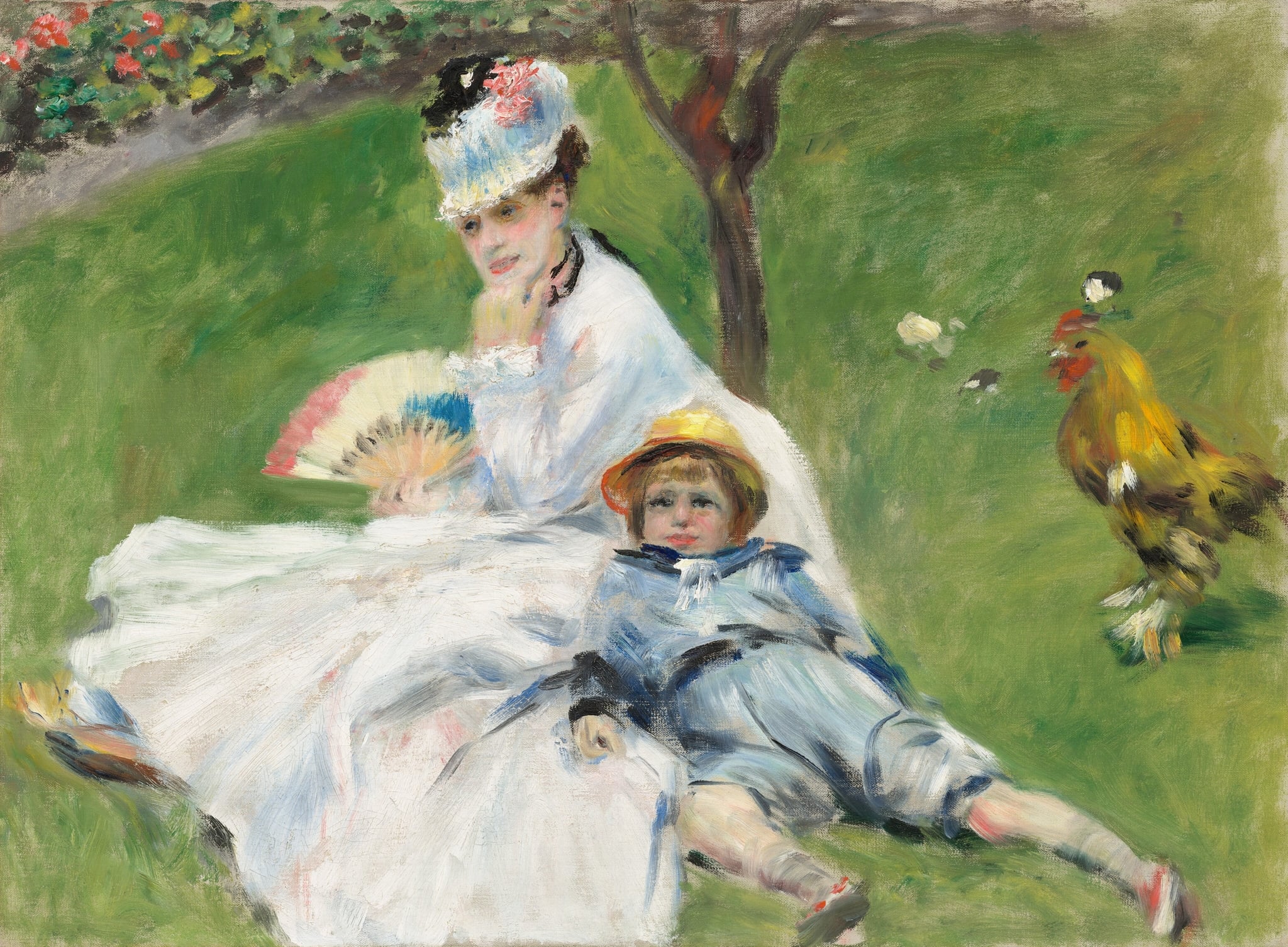
Madame Monet and Her Son
Pierre-Auguste Renoir (1874)
Renoir’s 1874 canvas Madame Monet and Her Son crystallizes <strong>modern domestic leisure</strong> and <strong>plein‑air immediacy</strong> in Argenteuil. A luminous white dress pools into light while a child in a pale‑blue sailor suit reclines diagonally; a strutting rooster punctuates the greens with warm color. The brushwork fuses figure and garden so the moment reads as <strong>lived, not staged</strong> <sup>[1]</sup><sup>[2]</sup><sup>[5]</sup>.

Olympia
Édouard Manet (1863 (Salon 1865))
A defiantly contemporary nude confronts the viewer with a steady gaze and a guarded pose, framed by crisp light and luxury trappings. In Olympia, <strong>Édouard Manet</strong> strips myth from the female nude to expose the <strong>modern economy of desire</strong>, power, and looking <sup>[1]</sup><sup>[3]</sup>.
Portrait of Dr. Gachet
Vincent van Gogh (1890)
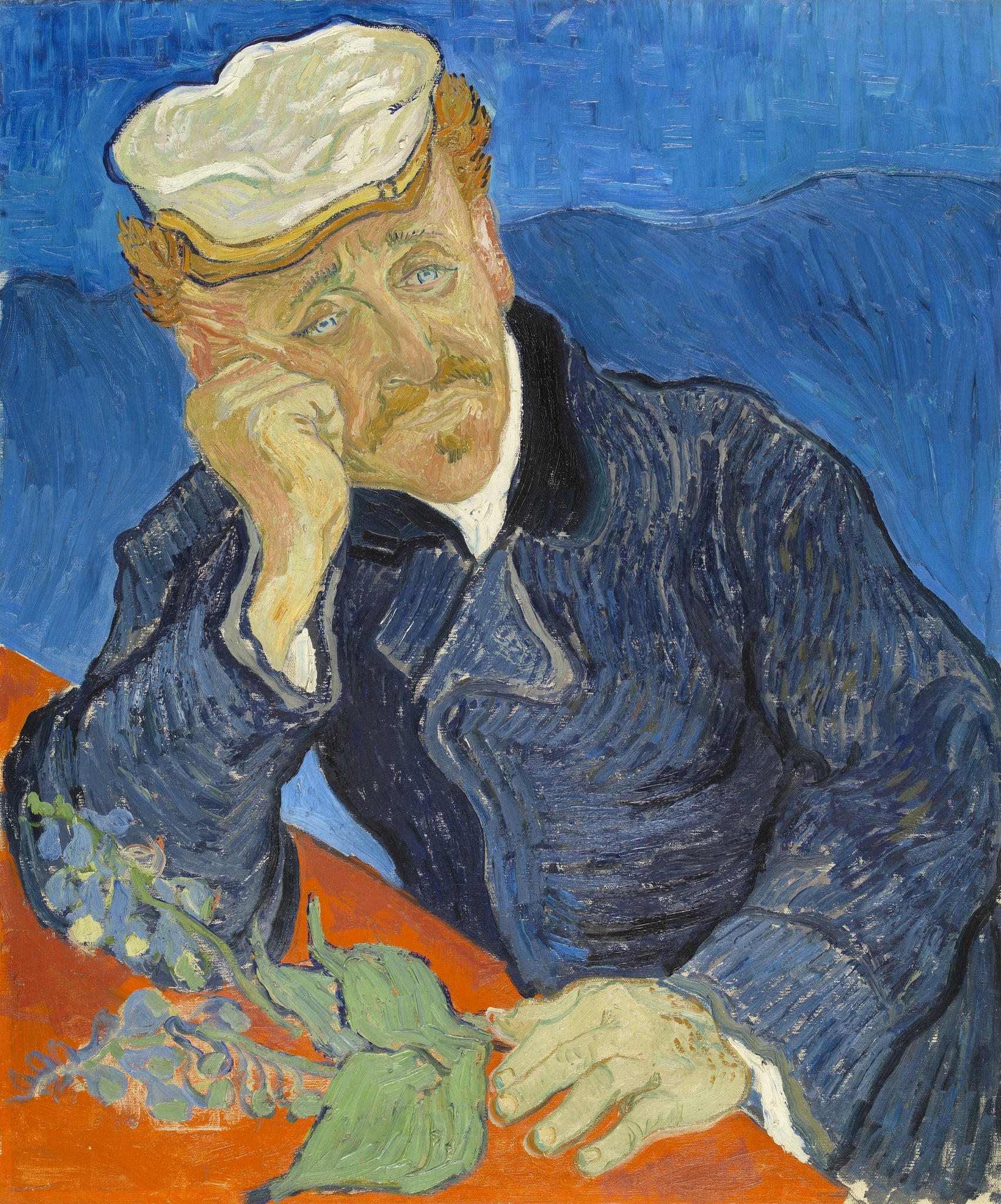
Portrait of Dr. Gachet distills Van Gogh’s late ambition for a <strong>modern, psychological portrait</strong> into vibrating color and touch. The sitter’s head sinks into a greenish hand above a <strong>blazing orange-red table</strong>, foxglove sprig nearby, while waves of <strong>cobalt and ultramarine</strong> churn through coat and background. The chromatic clash turns a quiet pose into an <strong>empathic image of fragility and care</strong> <sup>[1]</sup><sup>[2]</sup>.
The Boating Party
Mary Cassatt (1893–1894)
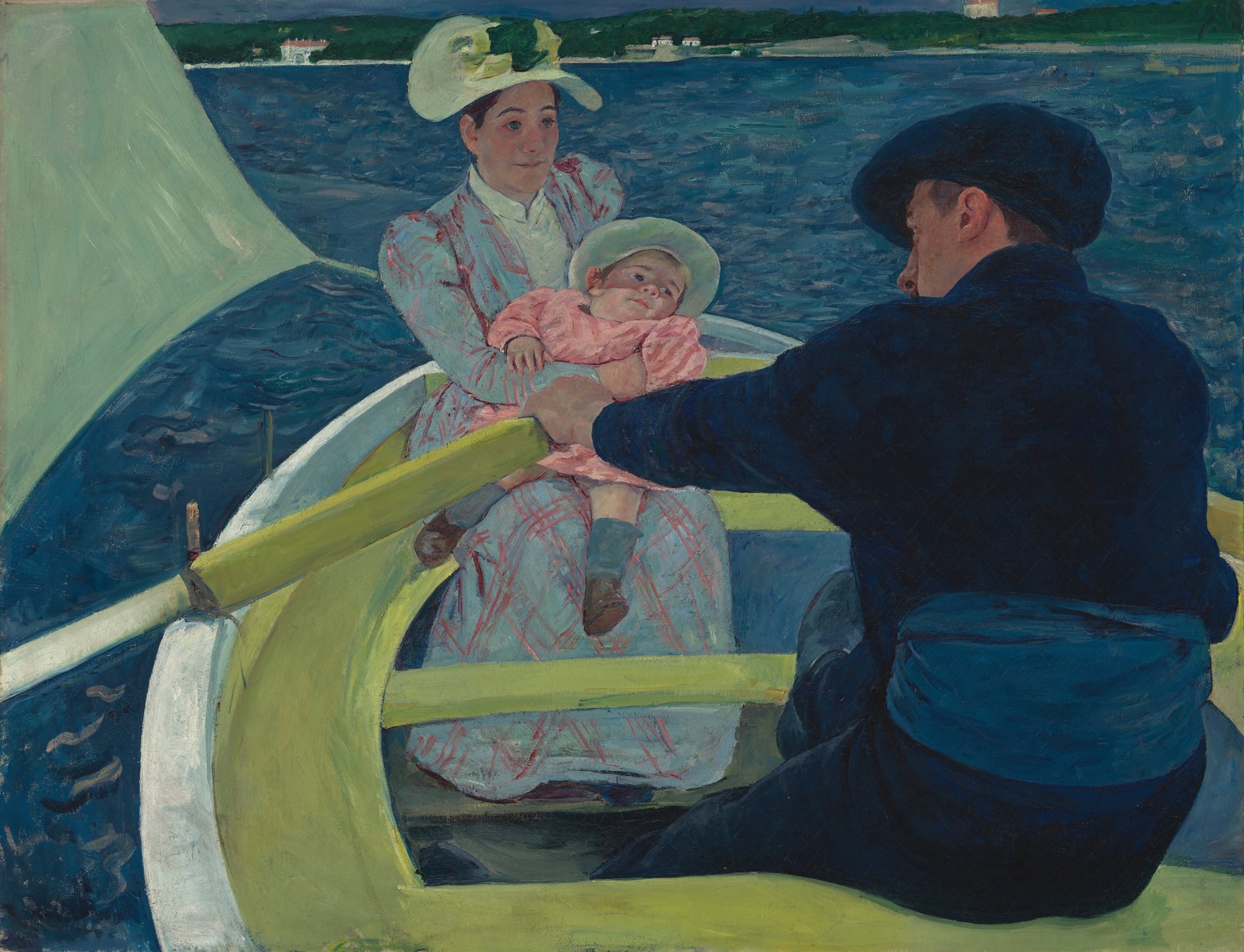
In The Boating Party, Mary Cassatt fuses <strong>intimate caregiving</strong> with <strong>modern mobility</strong>, compressing mother, child, and rower inside a skiff that cuts diagonals across ultramarine water. Bold arcs of citron paint and a high, flattened horizon reveal a deliberate <strong>Japonisme</strong> logic that stabilizes the scene even as motion surges around it <sup>[1]</sup>. The painting asserts domestic life as a public, modern subject while testing the limits of Impressionist space and color.
The Child's Bath
Mary Cassatt (1893)
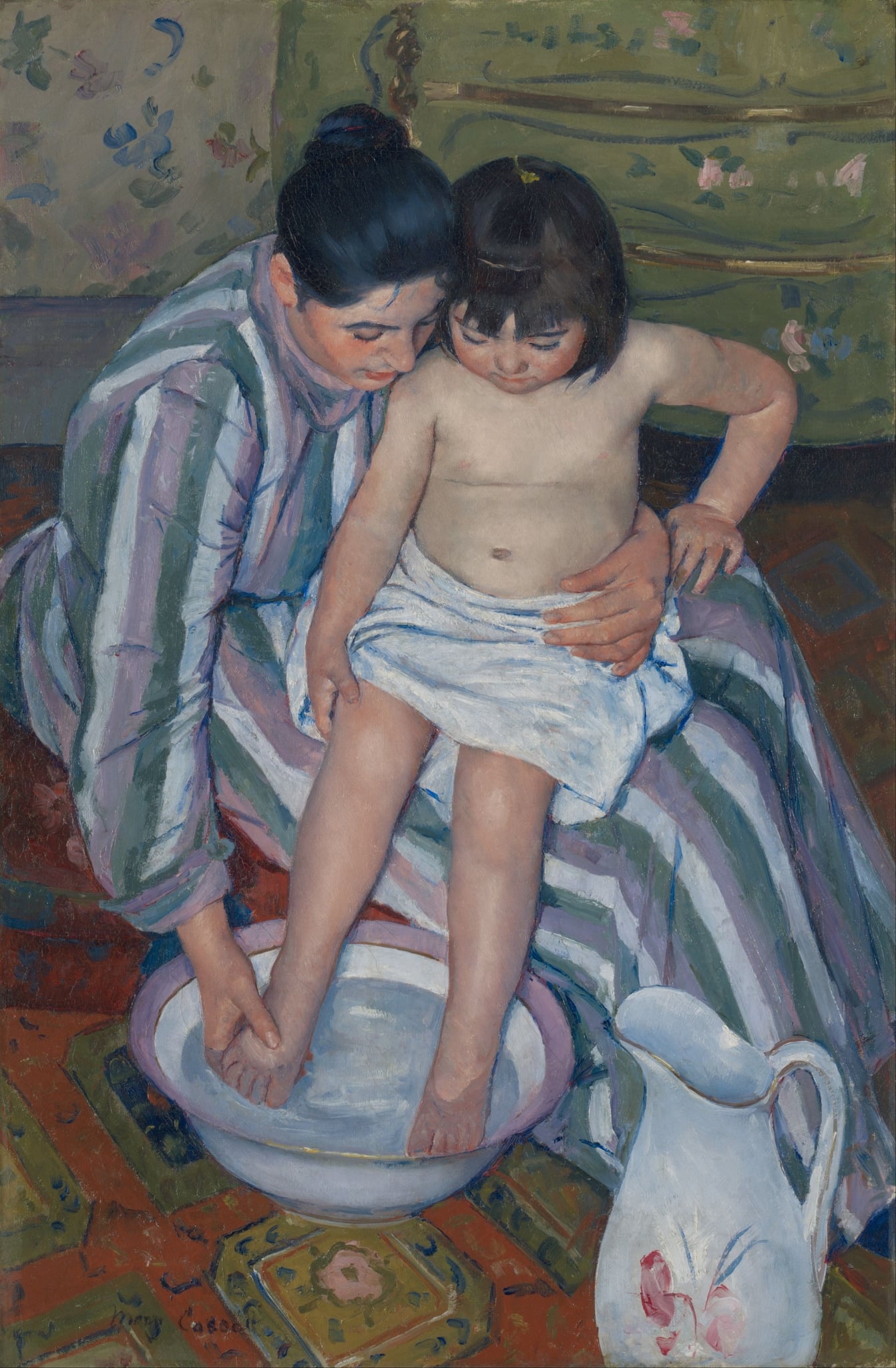
Mary Cassatt’s The Child’s Bath (1893) recasts an ordinary ritual as <strong>modern devotion</strong>. From a steep, print-like vantage, interlocking stripes, circles, and diagonals focus attention on <strong>touch, care, and renewal</strong>, turning domestic labor into a subject of high art <sup>[1]</sup><sup>[3]</sup>. The work synthesizes Impressionist sensitivity with <strong>Japonisme</strong> design to monumentalize the private sphere <sup>[1]</sup><sup>[2]</sup>.
The Cradle
Berthe Morisot (1872)
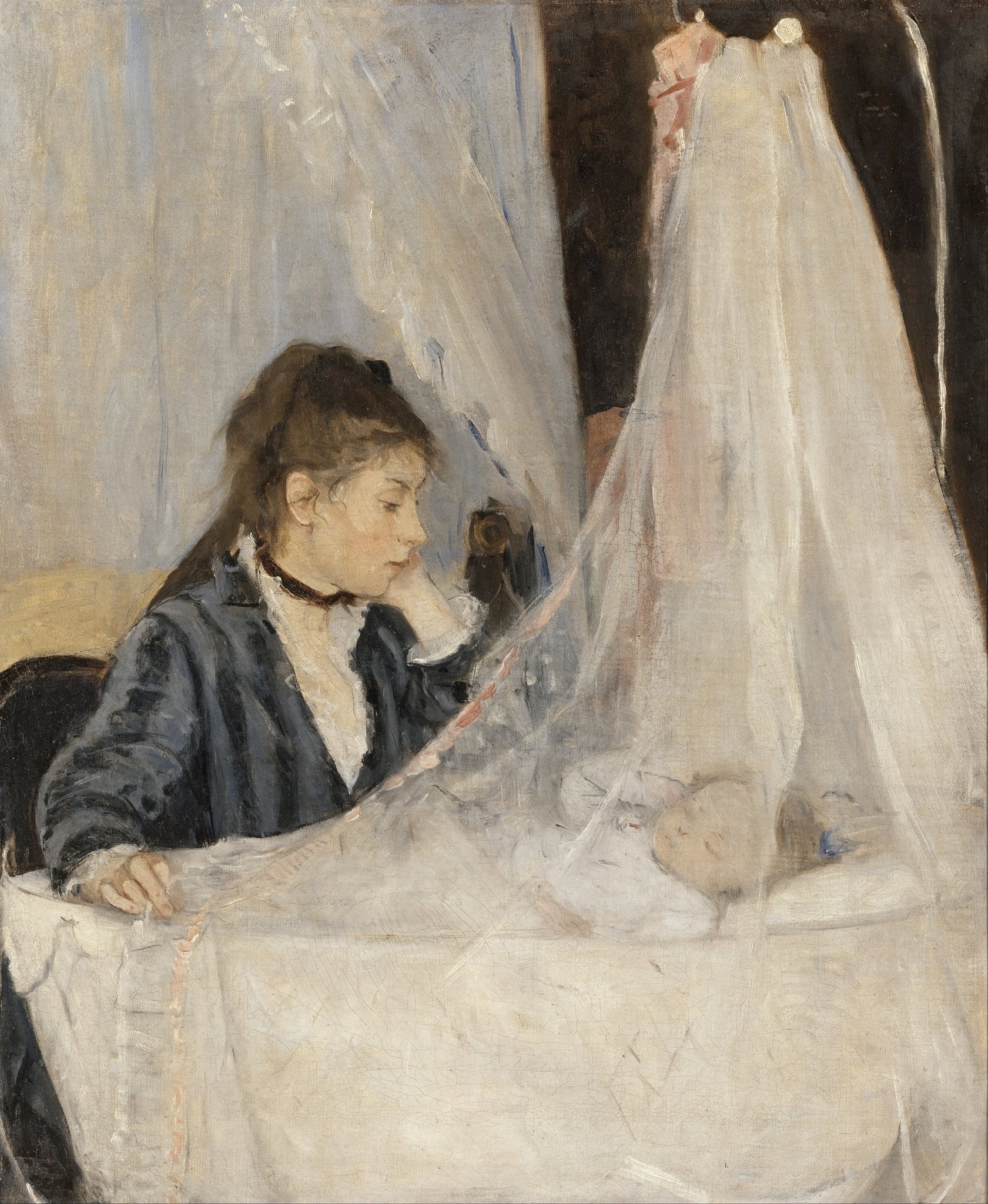
Berthe Morisot’s The Cradle turns a quiet nursery into a scene of <strong>vigilant love</strong>. A gauzy veil, lifted by the watcher’s hand, forms a <strong>protective boundary</strong> that cocoons the sleeping child in light while linking the two figures through a decisive diagonal <sup>[1]</sup><sup>[2]</sup>. The painting crystallizes modern maternity as a form of attentiveness rather than display—an <strong>unsentimental icon</strong> of care.

The Creation of Adam
Michelangelo (c.1511–1512)
Michelangelo’s The Creation of Adam crystallizes the instant before life is conferred, staging a charged interval between two nearly touching hands. The fresco turns Genesis into a study of <strong>imago Dei</strong>, bodily perfection, and the threshold between inert earth and <strong>active spirit</strong> <sup>[1]</sup><sup>[2]</sup>.
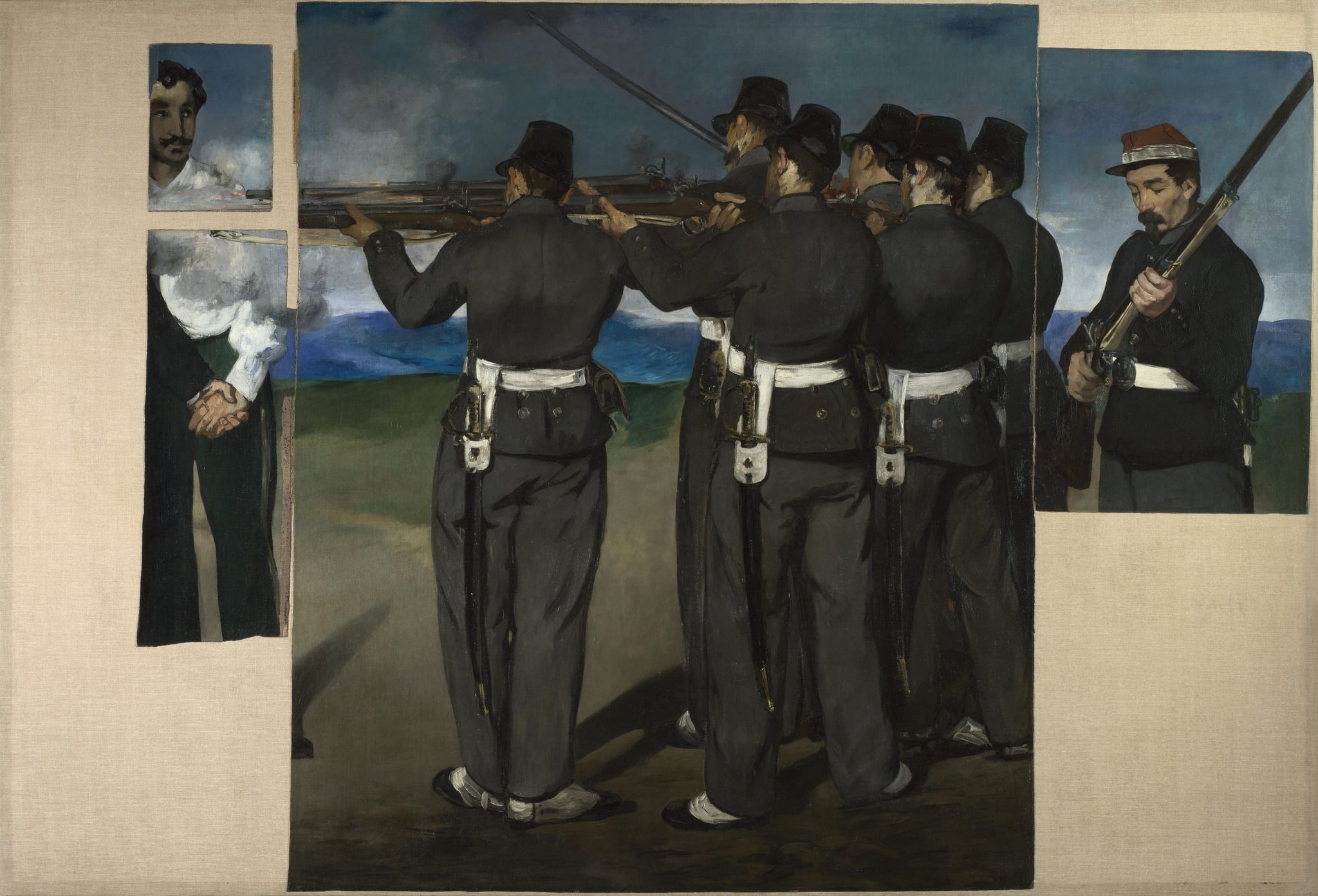
The Execution of Emperor Maximilian
Édouard Manet (1867–1868)
Manet’s The Execution of Emperor Maximilian confronts state violence with a <strong>cool, reportorial</strong> style. The wall of gray-uniformed riflemen, the <strong>fragmented canvas</strong>, and the dispassionate loader at right turn the killing into <strong>impersonal machinery</strong> that implicates the viewer <sup>[1]</sup><sup>[2]</sup>.
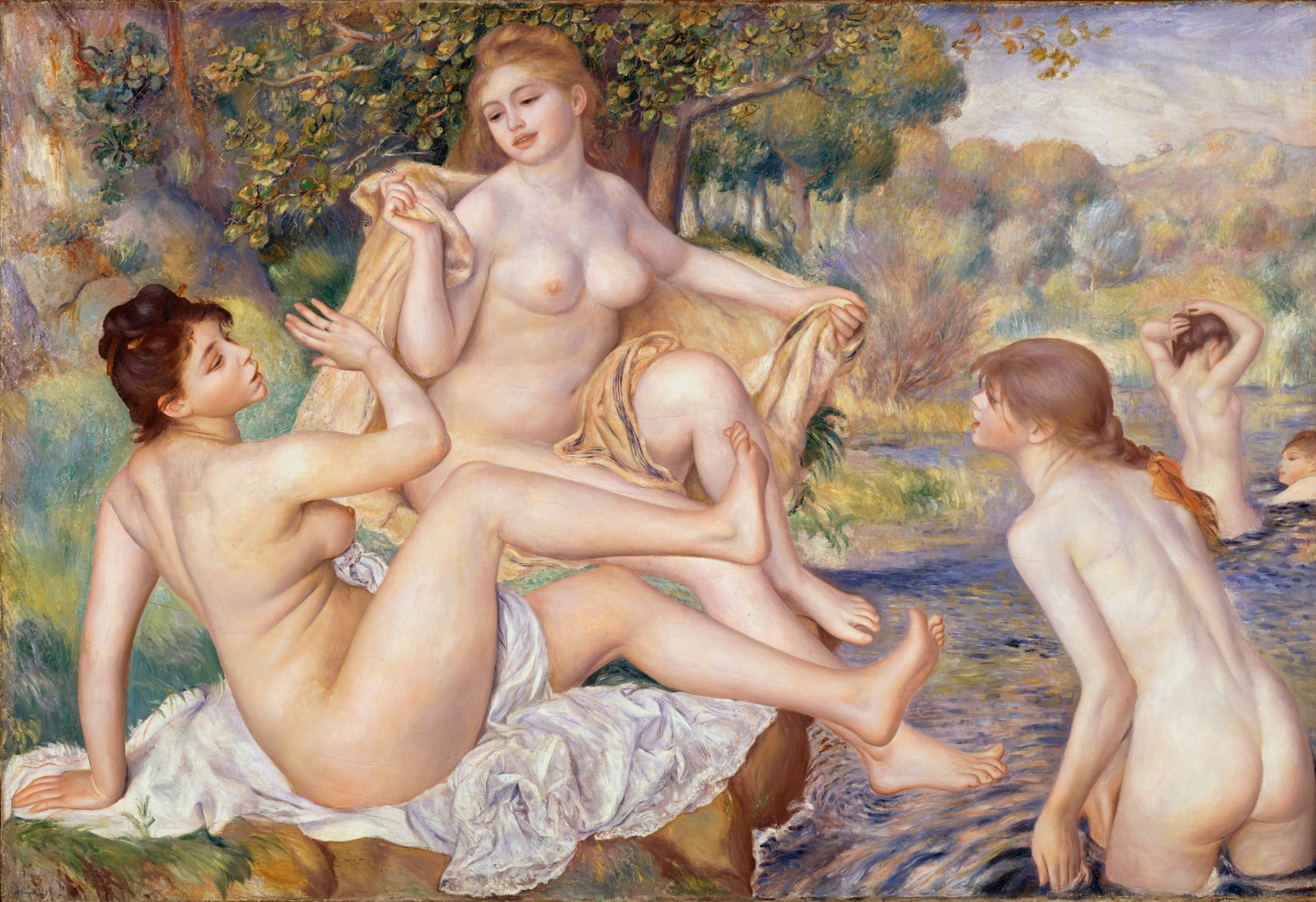
The Large Bathers
Pierre-Auguste Renoir (1884–1887)
Pierre-Auguste Renoir’s The Large Bathers unites modern bodies with a pastoral grove to stage an <strong>Arcadian ideal</strong>. Three monumental nudes form interlocking curves and triangles while two background figures splash and groom, fusing <strong>sensual warmth</strong> with <strong>classical order</strong> <sup>[1]</sup><sup>[2]</sup>.
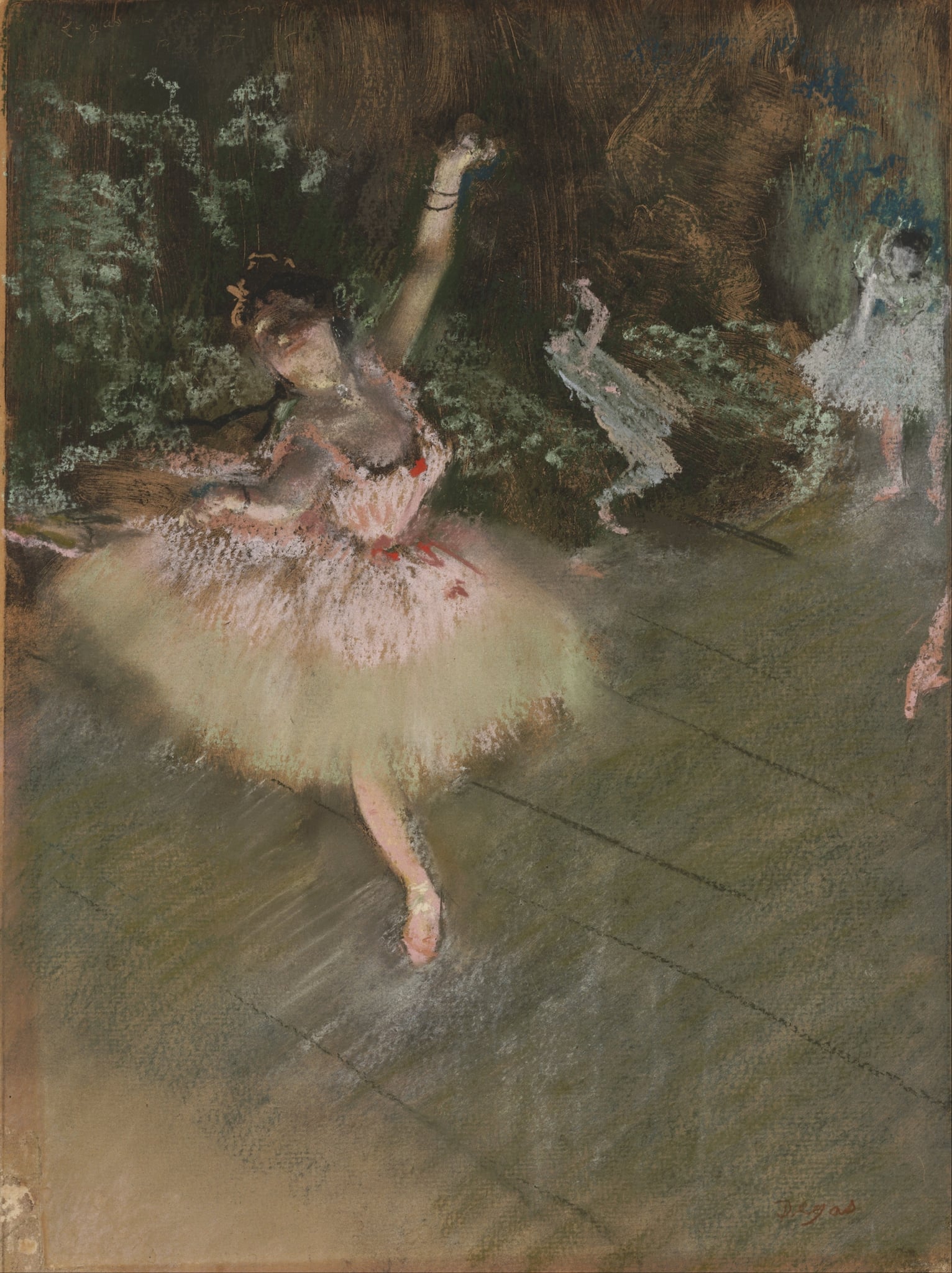
The Star
Edgar Degas (c. 1876–1878)
Edgar Degas’s The Star shows a prima ballerina caught at the crest of a pose, her tutu a <strong>vaporous flare</strong> against a <strong>murky, tilted stage</strong>. Diagonal floorboards rush beneath her single pointe, while pale, ghostlike dancers linger in the wings, turning triumph into a scene of <strong>radiant isolation</strong> <sup>[2]</sup><sup>[5]</sup>.
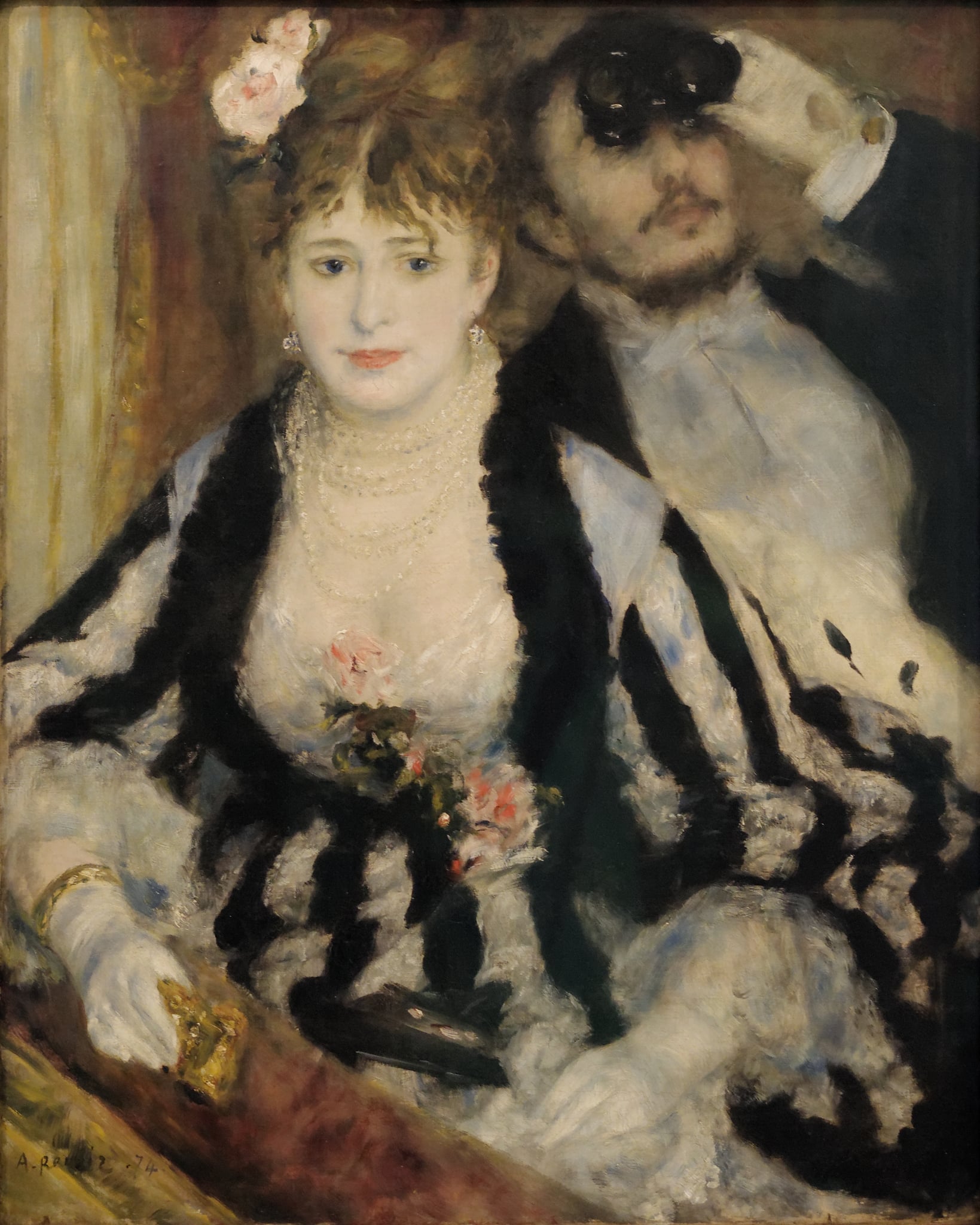
The Theater Box
Pierre-Auguste Renoir (1874)
Renoir’s The Theater Box turns a plush loge into a stage where seeing becomes the performance. A luminous woman—pearls, pale gloves, black‑and‑white stripes—faces us, while her companion scans the auditorium through opera glasses. The painting crystallizes Parisian <strong>modernity</strong> and the choreography of the <strong>gaze</strong> <sup>[1]</sup><sup>[5]</sup>.
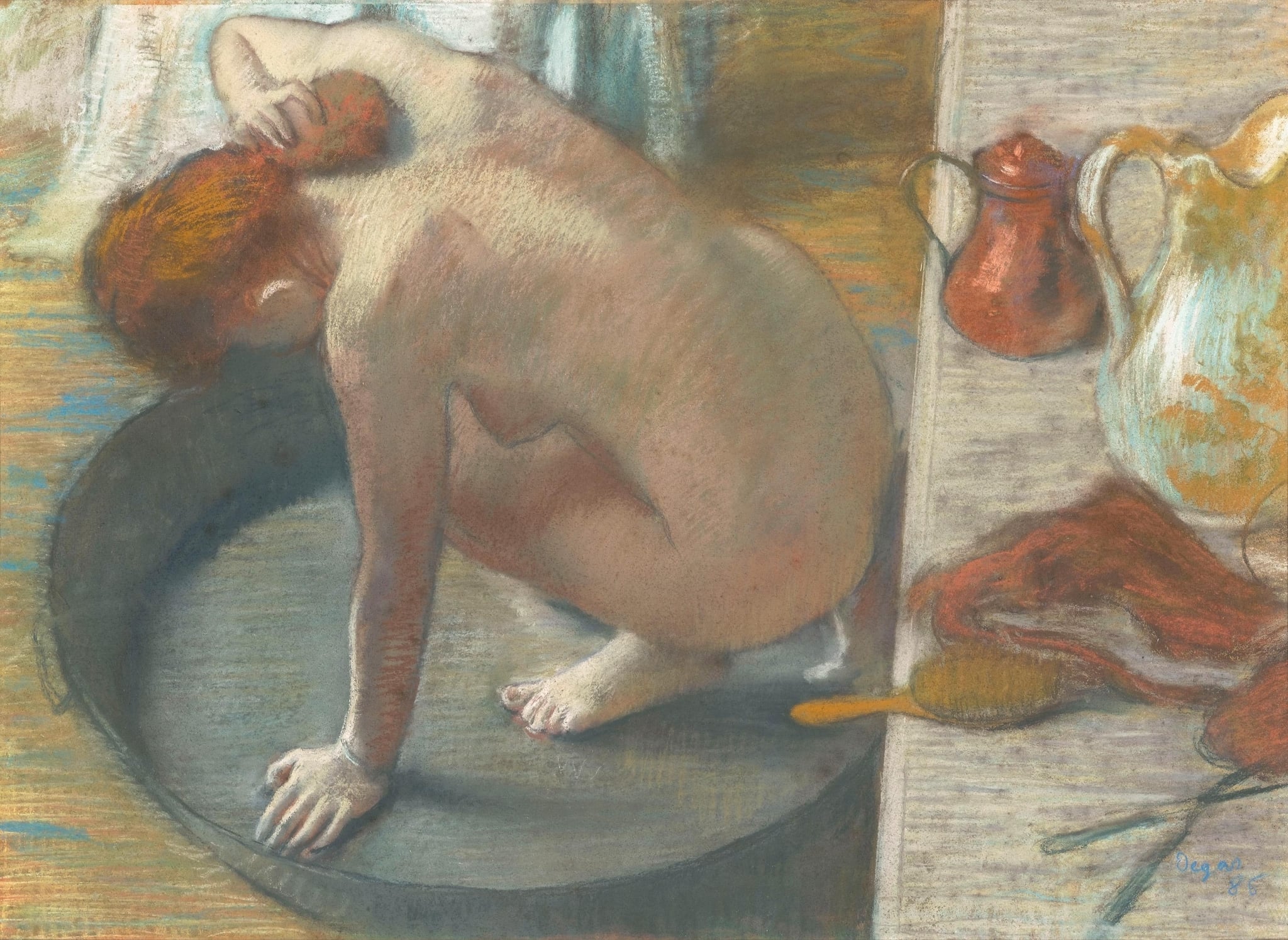
The Tub
Edgar Degas (1886)
In The Tub (1886), Edgar Degas turns a routine bath into a study of <strong>modern solitude</strong> and <strong>embodied labor</strong>. From a steep, overhead angle, a woman kneels within a circular basin, one hand braced on the rim while the other gathers her hair; to the right, a tabletop packs a ewer, copper pot, comb/brush, and cloth. Degas’s layered pastel binds skin, water, and objects into a single, breathing field of <strong>warm flesh tones</strong> and blue‑greys, collapsing distance between body and still life <sup>[1]</sup>.

Woman at Her Toilette
Berthe Morisot (1875–1880)
Woman at Her Toilette stages a private ritual of self-fashioning, not a spectacle of vanity. A woman, seen from behind, lifts her arm to adjust her hair as a <strong>black velvet choker</strong> punctuates Morisot’s silvery-violet haze; the <strong>mirror’s blurred reflection</strong> with powders, jars, and a white flower refuses a clear face. Morisot’s <strong>feathery facture</strong> turns a fleeting toilette into modern subjectivity made visible <sup>[1]</sup>.
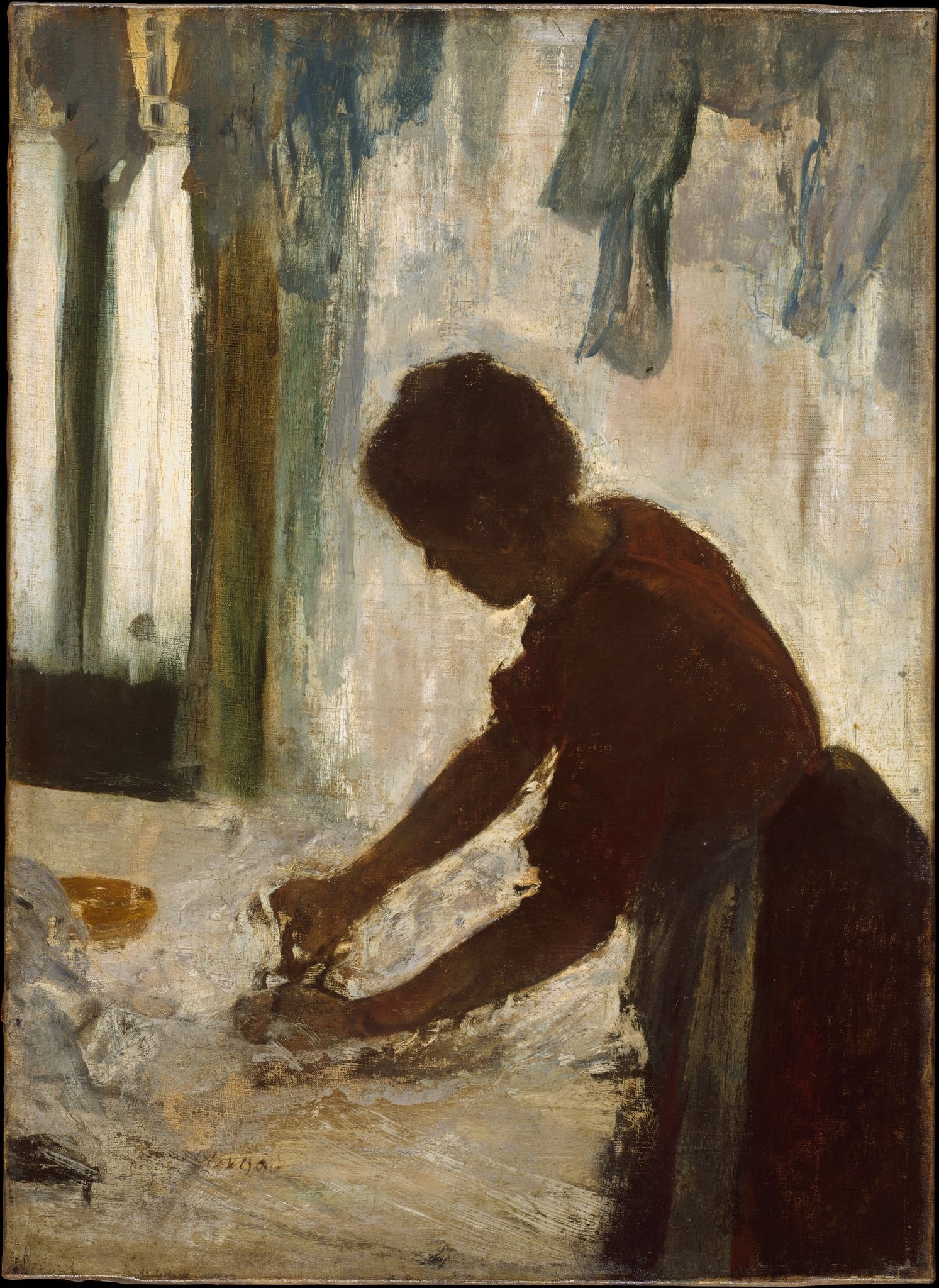
Woman Ironing
Edgar Degas (c. 1876–1887)
In Woman Ironing, Degas builds a modern icon of labor through <strong>contre‑jour</strong> light and a forceful diagonal from shoulder to iron. The worker’s silhouette, red-brown dress, and the cool, steamy whites around her turn repetition into <strong>ritualized transformation</strong>—wrinkled cloth to crisp order <sup>[1]</sup><sup>[2]</sup>.
Related Themes
Related Symbolism Categories
Body
The body symbolism in this group charts how modern artists turn gesture, posture, and gaze into primary vehicles of meaning, shifting from inherited sacred and classical idioms toward intimate, psychological, and sociopolitical registers.
Femininity
In late nineteenth‑century painting, femininity is articulated not as an essence but as a mutable ensemble of fashion, gesture, and setting, through which modern artists probe women’s visibility, labor, and agency within emerging urban and suburban worlds.
Interiority
“Interiority” symbols in modern painting transform gesture, gaze, and domestic props into visual indices of inward life, staging psychological depth, self-consciousness, and mediated subjectivity within scenes of everyday modernity.
Within the long history of Western art, gesture has functioned as a privileged vehicle for meaning: from the codified rhetoric of antique oratory and Renaissance maniera to the intimate physiognomies of nineteenth‑century portraiture, the body in motion or suspension carries ideas that words cannot quite fix. In the modern period, the inherited “language of gesture” is neither abandoned nor simply repeated; rather, it is tested against new social forms—urban leisure, theatrical celebrity, anonymous labor, bourgeois domesticity. The works considered here, all from the later nineteenth century, demonstrate how minute inflections of hand, arm, and pose operate semiotically, as repeatable signs in a visual lexicon, and iconographically, as references to older types such as the contemplative pose, the guarding hand of modesty, or the intimate clasp.
In the realm of courtship and social exchange, Renoir proves particularly attuned to the expressive capacities of hands. In In the Garden (1885), the couple’s lightly clasped hands enact what might be called a grammar of hesitation. The man’s fingers fold over the woman’s, yet her arm is braced along the table, the diagonal of the tabletop mediating contact. This is precisely the domain of the “clasped hands” as a symbol: a tentative bond, an emotional petition checked by restraint. Semiotic ambiguity is built into the gesture. The clasp marks a departure from impersonal decorum, yet the firmness of her posture and her frontal, outward gaze render the link provisional, a question rather than an answer. Iconographically, this recalls earlier imagery of betrothal or supplication, but in the café garden it registers instead the delicate negotiation of modern bourgeois flirtation.
Dance at Bougival (1883) intensifies that suspended state into centrifugal motion. Here the “clasped, ungloved hands” between dancers form the literal and symbolic axis of the painting. Their joining is not merely descriptive of a dance step; it constitutes the pivot around which the entire composition turns. Uncovered hands in a public, outdoor setting signal a degree of intimacy that contemporary viewers would have recognized as flirtatious. Semiotic weight accrues to the detail that the hands are ungloved: touch is unmediated, socially visible, and yet regulated by the waltz’s codified hold. If In the Garden dramatizes the petitionary aspect of contact, Dance at Bougival pushes toward the “clasped hands/consenting grip” of mutual surrender, though Renoir’s ring of circular rhythms and the absorbed, half‑closed gaze of the woman keeps the scene just short of narrative closure. The gesture is a hinge between decorous choreography and personal desire.
Renoir’s Madame Monet and Her Son (1874) relocates the expressive hand from erotic to familial space. The mother’s posture and the boy’s diagonal recline are inflected by subtler gestural signs: the “hand fan” as emblem of comfort and bourgeois ease; the boy’s flung body forming a “Diagonal Axis of Care” that binds child to caregiver. The fan is explicitly not coded in the mythic “language of the fan,” but its very superfluity underscores the unthreatened leisure of the scene. By contrast, the child’s reach and bodily orientation articulate dependence and guidance. The diagonal that connects them operates iconographically like a secularized Madonna‑and‑Child schema, an instance of the broader “mother‑and‑child unit,” in which touch and proximate bodies figure continuity and nurture. Gesture here is less about momentary petition than about ongoing relation.
Mary Cassatt’s The Boating Party (1893–1894) radicalizes this line of care into a compositional principle. The mother and child form a compact unit, their arms and bodies describing an enveloping, triangular configuration that corresponds to the “encircling hands and arms (circle of touch)” and the “triangular grouping of the three children” in related works. Although only one child is present, Cassatt borrows that triangular logic to symbolize stability through relationship. Opposed to this intimate geometry is the rower’s emphatic diagonal oar, an “opposing diagonal of bodies and loads” that translates the physical act of rowing into a visible vector of effort. The result is a double semiotics: the closed, circular gestures of care versus the open, thrusting line of labor and propulsion. Iconographically, this juxtaposition reimagines maritime and voyage imagery—traditionally masculine, heroic—in terms of domestic guardianship and maternal presence.
Gestures of reverie and psychological inwardness thread through portraits and modern life scenes. In Van Gogh’s Portrait of Dr. Gachet (1890), the “hand‑to‑cheek pose”—a classic sign of melancholy—becomes, through chromatic vehemence, an image of “compassionate fatigue rather than collapse.” The sitter’s head sinks into a pallid hand, while swirling blues and the blazing orange‑red table dramatize the weight of thought. Semiotic repetition is evident: the pose is recognizable from early modern images of thinkers and mourners, yet here it is keyed to a specifically modern psychology of nervous strain and caregiving. The pose’s iconographic lineage (philosopher, pensieroso, melancholic) is not denied; it is transposed into a fragile, medicalized modernity.
Cézanne’s Madame Cézanne in a Red Armchair (about 1877) offers a related but distinct variant in the “head propped on hand” and “cheek‑in‑hand pose (triangular armature).” Her slightly inclined head and clasped hands, anchored within the armchair’s enveloping red, create a triangle of support that suggests reflective poise more than emotional drama. The triangular armature confers structural stability: gesture becomes an element of pictorial architecture. Semiologically, the pose withdraws from obvious narrative cues; her expression is famously “blank,” her body contained. Iconographically, Cézanne cools the romantic vocabulary of introspection into an almost abstract study of equilibrium. Gesture, once a vehicle of legible feeling, here tests the limit at which bodily sign becomes pure form.
Other modern works probe the politics of display and surveillance through the face and hands. Manet’s Luncheon on the Grass (1863) and Olympia (1863, Salon 1865) center the “direct gaze of the nude” as a confrontational gesture that displaces classical passivity. In Olympia, the infamous “guarding hand” over the pelvis turns what might once have been a Venus pudica gesture of modesty into an unequivocal act of refusal and control. Semiotics here is blunt: the hand does not merely veil; it bars access, conditions desire on contract. Iconographically, Manet appropriates and inverts the long history of chaste concealment, recoding it as an assertion of agency within a modern economy of prostitution and spectatorship.
Henri de Toulouse‑Lautrec’s Jane Avril (c. 1891–1892) engages a different subset of gestural signs: the “backward glance” and the “raised arm / hair‑adjusting gesture” of self‑fashioning. While the surviving description emphasizes the sitter’s whiplash silhouette and chromatic mask, the underlying symbolic category is clear. Lautrec crystallizes a public persona from a few strokes; the body appears as if in mid‑turn, head angled so that the gaze grazes, rather than squarely meets, the viewer. This backward glance encodes allure coupled with reserve, a persona partially offered but fundamentally withheld. Iconographically, it emerges from the world of posters and stagecraft, where a single turn of the head must bear the burden of advertisement. The gesture is at once intimate and radically constructed, a sign of the modern subject as performance.
Even ostensibly non‑narrative scenes of labor rely on gestural symbolism. In Pissarro’s Laundresses Carrying Linen in Town (1879), the “opposing diagonals of bodies and loads” read as effort and balance under strain. The women’s torsos twist; their arms tuck; the white bundles flare as palpable weight. The canvas operates as a frieze of work, the abstract play of diagonals semantically charged with classed and gendered toil. Where courtship scenes privilege the delicate grammar of the clasped hand, here the language of labor is written in the whole armature of the body, aligning with symbols such as the “diagonal arm‑and‑shoulder thrust” in Degas’s laundresses: a metronome‑like rhythm that monumentalizes repetitive work.
Taken together, these images map a transformation in the function of gesture from early modern to late nineteenth‑century art. Classical systems of gesture aimed at legibility; each pose or hand sign belonged to a relatively stable rhetoric of passions, virtues, and vices. By contrast, the Impressionists, Manet, Cassatt, Van Gogh, and Lautrec inherit those codes only to subject them to the contingencies of modern life: gestures of modesty become assertions of economic agency; contemplative poses become indices of psychological strain; the courtly handclasp is transposed into the half‑public, half‑private arena of cafés and dance halls. Iconographic continuity coexists with semiotic indeterminacy. The same clasp can signify petition, consent, or precarious truce, depending on context; the same supporting hand can read as bored reverie, philosophical reflection, or medical exhaustion. In this way, gesture in modern painting is no longer a transparent language but an arena in which the very legibility of bodies—and the social contracts they index—is tested, revised, and, at times, radically reimagined.